USD/JPY steadies ahead of US JOLTS data and potential clues on the health of the US labour market
- USD/JPY edges lower with the US Dollar attempting a recovery ahead of JOLTS labour data at 14:00 GMT.
- Bank of Japan (BoJ) Governor Ueda reaffirms Japan’s willingness to increase interest rates if inflation pressures persist.
- The United States (US) remains vulnerable to changes in the labour market as investors look for signs of when the Fed may cut rates.


The Japanese Yen (JPY) is edging lower against the US Dollar (USD) on Tuesday as market participants await the release of the US Job Openings and Labor Turnover Survey, scheduled for 14:00 GMT.
At the time of writing, USD/JPY is trading back above 143.00, recovering approximately 0.50% of Monday’s losses.
As the US Bureau of Labor Statistics provides a monthly report on the number of job openings reported in the previous month, April’s figures are expected to show a decline in the number of job openings to 7.1 million in April, from nearly 7.2 million in March.
The JOLTS data is the first of a wide range of employment releases scheduled for this week. The main scheduled risk event this week for employment data and the US Dollar is Friday’s employment data, which will include the latest unemployment rate for May, with JOLTS indicating what may be revealed in Friday’s report.
Monetary policy divergence between the Fed and the BoJ remains in the spotlight for the USD/JPY pair
With monetary policy divergence remaining a key theme for the USD/JPY major currency pair, the US Federal Reserve (Fed) has maintained a restrictive stance toward interest rates, remaining committed to achieving its objective of restoring price stability by maintaining an objective core inflation target of 2%.
However, the other side of its dual mandate focuses on maintaining full employment, which is considered to exist when the Unemployment Rate is generally at 4%.
That data will be provided on Friday, upon the release of the May Nonfarm Payrolls (NFP) data, which is a key driver of market volatility.
But with the labour market recently showing signs of slowing and market participants expecting the Fed to cut rates in September, any additional signs of a weaker US labour market could provide some support for the Japanese Yen (JPY).
While the Fed is under pressure to move away from its high-interest-rate environment, Japan is being encouraged to turn away from its ultra-loose monetary policy stance that continues to favour low interest rates, with its benchmark rate currently at 0.5%.
With the Governor of the Bank of Japan (BoJ), Kazuo Ueda, addressing markets during the Asian session, the BoJ maintained a hawkish stance, opening the door to the potential increase in interest rates in response to rising inflation. His comments, covered by Reuters, included a statement that the “BoJ expected to continue hiking rates if underlying inflation accelerates to 2% as projected.”
USD/JPY rebounds off support, gaining ground above 143.00
On the daily chart below, the USD/JPY pair experienced a rebound on Tuesday, allowing bulls to retest the 61.8% Fibonacci retracement level from the April-May rally at 143.24. This level sits just above the key psychological threshold of 143.00, and a clear break above or below it could dictate the pair's next movement.
USD/JPY daily chart
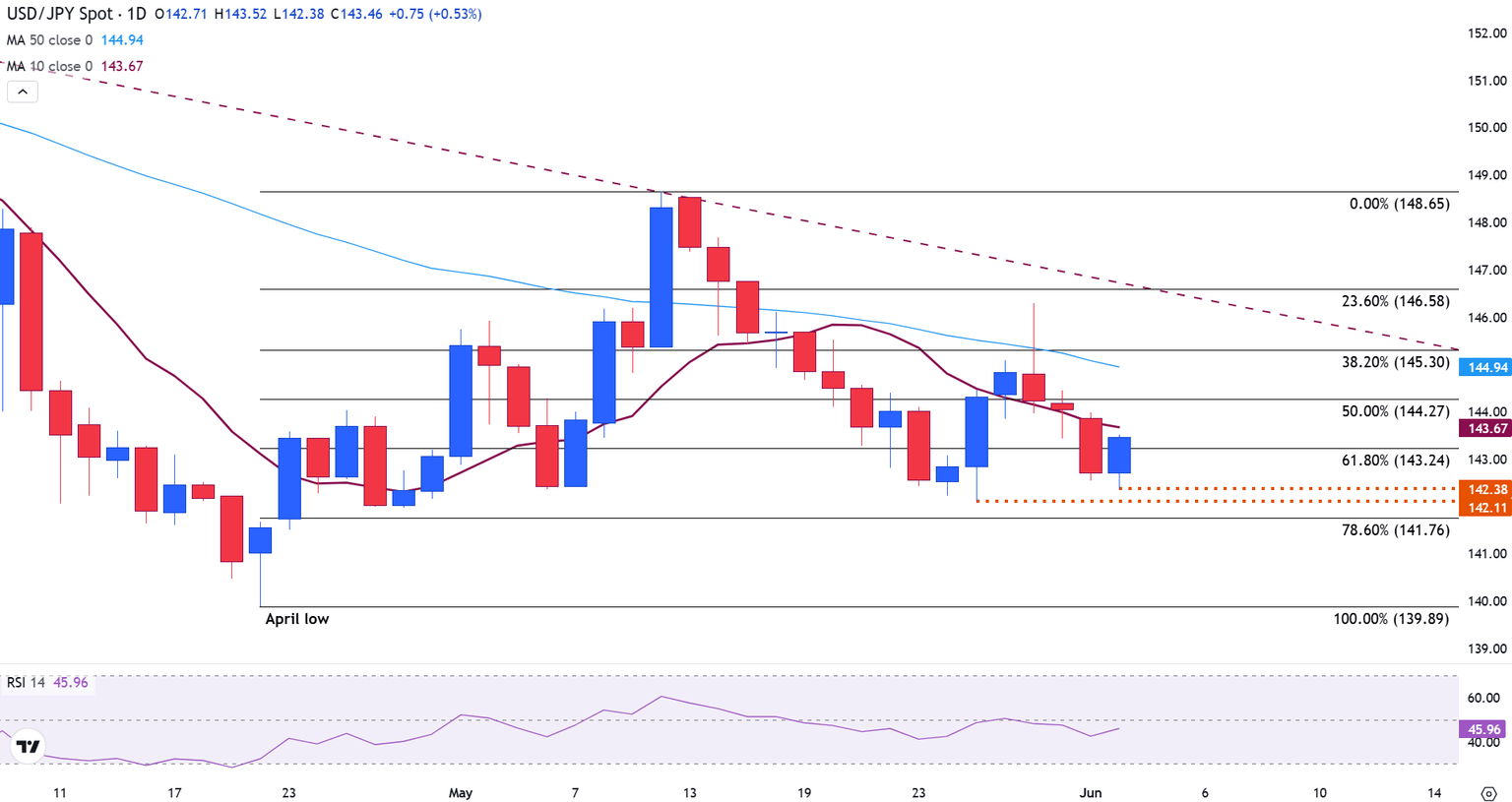
After dropping below the 10-day Simple Moving Average (SMA) at 143.66 on Monday, bearish momentum temporarily stalled, keeping prices above the important support level of 142.00.
For a downside movement to gain traction, the pair would need to fall below the daily low of 142.38 and the May 27 low of 142.11, which could bring the 142.00 level into play.
Conversely, if the USD/JPY continues its recovery, a move above the 61.8% retracement level and the 10-day SMA could pave the way to the midpoint of the April-May movement at 144.27.
Employment FAQs
Labor market conditions are a key element to assess the health of an economy and thus a key driver for currency valuation. High employment, or low unemployment, has positive implications for consumer spending and thus economic growth, boosting the value of the local currency. Moreover, a very tight labor market – a situation in which there is a shortage of workers to fill open positions – can also have implications on inflation levels and thus monetary policy as low labor supply and high demand leads to higher wages.
The pace at which salaries are growing in an economy is key for policymakers. High wage growth means that households have more money to spend, usually leading to price increases in consumer goods. In contrast to more volatile sources of inflation such as energy prices, wage growth is seen as a key component of underlying and persisting inflation as salary increases are unlikely to be undone. Central banks around the world pay close attention to wage growth data when deciding on monetary policy.
The weight that each central bank assigns to labor market conditions depends on its objectives. Some central banks explicitly have mandates related to the labor market beyond controlling inflation levels. The US Federal Reserve (Fed), for example, has the dual mandate of promoting maximum employment and stable prices. Meanwhile, the European Central Bank’s (ECB) sole mandate is to keep inflation under control. Still, and despite whatever mandates they have, labor market conditions are an important factor for policymakers given its significance as a gauge of the health of the economy and their direct relationship to inflation.
Author
Tammy Da Costa, CFTe®
FXStreet
Tammy is an economist and market analyst with a deep passion for financial markets, particularly commodities and geopolitics.