USD/JPY recovers above 144.00 on Israel-Iran tensions, cautious BoJ
- USD/JPY trades above 144.00 as safe-haven flows boost the US Dollar amid rising Middle East tensions.
- BoJ is expected to hold rates steady, limiting support for the Yen despite earlier hawkish signals from Governor Ueda.
- Japan and the US prepare to meet at the G7 summit in Canada, where the two nations are expected to discuss bilateral relations and negotiate over tariffs.

The Japanese Yen (JPY) is trading weaker against the US Dollar (USD) on Friday, as geopolitical tensions and central bank policy divergence drive market flows.
USD/JPY has staged a modest rebound, trading above 144.00 at the time of writing, as demand for the safe-haven US Dollar picks up.
Reports of Israeli strikes on Iranian nuclear facilities have lifted geopolitical risk, supporting the USD and weighing on the Yen.
Meanwhile, expectations that the Bank of Japan (BoJ) will leave interest rates unchanged at its upcoming meeting on Tuesday have further limited JPY gains.
While BoJ Governor Kazuo Ueda previously signaled the possibility of a rate hike in response to rising domestic inflation, recent economic data suggest Japan’s recovery remains fragile. Industrial production has slowed, and Japan’s export-sensitive manufacturing sector is struggling under the pressure of steep US tariffs on steel, aluminium, and automobiles, key contributors to Japan’s Gross Domestic Product (GDP).
The University of Michigan released its preliminary Consumer Sentiment survey for the United States on Friday, indicating a noticeable increase in confidence among US households.
Meanwhile, both the one-year and five-year Consumer Inflation Expectations indices edged lower, with the one-year outlook falling to 5.1% from 6.6% and the five-year outlook decreasing to 4.1% from 4.2%. This echoed the softer-than-expected readings of the Consumer Price Index (CPI) and Producer Price Index (PPI) reports earlier in the week, which have raised expectations of a rate cut by the Federal Reserve in September.
However, with the Fed widely expected to hold rates steady in both June and July, and the BoJ showing little urgency to tighten further, current interest rate differentials remain supportive of USD/JPY upside in the near term.
USD/JPY technical analysis - Daily chart
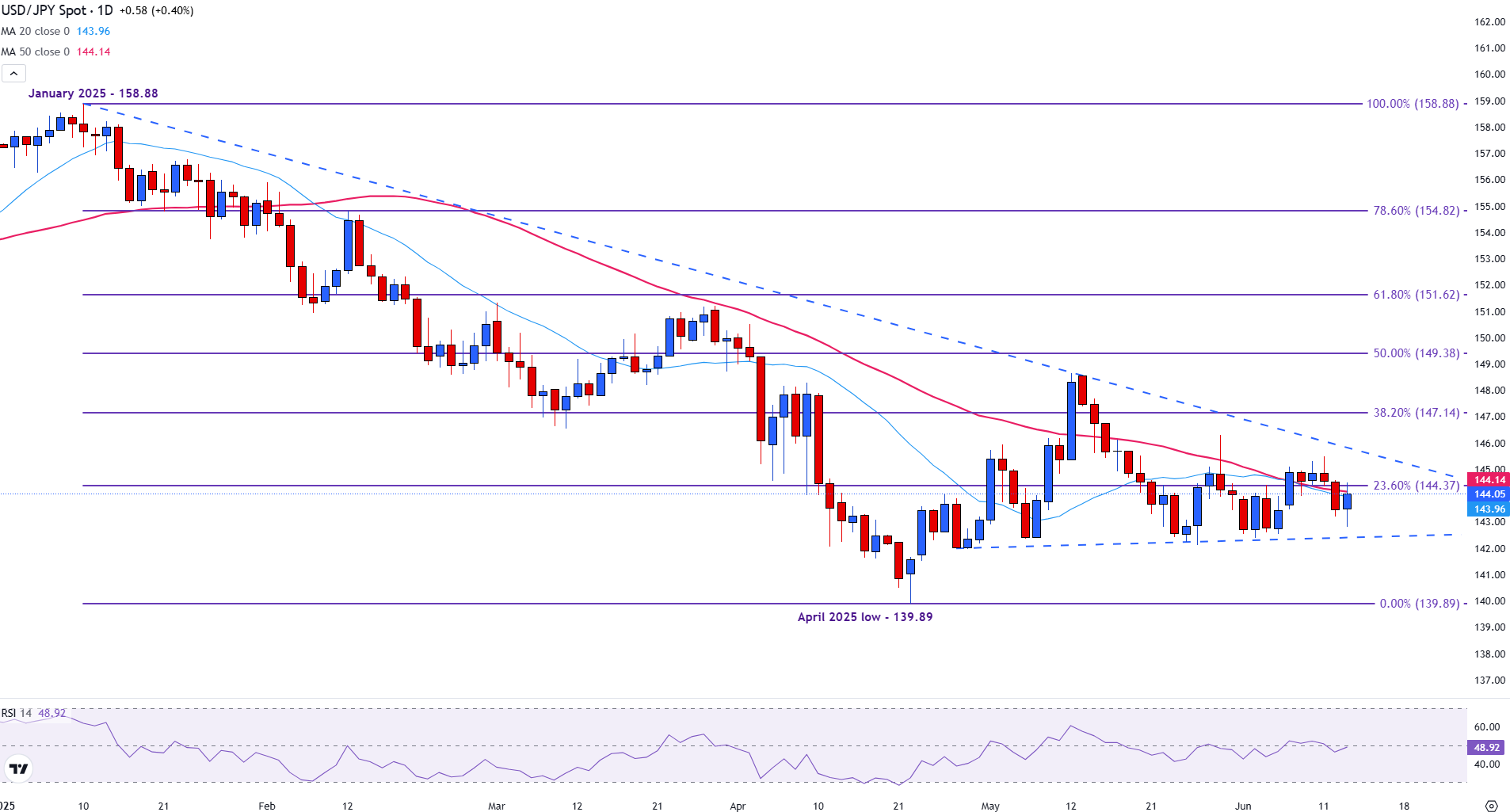
USD/JPY is trading near 144.14 on Friday, sitting just below the 23.6% Fibonacci retracement of the January–April decline at 144.37.
The pair continues to coil within a symmetrical triangle, defined by a descending trendline from the January high at 158.88 and rising support from the April 2025 low at 139.89.
Both the 20-day (143.96) and 50-day (144.14) Simple Moving Averages (SMA) are converging near current levels, highlighting indecision and the potential for a breakout. A daily close above the triangle resistance and 144.37 could expose the 147.14 level (38.2% Fibonacci retracement) and 149.38 (50% Fibonacci retracement).
On the downside, a break below 143.00 would increase pressure toward the 141.00 handle and the April low. The Relative Strength Index (RSI) is neutral at 49, indicating a lack of strong momentum in either direction; however, price compression suggests that a larger directional move may be building.
USD/JPY daily chart
Japanese Yen FAQs
The Japanese Yen (JPY) is one of the world’s most traded currencies. Its value is broadly determined by the performance of the Japanese economy, but more specifically by the Bank of Japan’s policy, the differential between Japanese and US bond yields, or risk sentiment among traders, among other factors.
One of the Bank of Japan’s mandates is currency control, so its moves are key for the Yen. The BoJ has directly intervened in currency markets sometimes, generally to lower the value of the Yen, although it refrains from doing it often due to political concerns of its main trading partners. The BoJ ultra-loose monetary policy between 2013 and 2024 caused the Yen to depreciate against its main currency peers due to an increasing policy divergence between the Bank of Japan and other main central banks. More recently, the gradually unwinding of this ultra-loose policy has given some support to the Yen.
Over the last decade, the BoJ’s stance of sticking to ultra-loose monetary policy has led to a widening policy divergence with other central banks, particularly with the US Federal Reserve. This supported a widening of the differential between the 10-year US and Japanese bonds, which favored the US Dollar against the Japanese Yen. The BoJ decision in 2024 to gradually abandon the ultra-loose policy, coupled with interest-rate cuts in other major central banks, is narrowing this differential.
The Japanese Yen is often seen as a safe-haven investment. This means that in times of market stress, investors are more likely to put their money in the Japanese currency due to its supposed reliability and stability. Turbulent times are likely to strengthen the Yen’s value against other currencies seen as more risky to invest in.
Author

Tammy Da Costa, CFTe®
FXStreet
Tammy is an economist and market analyst with a deep passion for financial markets, particularly commodities and geopolitics.