Japanese Yen maintains its strong bid tone near two-week high against a broadly weaker USD
- Japanese Yen attracts some follow-through buying for the fourth straight day against a broadly weaker USD.
- Hawkish BoJ expectations and sustained safe-haven buying turn out to be key factors underpinning the JPY.
- Fed rate cut bets and the US government shutdown weigh on the USD and exert pressure on USD/JPY.

The Japanese Yen (JPY) prolongs its uptrend for the fourth successive day against a broadly weaker US Dollar (USD) and rises to a nearly two-week top during the first half of the European session on Wednesday. The growing acceptance that the Bank of Japan (BoJ) will stick to its policy normalization path and hike interest rates in October turns out to be a key factor supporting the JPY. Moreover, rising geopolitical tensions and the US government shutdown drive safe-haven flows towards the JPY.
Meanwhile, hawkish BoJ expectations mark a significant divergence in comparison to the growing market acceptance that the US Federal Reserve (Fed) will lower borrowing costs twice this year. The latter drags the USD to a one-week low. Moreover, the resultant narrowing US-Japan rate differential benefits the lower-yielding JPY, which contributes to the USD/JPY pair’s decline to the 147.00 mark. Traders now look to the US ADP report and the US ISM Manufacturing PMI for a fresh impetus.
Japanese Yen continues with its outperformance amid BoJ rate hike bets, safe-haven buying
- Japan’s Manufacturing PMI for September was finalized at 48.5, down from 49.7 in the previous month and marking the fastest pace of contraction in six months. That said, the Bank of Japan's Tankan survey signaled a slight improvement in business sentiment among large Japanese manufacturers for the second consecutive quarter. In fact, the Tankan Large Manufacturers' Index increased from 13 to 14 during the July-September period.
- This comes on top of the BoJ Summary of Opinions from the September meeting released on Tuesday, indicating increasing pressure from hawks to normalise policy, and keeps the door open for an imminent rate hike. Traders are still pricing in the possibility of a 25-basis-point rate hike by the BoJ in October, which continues to act as a tailwind for the Japanese Yen and limits the downtick witnessed during the Asian session on Wednesday.
- Meanwhile, a Republican spending bill failed to pass through the Senate on Tuesday, leading to a partial US government shutdown starting midnight. A prolonged shutdown could have an adverse effect on economic performance and set the stage for a more aggressive policy easing by the US Federal Reserve. According to the CME Group's FedWatch Tool, traders are pricing in a greater chance of two Fed rate cuts in October and December.
- On the economic data front, the US Bureau of Labor Statistics (BLS) reported in the Job Openings and Labor Turnover Survey (JOLTS) on Tuesday that the number of job openings on the last business day of August stood at 7.22 million. The reading was slightly above the 7.2 million estimated, though it does little to impress the US Dollar bulls or assist the USD/JPY pair to build on its modest intraday move up to the 148.20-148.25 region.
- Traders now look forward to Wednesday's US economic docket – featuring the release of the ADP report on private-sector employment and the ISM Manufacturing PMI. The US Labor Department said Monday its statistics agency would halt data releases - including Friday's closely-watched Nonfarm Payrolls (NFP) report - if a partial government shutdown occurs, leaving the USD at the mercy of comments from influential FOMC members.
USD/JPY bears might now await a sustained break and acceptance below the 147.00 mark
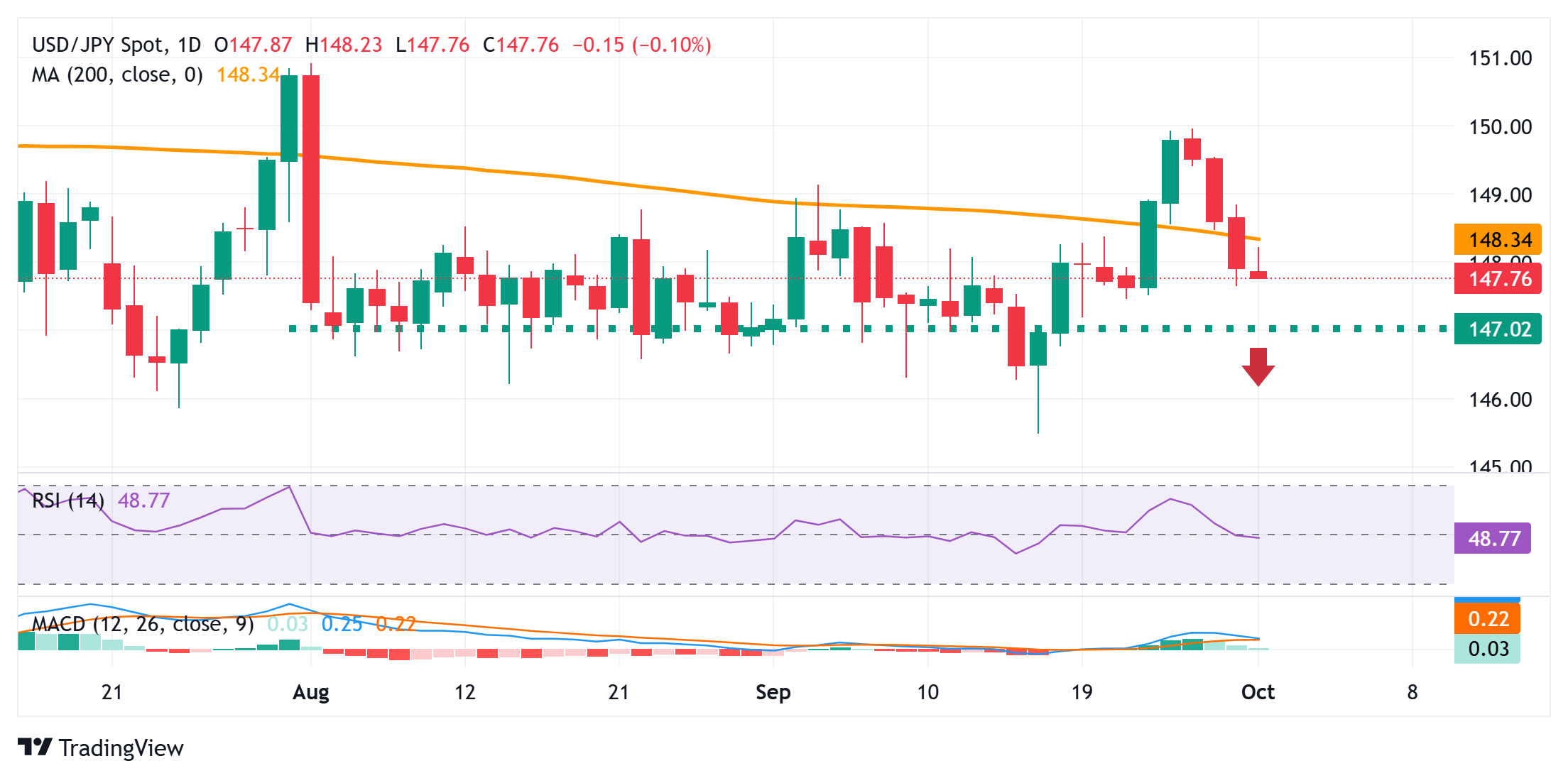
From a technical perspective, the USD/JPY pair's intraday uptick on Wednesday falters ahead of the 200-day Simple Moving Average (SMA). Some follow-through selling below the overnight swing low, around the 147.65 region, might have already set the stage for deeper losses. A sustained break and acceptance below the 147.00 mark will reinforce the negative outlook.
On the flip side, momentum back above the 200-day SMA, currently pegged around the 148.40 area, is likely to confront resistance near the 149.00 round figure. A sustained strength beyond the latter could allow the USD/JPY pair to surpass an intermediate barrier near the 149.40-149.45 region and make a fresh attempt to conquer the 150.00 psychological mark.
Economic Indicator
ADP Employment Change
The ADP Employment Change is a gauge of employment in the private sector released by the largest payroll processor in the US, Automatic Data Processing Inc. It measures the change in the number of people privately employed in the US. Generally speaking, a rise in the indicator has positive implications for consumer spending and is stimulative of economic growth. So a high reading is traditionally seen as bullish for the US Dollar (USD), while a low reading is seen as bearish.
Read more.Next release: Wed Oct 01, 2025 12:15
Frequency: Monthly
Consensus: 50K
Previous: 54K
Source: ADP Research Institute
Traders often consider employment figures from ADP, America’s largest payrolls provider, report as the harbinger of the Bureau of Labor Statistics release on Nonfarm Payrolls (usually published two days later), because of the correlation between the two. The overlaying of both series is quite high, but on individual months, the discrepancy can be substantial. Another reason FX traders follow this report is the same as with the NFP – a persistent vigorous growth in employment figures increases inflationary pressures, and with it, the likelihood that the Fed will raise interest rates. Actual figures beating consensus tend to be USD bullish.
Author

Haresh Menghani
FXStreet
Haresh Menghani is a detail-oriented professional with 10+ years of extensive experience in analysing the global financial markets.














