USD/JPY holds steady amid US housing data, Japanese intervention woes
- US housing starts rebound in July, though rising mortgage rates may hinder sector recovery.
- Japan’s Q2 GDP growth doubles expectations, but concerns over China’s economic slowdown loom.
- USD/JPY’s upward momentum may be limited by potential Japanese intervention and BoJ’s anticipated policy normalization.

USD/JPY aims higher but remains trading within a narrow range as threats of a possible intervention by Japanese authorities loom. Housing data from the United States (US) shows the construction sector stabilizing after the US Federal Reserve (Fed) lifted rates aggressively, dampening house demand. The USD/JPY is exchanging hands at 145.85 after hitting a daily low of 145.30.
Positive housing data from the US meets robust Japanese GDP growth, keeping the pair in a tight range
The US Census Bureau revealed that housing starts jumped at a 3.9% rate of 1.452 million in July, crashing June’s -11.7% plunge, which was downward revised from -8%. Although data is encouraging, higher mortgage rates for 30-year hitting 6.96% over the last week, can curtail the sector’s recovery. At the same time, Building Permits rose 0.1% in July, above June’s -3.7% slide.
Even though the data was positive, the Greenback failed to gain traction as expected, as shown by the US Dollar Index (DXY) losing 0.02% at 103.187. Consequently, the USD/JPY uptrend was capped at spot price, as the US 10-year Treasury bond yield is unchanged at 4.211%.
On the Japanese front, the latest Gross Domestic Product (GDP) report for Q2 2023 smashed estimates of 3.1%, with the economy growing at an outstanding 6%, doubling forecasts, as reported on August 14. Furthermore, as reported by the Reuters Tankan Index, business activity shows an improvement from July’s 3 reading to 12 in August. Although the report was positive, many firms remain cautious about the economic outlook, as slowing growth in China could dent demand for Japanese products. Traders should be aware that China is Japan’s largest partner.
Given the backdrop, the USD/JPY trades sideways, as the US and Japan have posted solid data. Though, expectations for monetary policy normalization of the Bank of Japan (BoJ) could favor the Japanese Yen (JPY) in the medium term. In the meantime, further USD/JPY upside is expected, but intervention jitters could cap the pair’s uptrend.
USD/JPY Price Analysis: Technical outlook
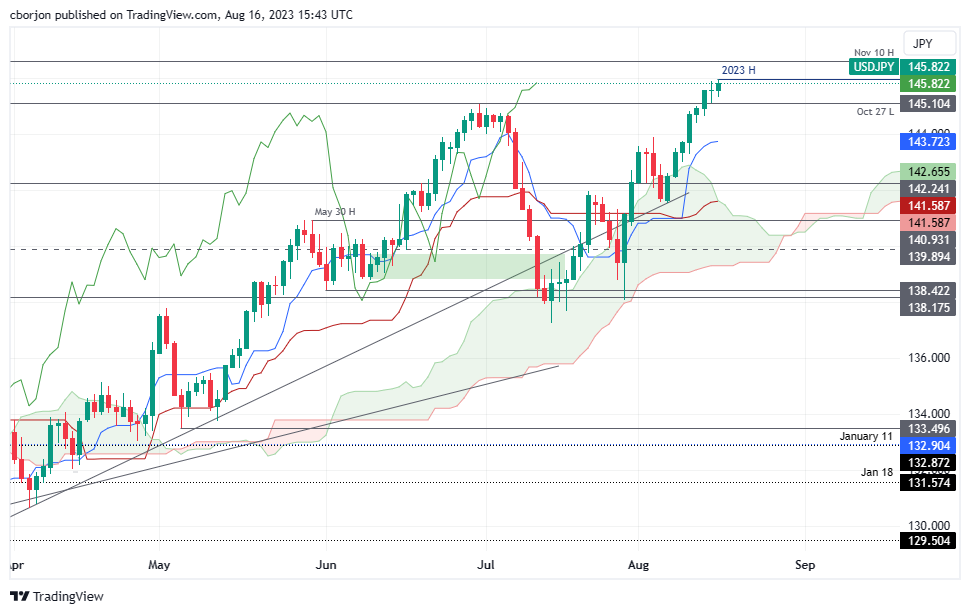
The USD/JPY daily chart portrays the pair peaking around current exchange rates after hitting a year-to-date (YTD) high of 145.94, shy of the 146.00 figure. A breach of the latter will expose higher resistance levels above the 146.00 mark, like the November 10 daily high at 146.59, followed by the November 8 high of 146.94, before reaching 147.00. Conversely, the USD/JPY first support would be today’s low of 145.30, followed by the August 15 low of 145.10, before sliding to the 145.00 figure.
Author

Christian Borjon Valencia
FXStreet
Markets analyst, news editor, and trading instructor with over 14 years of experience across FX, commodities, US equity indices, and global macro markets.

















