USD/JPY grapples with fresh declines after Japanese PM resigns
- USD/JPY faced sharp declines on Monday, closing a bullish weekend gap.
- Japanese PM Shigeru Ishiba announced his resignation over the weekend.
- Dovish BoJ prospects are now weighing on the Yen.

USD/JPY whipsawed on Monday, driven into fresh volatility by the surprise resignation of Japanese Prime Minister Shigeru Ishiba. With the Japanese government now pivoting to install a new PM, odds that the Bank of Japan (BoJ) will begin lifting interest rates have fallen even further, bolstering Asian stocks and propping up Yen demand.
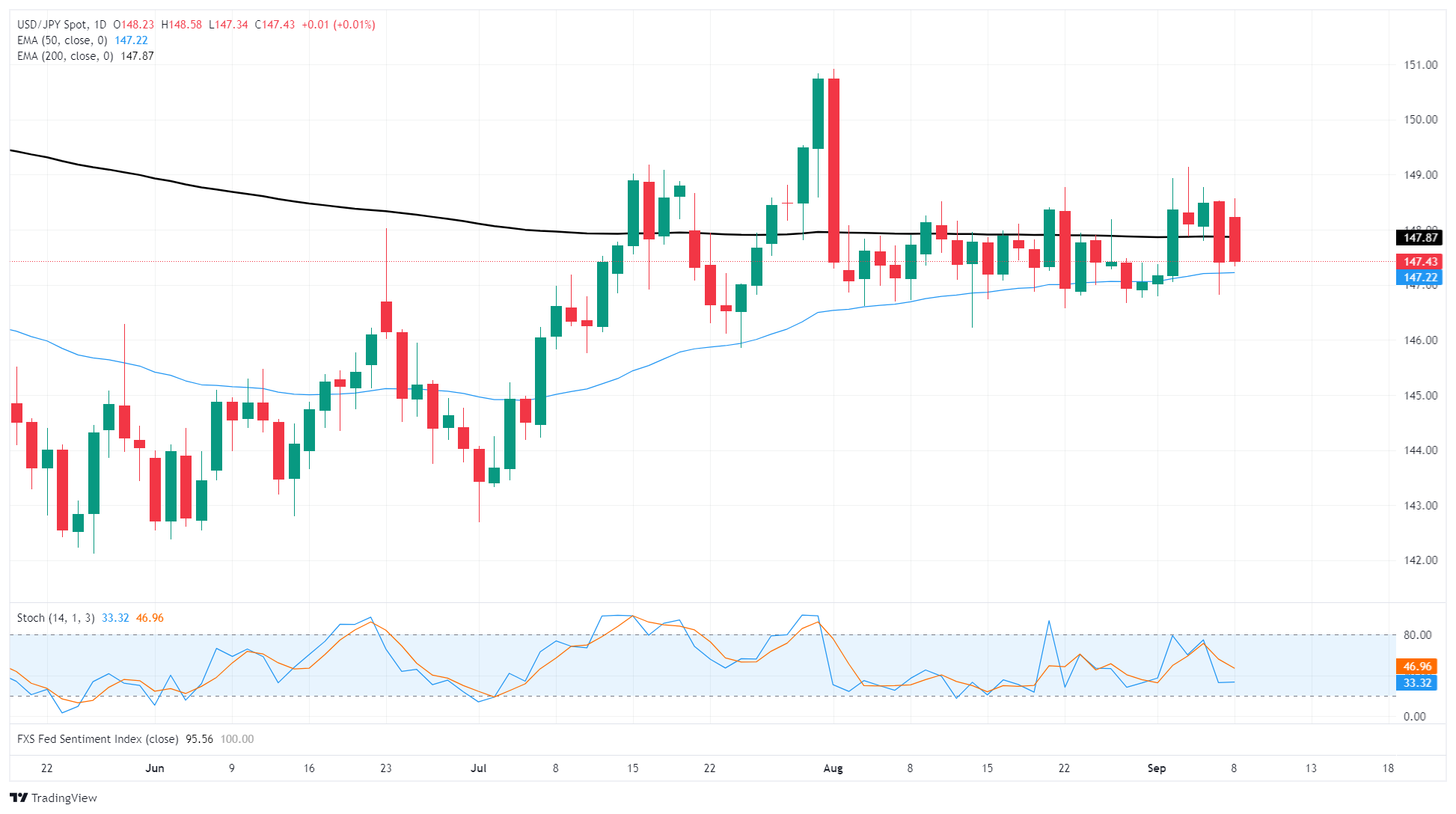
USD/JPY opened the week trading near 148.25, rebounding from last week’s late backslide following further declines in US employment figures. The Yen quickly pared intraday losses, closing the weekend gap and pushing USD/JPY back down below 147.50. The Dollar-Yen pairing remains trapped in medium-term congestion, trading between the 200-day and 50-day Exponential Moving Averages (EMA) near 147.90 and 147.20, respectively.
Japanese PM resigns after securing trade tariff reductions
Now-former Japanese PM Shigeru announced that he had already been planning to resign from his post following his party’s stunning defeat in election polls across Japan earlier this summer. However, the PM decided to keep his decision private until after settling trade details with the Trump administration. After convincing US President Donald Trump to drop tariffs on Japanese goods from 25% to 15% last week, PM Shigeru decided it was time to turn over control of his party and Japan’s PM office.
Despite headline Japanese inflation metrics holding steadily above target levels for an extended period of time, the BoJ has been quick to latch onto any chance to push out interest rate increases. Turnover in the Japanese government will likely be more than enough reason for the BoJ to continue to hold interest rates in place for the time being.
USD/JPY price forecast
Japanese Yen FAQs
The Japanese Yen (JPY) is one of the world’s most traded currencies. Its value is broadly determined by the performance of the Japanese economy, but more specifically by the Bank of Japan’s policy, the differential between Japanese and US bond yields, or risk sentiment among traders, among other factors.
One of the Bank of Japan’s mandates is currency control, so its moves are key for the Yen. The BoJ has directly intervened in currency markets sometimes, generally to lower the value of the Yen, although it refrains from doing it often due to political concerns of its main trading partners. The BoJ ultra-loose monetary policy between 2013 and 2024 caused the Yen to depreciate against its main currency peers due to an increasing policy divergence between the Bank of Japan and other main central banks. More recently, the gradually unwinding of this ultra-loose policy has given some support to the Yen.
Over the last decade, the BoJ’s stance of sticking to ultra-loose monetary policy has led to a widening policy divergence with other central banks, particularly with the US Federal Reserve. This supported a widening of the differential between the 10-year US and Japanese bonds, which favored the US Dollar against the Japanese Yen. The BoJ decision in 2024 to gradually abandon the ultra-loose policy, coupled with interest-rate cuts in other major central banks, is narrowing this differential.
The Japanese Yen is often seen as a safe-haven investment. This means that in times of market stress, investors are more likely to put their money in the Japanese currency due to its supposed reliability and stability. Turbulent times are likely to strengthen the Yen’s value against other currencies seen as more risky to invest in.
Author

Joshua Gibson
FXStreet
Joshua joins the FXStreet team as an Economics and Finance double major from Vancouver Island University with twelve years' experience as an independent trader focusing on technical analysis.