USD/INR struggles to gain ground amid RBI’s likely intervention
- The Indian Rupee gains momentum in Tuesday’s early European session.
- The routine interventions by the RBI support the INR; portfolio outflows and a stronger USD might cap its upside.
- Kansas City Fed President Jeffrey Schmid is set to speak later on Tuesday.

The Indian Rupee (INR) extends the rally on Tuesday, bolstered by the intervention by the Reserve Bank of India (RBI) to prevent the local currency from significant depreciation. Furthermore, the recovery in crude oil prices provides some support to the INR as India is the world's third-largest oil consumer.
Nonetheless, the sustained outflow of foreign funds and the renewed US Dollar (USD) demand might exert some selling pressure on the Indian Rupee. A decline in most Asian currencies also weighs on the local currency for the time being. In the absence of top-tier US economic data releases on Tuesday, the attention will be on risk sentiment and the US Federal Reserve’s (Fed) Jeffrey Schmid speech.
Indian Rupee rebounds as RBI Intervention caps decline
- Foreign investors withdrew $3.3 billion from Indian stocks and bonds on a net basis over November so far, adding to the $11.4 billion outflow in the previous month.
- India's foreign exchange reserves fell to $675.65 billion for the sixth week in a row, from a record high of $704 billion in late September.
- DBS Bank estimated India's economic growth will moderate to 6.0% in 2025 and 2026, down from 8.2% in 2024.
- Moody's Ratings projected the Indian economy to grow by 7.2% in 2024, driven by a gradual recovery in household spending and easing inflation pressures.
- The National Association of Home Builders (NAHB) Housing Market Index climbed to 46.0 in November, the highest since April, from 43.0 in October, beating the estimate of 44.0.
USD/INR’s outlook remains positive in the longer term
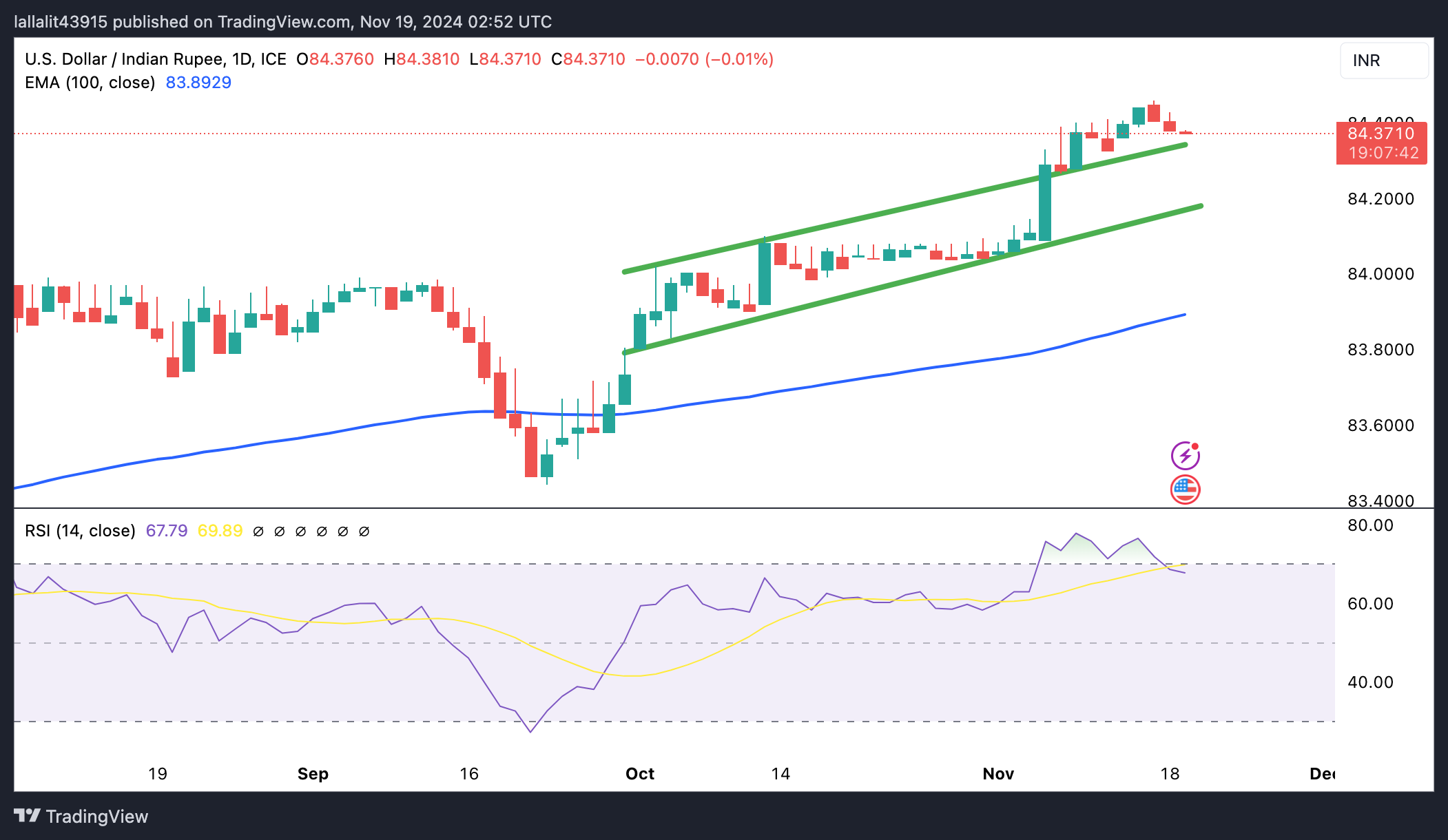
The Indian Rupee trades on a stronger note on the day. The bullish outlook of the USD/INR pair prevails as the pair remains above the key 100-day Exponential Moving Average (EMA) on the daily chart. Additionally, the 14-day Relative Strength Index (RSI) is located above its midline near 67.00, suggesting that the support is likely to hold rather than break.
The first upside barrier to watch is the all-time high of 84.45. A decisive break above this level could clear the way for a move to the 85.00 psychological level.
On the flip side, the resistance-turned-support level at 84.35 acts as an initial support level for USD/INR. A move below the mentioned level could expose 84.00, the round mark. Extended losses could see a drop to 83.89, the 100-day EMA.
RBI FAQs
The role of the Reserve Bank of India (RBI), in its own words, is "..to maintain price stability while keeping in mind the objective of growth.” This involves maintaining the inflation rate at a stable 4% level primarily using the tool of interest rates. The RBI also maintains the exchange rate at a level that will not cause excess volatility and problems for exporters and importers, since India’s economy is heavily reliant on foreign trade, especially Oil.
The RBI formally meets at six bi-monthly meetings a year to discuss its monetary policy and, if necessary, adjust interest rates. When inflation is too high (above its 4% target), the RBI will normally raise interest rates to deter borrowing and spending, which can support the Rupee (INR). If inflation falls too far below target, the RBI might cut rates to encourage more lending, which can be negative for INR.
Due to the importance of trade to the economy, the Reserve Bank of India (RBI) actively intervenes in FX markets to maintain the exchange rate within a limited range. It does this to ensure Indian importers and exporters are not exposed to unnecessary currency risk during periods of FX volatility. The RBI buys and sells Rupees in the spot market at key levels, and uses derivatives to hedge its positions.
Author

Lallalit Srijandorn
FXStreet
Lallalit Srijandorn is a Parisian at heart. She has lived in France since 2019 and now becomes a digital entrepreneur based in Paris and Bangkok.