USD/INR ticks down despite India's private sector activity growth slows down
- The Indian Rupee edges higher against its major peers despite the cooling of India’s private sector activity growth.
- Traders pare Fed dovish bets amid upside inflation risks.
- The US Unemployment Rate rose to 4.4% in September.

The Indian Rupee (INR) attracts slight bids against its major peers on Friday after the release of India’s preliminary HSBC Purchasing Managers’ Index (PMI) data for November. The Indian currency ticks up even as the private sector PMI data showed that overall business activity expanded at a moderate pace.
India's HSBC Composite PMI dropped to 59.9 from the final reading of 60.4 in October due to a slowdown in the growth of manufacturing sector activity. The Manufacturing PMI fell to 57.4 from the prior reading of 59.2, despite the government's reduction of Goods and Services Tax (GST) rates across all product categories. Meanwhile, the Services PMI expanded at a faster pace to 59.5 from the former release of 58.9.
"The HSBC flash manufacturing PMI eased, though the improvement in operating conditions remained healthy. The rise in new export orders matched that seen in October. However, overall new orders came in soft, indicating that the GST-led boost may have peaked. Cost pressures eased considerably, and so did prices charged," Pranjul Bhandari, Chief India Economist at HSBC, said.
On a broader note, the Indian Rupee has been underperforming, as the United States (US) and India have not yet reached a trade deal despite months of negotiations. However, they have stated that a bilateral pact will be announced soon.
Earlier this month, US President Donald Trump stated that he will reduce tariffs on imports from India “at some point in time”. Currently, Washington is charging 50% tariffs on imports coming from New Delhi, which includes a 25% additional levy as a penalty for buying Oil from Russia.
On the monetary policy front, market experts have become confident that the Reserve Bank of India (RBI) will reduce interest rates in its upcoming monetary policy in December. "On monetary policy, we expect the RBI to cut the Repo rate by 25 basis points (bps) to 5.25% in the policy meeting next month amid inflation undershooting the central bank’s 2%-6% tolerance range,” analysts at Morgan Stanley said.
Daily digest market movers: Fed's Hammack stresses to bring inflation down
- The USD/INR ticks down to near 88.75 after the release of India's HSBC PMI data. However, the pair remains firm broadly as the US Dollar (USD) holds onto its week-long recovery move, driven by receding dovish Federal Reserve (Fed) expectations.
- At the time of writing, the US Dollar Index (DXY), which tracks the Greenback’s value against six major currencies, trades calmly around 100.36, the highest level seen in over five months.
- Traders started paring dovish Fed bets as Federal Open Market Committee (FOMC) members had been stressing to keep the monetary policy somewhat restrictive to bring inflation sustainably to the 2% target.
- The FOMC minutes of the October policy meeting also showed that many policymakers are not comfortable with the option of reducing interest rates again in December, as it would dampen trust of households towards the central bank’s commitment to bring inflation down.
- According to the CME FedWatch tool, the probability of the Fed cutting interest rates by 25 basis points (bps) to 3.50%-3.75% in the December meeting is 35.5%. Fed dovish bets accelerated slightly from 30%, recorded on Wednesday, after the release of the US Nonfarm Payrolls (NFP) data for September.
- The US NFP report showed on Thursday that the Unemployment Rate rose to 4.4% from estimates and the prior reading of 4.3%. Meanwhile, job creation remained robust as employers added a fresh 119K workers.
- After the US NFP data release, Cleveland Fed President Beth Hammack stated that the official employment data is a “bit stale”, as it was delayed due to the government shutdown, and the monetary policy must be focused on reducing inflation. “Jobs report is a bit stale but is in line with expectations, while high inflation is still a real issue for the economy,” Hammack said.
- In Friday’s session, investors will focus on the flash US S&P Global PMI data for November, which will be published at 14:45 GMT.
Technical Analysis: USD/INR contonues to hold 20-day EMA
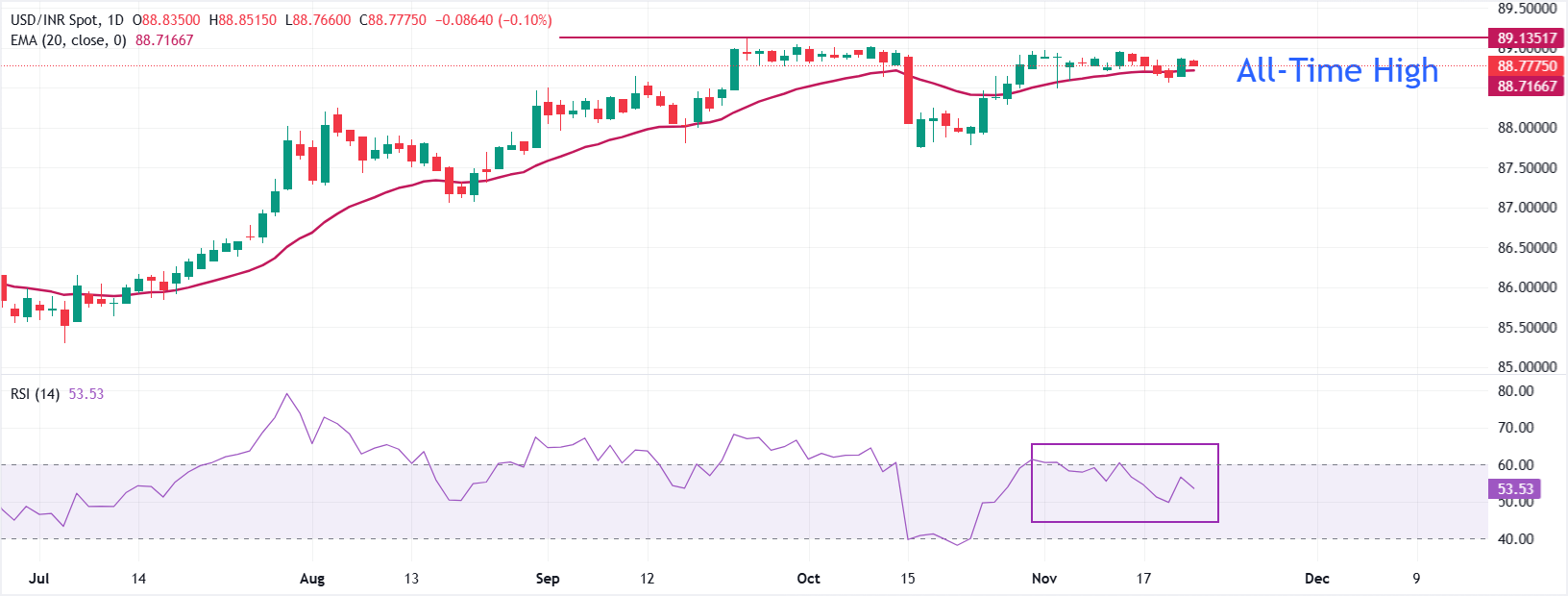
In the daily chart, USD/INR trades at 88.85. The pair holds above the rising 20-day EMA at 88.7239, keeping the short-term bias tilted upward. The average has been grinding higher in recent sessions, showing persistent buying interest. RSI at 56.17 sits above 50, confirming modest bullish momentum without overbought conditions.
Momentum remains supportive while price stays above the 20-day EMA at 88.7239, with dips expected to find support at that gauge. A daily close below the average would weaken the tone and open a phase of consolidation, whereas sustained closes above the EMA would allow the advance to extend. RSI holding in the mid-50s would favor gradual gains, though a rollover toward 50 would flag fading momentum.
Looking down, the August 21 low of 87.07 will act as key support for the pair. On the upside, the all-time high of 89.12 will be a key barrier.
(The technical analysis of this story was written with the help of an AI tool)
Economic Indicator
Nonfarm Payrolls
The Nonfarm Payrolls release presents the number of new jobs created in the US during the previous month in all non-agricultural businesses; it is released by the US Bureau of Labor Statistics (BLS). The monthly changes in payrolls can be extremely volatile. The number is also subject to strong reviews, which can also trigger volatility in the Forex board. Generally speaking, a high reading is seen as bullish for the US Dollar (USD), while a low reading is seen as bearish, although previous months' reviews and the Unemployment Rate are as relevant as the headline figure. The market's reaction, therefore, depends on how the market assesses all the data contained in the BLS report as a whole.
Read more.Last release: Thu Nov 20, 2025 13:30
Frequency: Monthly
Actual: 119K
Consensus: 50K
Previous: 22K
Source: US Bureau of Labor Statistics
America’s monthly jobs report is considered the most important economic indicator for forex traders. Released on the first Friday following the reported month, the change in the number of positions is closely correlated with the overall performance of the economy and is monitored by policymakers. Full employment is one of the Federal Reserve’s mandates and it considers developments in the labor market when setting its policies, thus impacting currencies. Despite several leading indicators shaping estimates, Nonfarm Payrolls tend to surprise markets and trigger substantial volatility. Actual figures beating the consensus tend to be USD bullish.
Author

Sagar Dua
FXStreet
Sagar Dua is associated with the financial markets from his college days. Along with pursuing post-graduation in Commerce in 2014, he started his markets training with chart analysis.