USD/INR climbs as record trade deficit drags Indian Rupee to all-time low
- The Indian Rupee weakens to near an all-time low in Tuesday’s early European session.
- Rising US bond yields and a weaker Chinese Yuan could undermine the INR, but the RBI’s intervention might help limit its losses.
- Traders brace for the US November Retail Sales on Tuesday ahead of the Fed rate decision.

The Indian Rupee (INR) edges lower to near a fresh record low on Tuesday. A rise in US Treasury bond yields and weakness in the Chinese Yuan exert some selling pressure on the local currency. Furthermore, the widening of India’s merchandise trade deficit in November further weighs on the INR.
Any significant depreciation of the Indian Rupee might be limited as the Reserve Bank of India (RBI) will likely sell the USD via state-owned banks to avoid excess volatility. The US November Retail Sales is due later on Tuesday. All eyes will be on the US Federal Reserve (Fed) interest rate decision on Wednesday for fresh catalysts. Also, the Fed Chair Jerome Powell’s press conference and the updated economic projections will be closely monitored.
Indian Rupee remains weak on the back of global cues
- “The rupee has weakened in anticipation of trade data, which reveals that the trade deficit has reached an all-time high. It is expected to weaken further in the near term. While the domestic currency has remained range-bound and stable for quite some time, it could weaken further against the dollar if the trade deficit widens or capital flows become weaker,” said Gopal Tripathi, head of treasury and capital markets, Jana Small Finance Bank.
- The Indian WPI inflation eased to a three-month low of 1.89% in November from 2.36% in October, the Ministry of Commerce and Industry showed on Monday. This figure came in softer than the expectation of 2.2%.
- The preliminary estimate released by HSBC showed on Monday that the India Manufacturing Purchasing Managers Index (PMI) rose to 57.4 in December versus 56.5 prior.
- The Indian Services PMI climbed to 60.8 in December from 58.4 prior. The Composite PMI jumped to 60.7 during the same report period from 58.6 in November.
- "The small rise in the headline manufacturing PMI in December was mainly driven by gains in current production, new orders, and employment," said Ines Lam, economist at HSBC.
- The US S&P Global Composite PMI improved to 56.6 in December’s flash estimate versus 54.9 prior. Meanwhile, the Services PMI increased to 58.5 in December’s flash estimate from 56.1. The Manufacturing PMI eased to 48.3 from 49.7.
USD/INR keeps the bullish vibe in the longer term
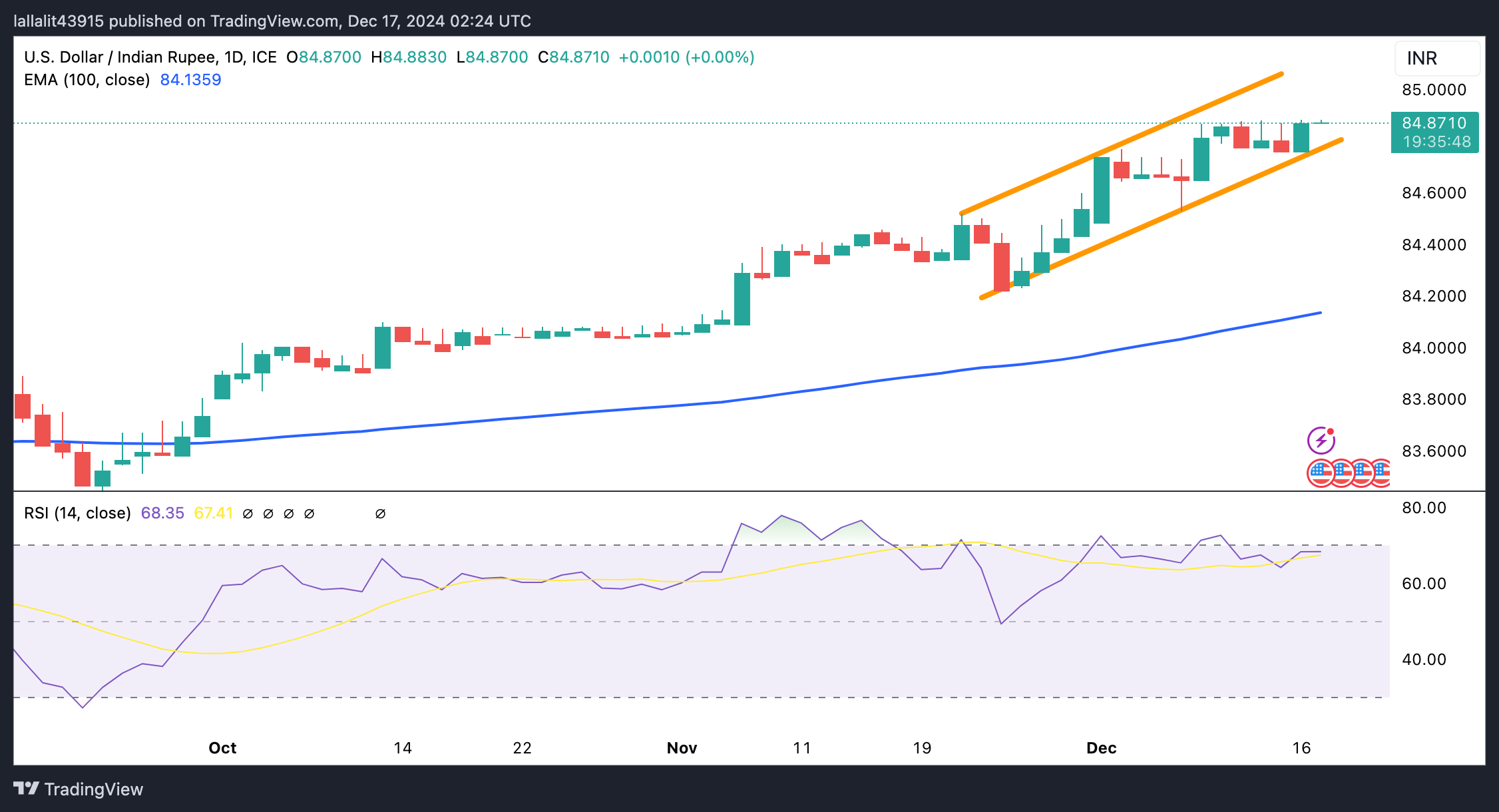
The Indian Rupee trades weaker on the day. The constructive view of the USD/INR pair prevails, with the price holding above the key 100-day Exponential Moving Average (EMA) on the daily chart. Additionally, the 14-day Relative Strength Index (RSI) is located above the midline near 68.35, supporting the buyers in the near term.
The ascending trend channel and the psychological level of 85.00 appear to be a tough nut to crack for bulls. Sustained bullish momentum could even take USD/INR to 85.50.
On the other hand, the first downside target to watch is the lower boundary of the trend channel of 84.80. A breach of this level could expose 84.22, the low of November 25. The potential support level for the pair is seen at 84.13, the 100-day EMA.
Fed FAQs
Monetary policy in the US is shaped by the Federal Reserve (Fed). The Fed has two mandates: to achieve price stability and foster full employment. Its primary tool to achieve these goals is by adjusting interest rates. When prices are rising too quickly and inflation is above the Fed’s 2% target, it raises interest rates, increasing borrowing costs throughout the economy. This results in a stronger US Dollar (USD) as it makes the US a more attractive place for international investors to park their money. When inflation falls below 2% or the Unemployment Rate is too high, the Fed may lower interest rates to encourage borrowing, which weighs on the Greenback.
The Federal Reserve (Fed) holds eight policy meetings a year, where the Federal Open Market Committee (FOMC) assesses economic conditions and makes monetary policy decisions. The FOMC is attended by twelve Fed officials – the seven members of the Board of Governors, the president of the Federal Reserve Bank of New York, and four of the remaining eleven regional Reserve Bank presidents, who serve one-year terms on a rotating basis.
In extreme situations, the Federal Reserve may resort to a policy named Quantitative Easing (QE). QE is the process by which the Fed substantially increases the flow of credit in a stuck financial system. It is a non-standard policy measure used during crises or when inflation is extremely low. It was the Fed’s weapon of choice during the Great Financial Crisis in 2008. It involves the Fed printing more Dollars and using them to buy high grade bonds from financial institutions. QE usually weakens the US Dollar.
Quantitative tightening (QT) is the reverse process of QE, whereby the Federal Reserve stops buying bonds from financial institutions and does not reinvest the principal from the bonds it holds maturing, to purchase new bonds. It is usually positive for the value of the US Dollar.
Author

Lallalit Srijandorn
FXStreet
Lallalit Srijandorn is a Parisian at heart. She has lived in France since 2019 and now becomes a digital entrepreneur based in Paris and Bangkok.