USD/INR extends decline on Fed's aggressive rate cut
- Indian Rupee gathers strength in Thursday’s early European session.
- The increased liquidity flowing into the Indian market and dovish Fed drag the US Dollar down.
- Traders await the US weekly Initial Jobless Claims, the Philly Fed Manufacturing Index and Existing Home Sales on Thursday.

The Indian Rupee (INR) gains traction on the softer US Dollar (USD) on Thursday. The downside of the INR might be limited after the US Federal Reserve (Fed) made a large rate cut at its September meeting, which might weaken the US Dollar (USD). Furthermore, the persistent Foreign Institutional Investor (FII) funds into Indian equities could further strengthen the local currency.
Nonetheless, further rebound in crude oil prices could undermine the INR as India is the third-largest oil consumer after the United States (US) and China. Moving on, investors await the US weekly Initial Jobless Claims, the Philly Fed Manufacturing Index and Existing Home Sales, which are due later on Thursday.
Daily Digest Market Movers: Indian Rupee edges higher after the Fed rate decision
- The Reserve Bank of India (RBI) is unlikely to ease the benchmark policy rate during 2024 given the uncertainty over food inflation, said State Bank of India (SBI) chairman C S Setty.
- Finance Minister Nirmala Sitharaman said on Wednesday that India is standing out globally in terms of economic growth and will continue to do so in the next few years.
- The Federal Open Market Committee (FOMC) decided to lower the federal funds rate by 50 basis points (bps) to a range of 4.75% to 5.00%, the Fed’s first rate cut in more than four years.
- Fed Chair Jerome Powell noted during a press conference that the half-point rate reduction did not represent any new pattern for the central bank but that policymakers want to keep the economy and the labor market in good shape.
- Fed policymakers revised their quarterly economic forecasts, raising the median projection for unemployment by the end of 2024 to 4.4% from the 4% projection in June. Fed officials raised their projection for the long-run federal funds rate to 2.9% from 2.8%.
Technical Analysis: USD/INR’s positive outlook remains fragile in the longer term
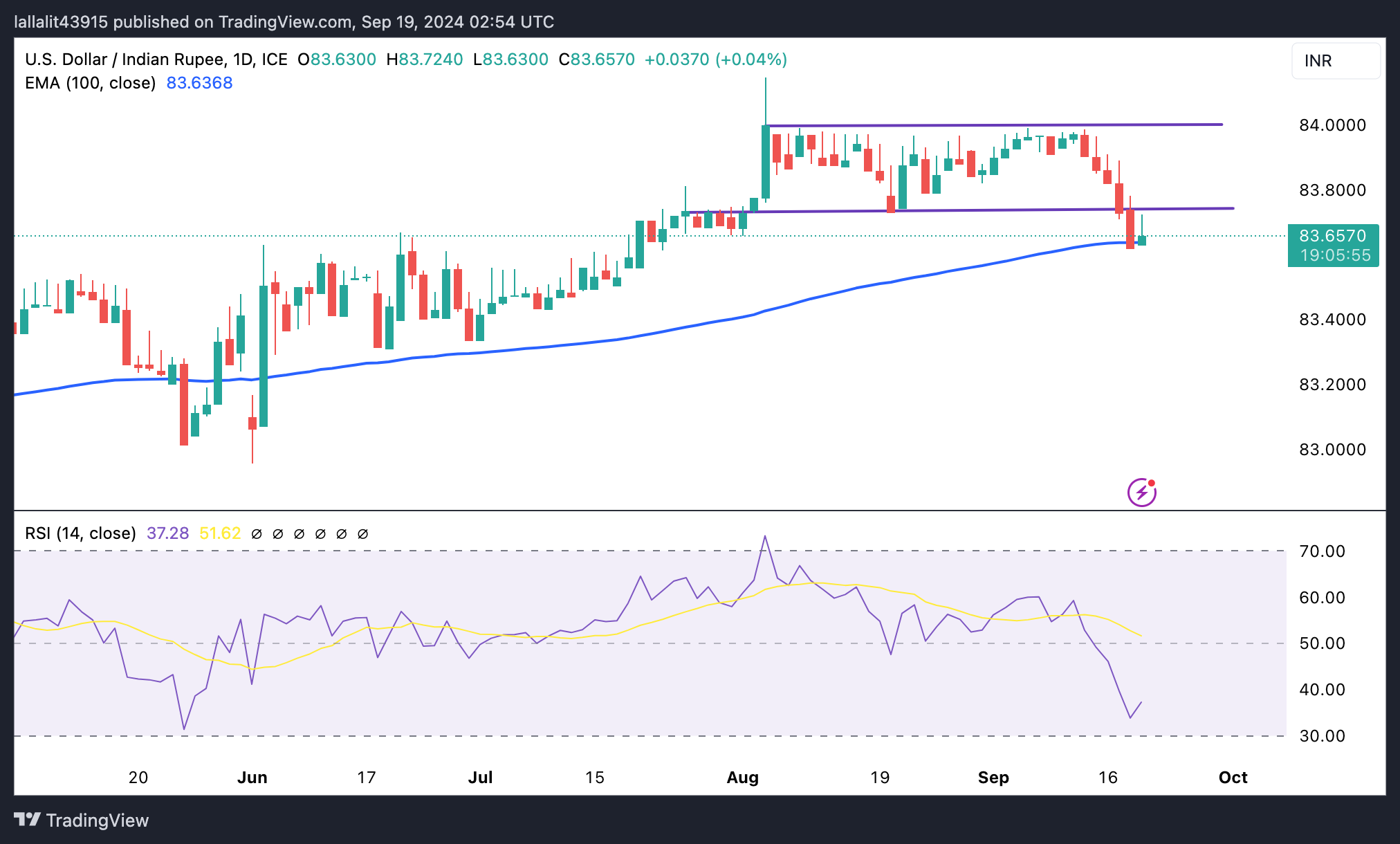
The Indian Rupee trades firmer on the day. The USD/INR pair has broken below the rectangle on the daily chart. The bullish outlook of the pair seems vulnerable as the price hovers the key 100-day Exponential Moving Average (EMA). If the pair closes below the 100-day EMA, it could resume the downside. Meanwhile, the 14-day Relative Strength Index (RSI) stands in the bearish zone below the midline near 38.0, suggesting the path of least resistance is to the downside.
The 100-day EMA at 83.64 acts as an initial support level for the pair. A breach of this level could see a drop to 83.31, the low of June 18. Extended losses could attract some sellers to the 83.00 psychological mark.
On the upside, the first upside barrier for USD/INR emerges at the support-turned-resistance level near 83.75. A crucial barrier is seen at the 83.90-84.00 region.
Fed FAQs
Monetary policy in the US is shaped by the Federal Reserve (Fed). The Fed has two mandates: to achieve price stability and foster full employment. Its primary tool to achieve these goals is by adjusting interest rates. When prices are rising too quickly and inflation is above the Fed’s 2% target, it raises interest rates, increasing borrowing costs throughout the economy. This results in a stronger US Dollar (USD) as it makes the US a more attractive place for international investors to park their money. When inflation falls below 2% or the Unemployment Rate is too high, the Fed may lower interest rates to encourage borrowing, which weighs on the Greenback.
The Federal Reserve (Fed) holds eight policy meetings a year, where the Federal Open Market Committee (FOMC) assesses economic conditions and makes monetary policy decisions. The FOMC is attended by twelve Fed officials – the seven members of the Board of Governors, the president of the Federal Reserve Bank of New York, and four of the remaining eleven regional Reserve Bank presidents, who serve one-year terms on a rotating basis.
In extreme situations, the Federal Reserve may resort to a policy named Quantitative Easing (QE). QE is the process by which the Fed substantially increases the flow of credit in a stuck financial system. It is a non-standard policy measure used during crises or when inflation is extremely low. It was the Fed’s weapon of choice during the Great Financial Crisis in 2008. It involves the Fed printing more Dollars and using them to buy high grade bonds from financial institutions. QE usually weakens the US Dollar.
Quantitative tightening (QT) is the reverse process of QE, whereby the Federal Reserve stops buying bonds from financial institutions and does not reinvest the principal from the bonds it holds maturing, to purchase new bonds. It is usually positive for the value of the US Dollar.
Due to the importance of trade to the economy, the Reserve Bank of India (RBI) actively intervenes in FX markets to maintain the exchange rate within a limited range. It does this to ensure Indian importers and exporters are not exposed to unnecessary currency risk during periods of FX volatility. The RBI buys and sells Rupees in the spot market at key levels, and uses derivatives to hedge its positions.
Author

Lallalit Srijandorn
FXStreet
Lallalit Srijandorn is a Parisian at heart. She has lived in France since 2019 and now becomes a digital entrepreneur based in Paris and Bangkok.