USD/INR strengthens amid stronger US Dollar, India's foreign inflows
- The Indian Rupee (INR) loses ground on the firmer US Dollar on Thursday.
- Significant inflows into Indian markets might support the INR, while Fed rate-cut bets could cap the upside.
- Investors await the US weekly Initial Jobless Claims, Housing data, and Philly Fed Manufacturing Index, which are due on Thursday.

The Indian Rupee (INR) trims gains on Thursday amid renewed US Dollar (USD) demand. The INR depreciation underscores the ongoing pressure from local importers and oil companies demanding USD. Furthermore, the rise in crude oil prices might contribute to the INR’s downside as India is the third largest consumer of crude oil in the world, after the United States and China.
Nonetheless, the significant inflows into Indian equities and bond markets could boost the INR in the near term. Meanwhile, the speculation that the US Federal Reserve (Fed) might cut the interest rate two times in 2024, beginning in September, might undermine the Greenback and create a headwind for the pair.
Looking ahead, the US weekly Initial Jobless Claims, Building Permits, Housing Starts and the Philly Fed Manufacturing Index will be released on Thursday. The attention will shift to the Indian HSBC Manufacturing and Services PMI on Friday, along with the US S&P Global PMI reports.
Daily Digest Market Movers: Indian Rupee edges lower amid the recovery of US Dollar
- Indian equity indices reached fresh record highs for the fourth consecutive session before ending on a flat note. The BSE Sensex ended at 77,337.59, up 36.46 points or 0.05%, while the Nifty50 closed at 23,516, down 41.90 points or 0.18%.
- The Indian Rupee may rise beyond 83.20 once inflows from India's inclusion in the JPMorgan emerging market debt index begin later this month, said Sajal Gupta, head of FX and commodities at Nuvama Wealth Management's institutional desk.
- Fitch Ratings raised India’s growth forecast from 7% in March to 7.2% due to the recovery in consumer spending and increased investment.
- "The Rupee is likely to hold in the 83-83.55 band in the next few trading sessions" with the Reserve Bank of India firmly capping sharp declines below 83.55,” said Anil Kumar Bhansali, head of treasury at Finrex Treasury Advisors.
- Traders have priced in a nearly 67% chance of a 25 basis points (bps) rate cut in September, up from 61% a day ago, according to the CME FedWatch tool.
- The US Initial Jobless Claims for the week ending June 15 are estimated to drop to235K from the previous week of 242K.
Technical analysis: USD/INR paints a positive picture in the longer term
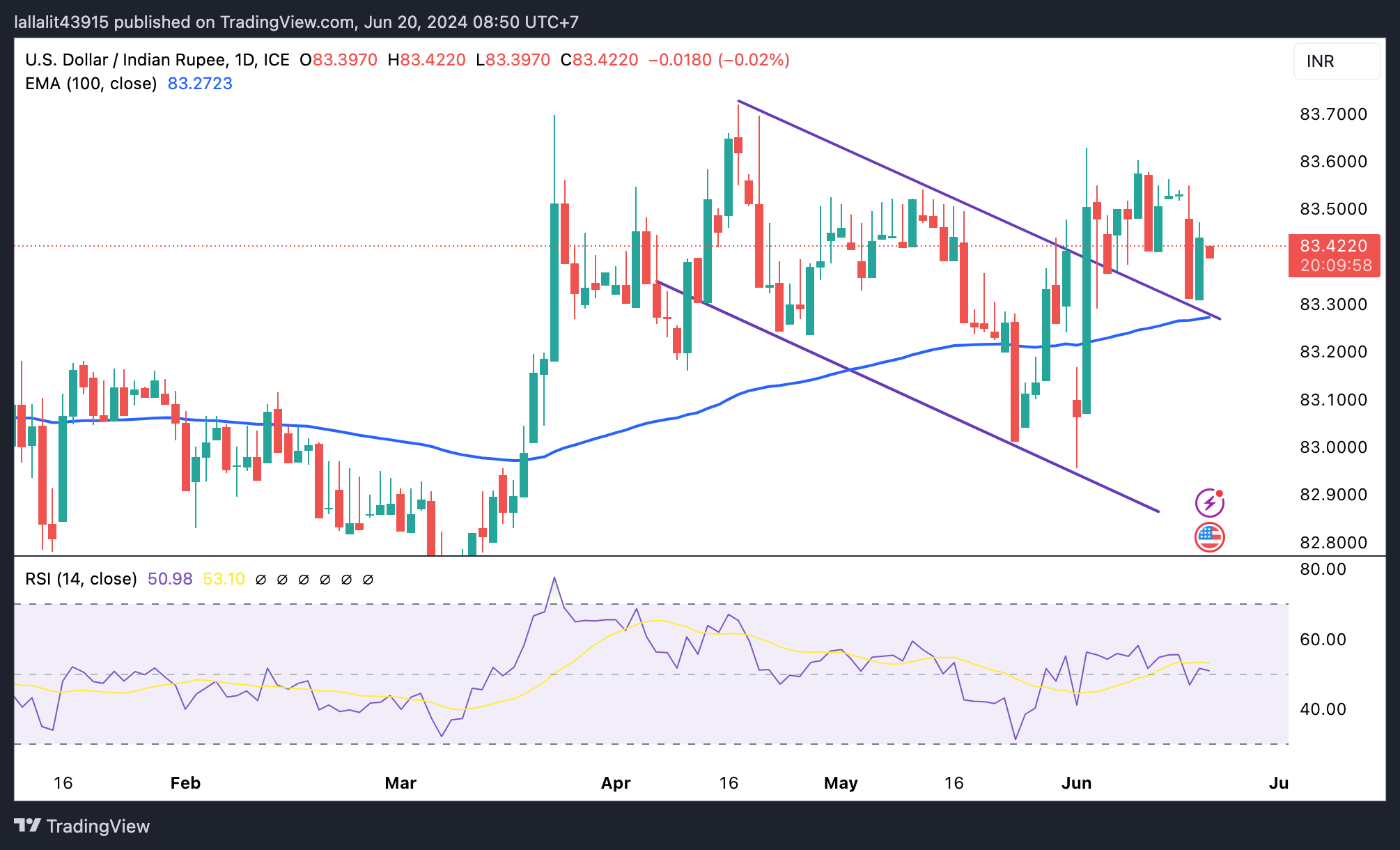
The Indian Rupee trades weaker on the day. The USD/INR pair maintains the constructive outlook unchanged above the key 100-day Exponential Moving Average (EMA) on the daily chart. Nonetheless, further consolidation looks favorable amid the neutral level of the 14-day Relative Strength Index (RSI).
In the bullish case, the first upside target for the pair will emerge at 83.55 (high of June 18). The next barrier is located at 83.72 (high of April 17) and then the 84.00 psychological level.
On the flip side, the key support level is seen near 83.30, the 100-day EMA. Any follow-through selling below this level will pave the way to 83.00 (round figure), followed by 82.78 (low of January 15).
US Dollar price this week
The table below shows the percentage change of US Dollar (USD) against listed major currencies this week. US Dollar was the strongest against the Japanese Yen.
| USD | EUR | GBP | CAD | AUD | JPY | NZD | CHF | |
| USD | -0.38% | -0.27% | -0.17% | -0.83% | 0.29% | 0.08% | -0.68% | |
| EUR | 0.33% | 0.10% | 0.16% | -0.51% | 0.68% | 0.39% | -0.52% | |
| GBP | 0.27% | -0.09% | 0.10% | -0.56% | 0.59% | 0.33% | -0.40% | |
| CAD | 0.17% | -0.22% | -0.11% | -0.66% | 0.49% | 0.24% | -0.51% | |
| AUD | 0.88% | 0.48% | 0.59% | 0.69% | 1.17% | 0.93% | 0.18% | |
| JPY | -0.31% | -0.70% | -0.60% | -0.46% | -1.15% | -0.23% | -1.01% | |
| NZD | -0.09% | -0.47% | -0.35% | -0.25% | -0.92% | 0.21% | -0.73% | |
| CHF | 0.67% | 0.31% | 0.39% | 0.50% | -0.16% | 1.00% | 0.74% |
The heat map shows percentage changes of major currencies against each other. The base currency is picked from the left column, while the quote currency is picked from the top row. For example, if you pick the Euro from the left column and move along the horizontal line to the Japanese Yen, the percentage change displayed in the box will represent EUR (base)/JPY (quote).
Interest rates FAQs
Interest rates are charged by financial institutions on loans to borrowers and are paid as interest to savers and depositors. They are influenced by base lending rates, which are set by central banks in response to changes in the economy. Central banks normally have a mandate to ensure price stability, which in most cases means targeting a core inflation rate of around 2%. If inflation falls below target the central bank may cut base lending rates, with a view to stimulating lending and boosting the economy. If inflation rises substantially above 2% it normally results in the central bank raising base lending rates in an attempt to lower inflation.
Higher interest rates generally help strengthen a country’s currency as they make it a more attractive place for global investors to park their money.
Higher interest rates overall weigh on the price of Gold because they increase the opportunity cost of holding Gold instead of investing in an interest-bearing asset or placing cash in the bank. If interest rates are high that usually pushes up the price of the US Dollar (USD), and since Gold is priced in Dollars, this has the effect of lowering the price of Gold.
The Fed funds rate is the overnight rate at which US banks lend to each other. It is the oft-quoted headline rate set by the Federal Reserve at its FOMC meetings. It is set as a range, for example 4.75%-5.00%, though the upper limit (in that case 5.00%) is the quoted figure. Market expectations for future Fed funds rate are tracked by the CME FedWatch tool, which shapes how many financial markets behave in anticipation of future Federal Reserve monetary policy decisions.
Author

Lallalit Srijandorn
FXStreet
Lallalit Srijandorn is a Parisian at heart. She has lived in France since 2019 and now becomes a digital entrepreneur based in Paris and Bangkok.