USD/INR gathers strength as investors brace for US CPI inflation data
- The Indian Rupee weakens in Thursday’s early European session.
- A muted sentiment in Indian markets and a firmer USD undermine the INR.
- The US CPI inflation data will take center stage on Thursday.

The Indian Rupee (INR) trades on a weaker note on Thursday. A muted trend in the domestic market and a stronger US Dollar (USD) weigh on the local currency. However, robust Indian macroeconomic fundamentals and the inclusion of government bonds in global indices would attract foreign investors and lift the INR.
The release of the key US Consumer Price Index (CPI) inflation data will be the highlight on Thursday. The US Initial Jobless Claims will be released on the same day, and the Federal Reserve’s (Fed) Lisa Cook and John Williams are scheduled to speak.
Daily Digest Market Movers: Indian Rupee remains weak ahead of key US inflation data
- FTSE Russell said on Tuesday that Indian sovereign bonds will be added to its Emerging Markets Government Bond Index (EMGBI), following a similar move by JP Morgan and Bloomberg Index Services.
- The Reserve Bank of India’s (RBI) Monetary Policy Committee (MPC) decided to keep the repo rate unchanged at 6.5% for the tenth consecutive meeting but changed the policy stance to neutral from withdrawal of accommodation.
- The Indian central bank kept the CPI inflation estimate for FY25 unchanged at 4.5% while maintaining the Gross Domestic Product (GDP) growth estimates for FY25 at 7.2%.
- According to minutes released Wednesday, the Federal Open Market Committee (FOMC) members agreed to cut interest rates in September but were unsure how aggressively to go, ultimately deciding on a half-percentage point move in an effort to balance inflation concerns with labor market worries.
- Fed Boston President Susan Collins said on Wednesday that it was “prudent” for officials to cut rates by a half percentage point last month as inflation eases and the economy becomes more vulnerable to shocks.
- San Francisco Fed President Mary Daly noted on Wednesday that she "fully" supported the Fed’s half-of-a-percentage-point interest-rate cut in the September meeting. Daly added that one or two more rate cuts this year are likely if the economy evolves as she expects.
- Dallas Fed President Lorie Logan argued on Wednesday that she supported last month's substantial interest-rate cut but favored smaller reductions going forward as there were "still real" upside risks to inflation.
Technical Analysis: USD/INR’s bullish stance remains intact in the longer term
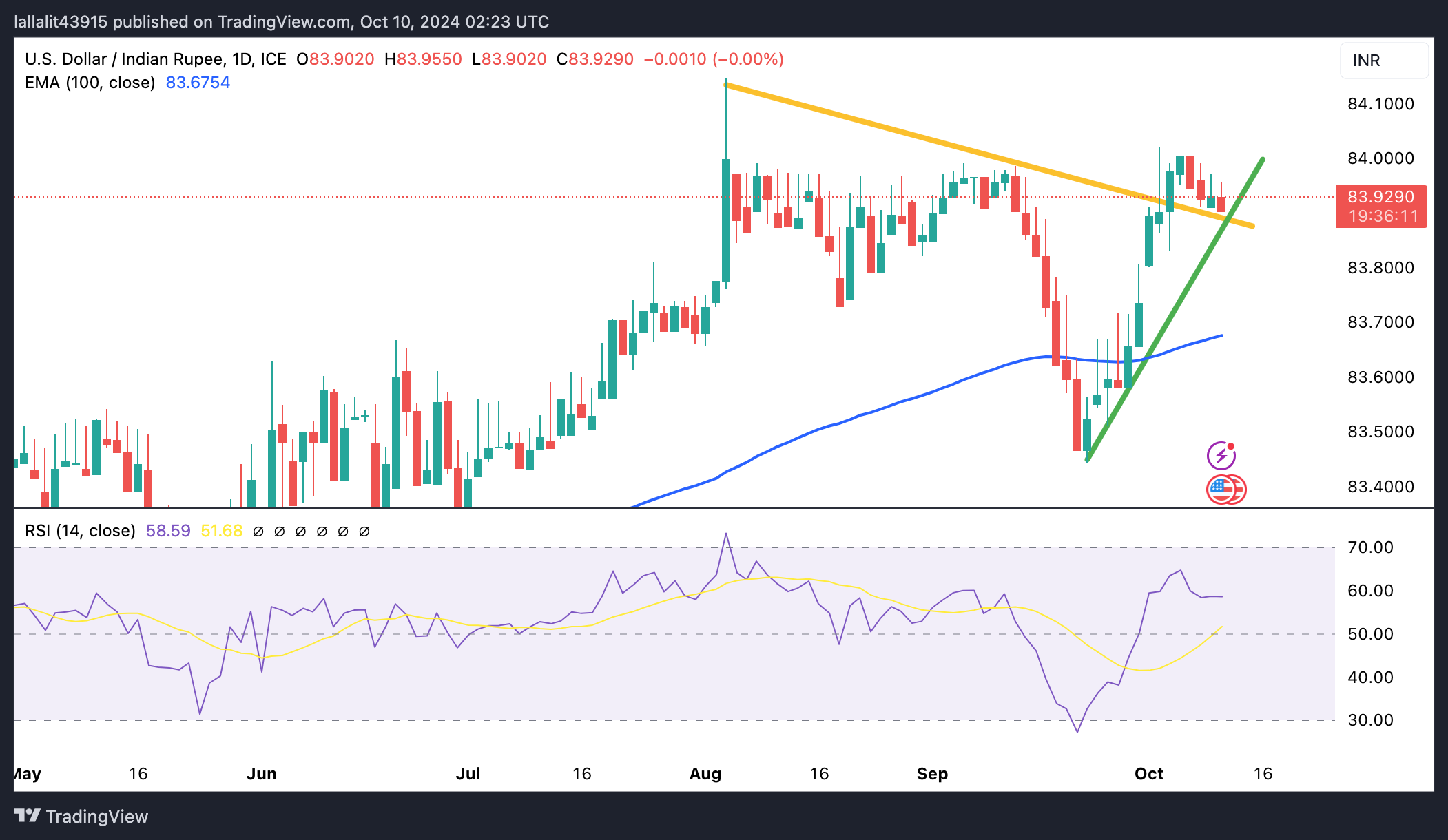
The Indian Rupee edges lower on the day. The USD/INR pair maintains a constructive view on the daily chart, with the price holding above the descending trend line and the key 100-day Exponential Moving Average (EMA). The 14-day Relative Strength Index (RSI) is located above the midline near 58.60, suggesting the support level is likely to hold rather than break.
The 84.00 psychological level appears to be a tough nut to crack for USD/INR bulls. Sustained bullish momentum above this level could see a rally to the all-time high of 84.15, en route to 84.50.
On the flip side, the first downside target is seen near the resistance-turned-support level at 83.90. Any follow-through selling could expose the 100-day EMA at 83.67. The key contention level emerges at 83.00, representing the round mark and the low of May 24.
Indian economy FAQs
The Indian economy has averaged a growth rate of 6.13% between 2006 and 2023, which makes it one of the fastest growing in the world. India’s high growth has attracted a lot of foreign investment. This includes Foreign Direct Investment (FDI) into physical projects and Foreign Indirect Investment (FII) by foreign funds into Indian financial markets. The greater the level of investment, the higher the demand for the Rupee (INR). Fluctuations in Dollar-demand from Indian importers also impact INR.
India has to import a great deal of its Oil and gasoline so the price of Oil can have a direct impact on the Rupee. Oil is mostly traded in US Dollars (USD) on international markets so if the price of Oil rises, aggregate demand for USD increases and Indian importers have to sell more Rupees to meet that demand, which is depreciative for the Rupee.
Inflation has a complex effect on the Rupee. Ultimately it indicates an increase in money supply which reduces the Rupee’s overall value. Yet if it rises above the Reserve Bank of India’s (RBI) 4% target, the RBI will raise interest rates to bring it down by reducing credit. Higher interest rates, especially real rates (the difference between interest rates and inflation) strengthen the Rupee. They make India a more profitable place for international investors to park their money. A fall in inflation can be supportive of the Rupee. At the same time lower interest rates can have a depreciatory effect on the Rupee.
India has run a trade deficit for most of its recent history, indicating its imports outweigh its exports. Since the majority of international trade takes place in US Dollars, there are times – due to seasonal demand or order glut – where the high volume of imports leads to significant US Dollar- demand. During these periods the Rupee can weaken as it is heavily sold to meet the demand for Dollars. When markets experience increased volatility, the demand for US Dollars can also shoot up with a similarly negative effect on the Rupee.
Author

Lallalit Srijandorn
FXStreet
Lallalit Srijandorn is a Parisian at heart. She has lived in France since 2019 and now becomes a digital entrepreneur based in Paris and Bangkok.