USD/INR gathers strength on US Dollar demand, US PMI data in focus
- The Indian Rupee attracts some sellers in Friday’s early European session.
- The ongoing USD strength and worries about India's economic slowdown continue to undermine the INR.
- The US December ISM Manufacturing PMI will be closely monitored.

The Indian Rupee (INR) extends its downside on Friday after closing at its weakest level on record for the eighth consecutive session. The local currency remains under pressure as the heavy US Dollar (USD) demand in the non-deliverable forward (NDF) market has widened the arbitrage with the Indian onshore market. Additionally, the discouraging growth rate in India, a wider trade deficit, and a slowdown in capital inflows contribute to the INR’s downside.
Nonetheless, the Reserve Bank of India (RBI) might intervene to sell the USD and offer short-term relief for the INR. Traders await the US December ISM Manufacturing Purchasing Managers Index (PMI) for fresh impetus, which is due on Friday. Also, the Federal Reserve Bank of Richmond President Thomas Barkin is set to speak later in the day.
Indian Rupee further weakens despite RBI’s intervention
- The Rupee is likely to experience slight depreciation in 2025, driven by volatile foreign portfolio investment(FPI) flows and a potentially stronger US dollar, per the Bank of Baroda report.
- State-run banks were spotted selling USD to the tune of $800 million to $1 billion, traders said.
- The Indian HSBC Manufacturing PMI hit a 2024 low in December, falling to 56.4 from 57.4 in November. This figure came in weaker than the 57.8 expected.
- "India's manufacturing activity ended a strong 2024 with a soft note amid more signs of a slowing trend, albeit moderate, in the industrial sector. The rate of expansion in new orders was the slowest in the year, suggesting weaker growth in future production," said Ines Lam, economist at HSBC.
- The US Initial Jobless Claims for the week ending December 28 declined to 211K, compared to the previous week's print of 220K (revised from 219K), according to the US Department of Labor (DOL) on Thursday. This reading came in below the market consensus of 222K.
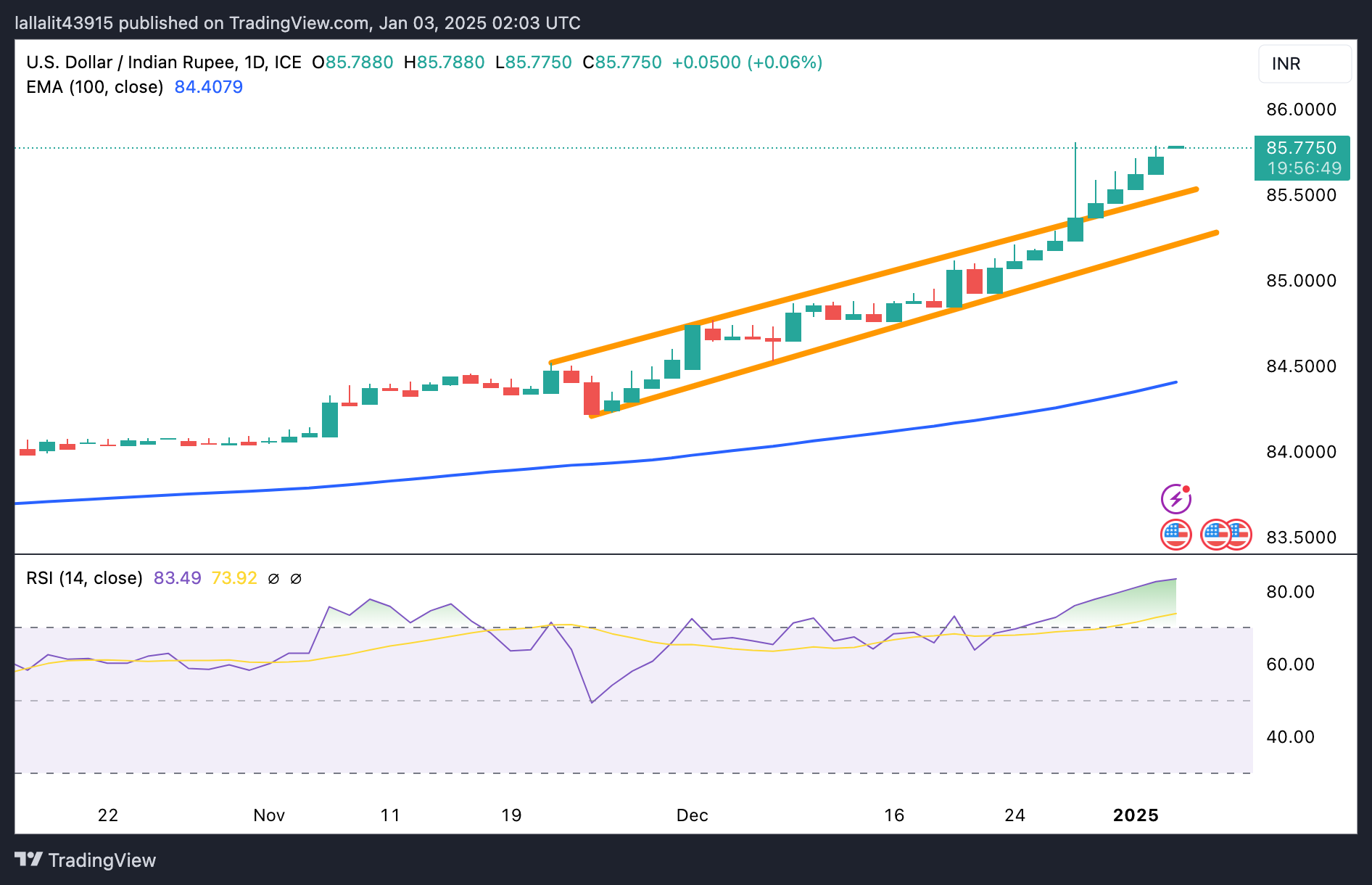
USD/INR keeps firm tone, overbought RSI warrants caution for bulls
However, the 14-day Relative Strength Index (RSI), with a reading above 70, suggests an overbought condition and signals that further consolidation cannot be ruled out before positioning for any near-term USD/INR appreciation.
In the bullish event, the first upside barrier emerges at the all-time high of 85.81. Sustained trading above the mentioned level could pave the way to the 86.00 psychological mark.
On the downside, the initial support level for USD/INR is located at the resistance-turned-support level of 85.54. A breach of this level could see a drop to 85.00, the round figure. The next contention level to watch is the 100-day EMA at 84.40.
Indian economy FAQs
The Indian economy has averaged a growth rate of 6.13% between 2006 and 2023, which makes it one of the fastest growing in the world. India’s high growth has attracted a lot of foreign investment. This includes Foreign Direct Investment (FDI) into physical projects and Foreign Indirect Investment (FII) by foreign funds into Indian financial markets. The greater the level of investment, the higher the demand for the Rupee (INR). Fluctuations in Dollar-demand from Indian importers also impact INR.
India has to import a great deal of its Oil and gasoline so the price of Oil can have a direct impact on the Rupee. Oil is mostly traded in US Dollars (USD) on international markets so if the price of Oil rises, aggregate demand for USD increases and Indian importers have to sell more Rupees to meet that demand, which is depreciative for the Rupee.
Inflation has a complex effect on the Rupee. Ultimately it indicates an increase in money supply which reduces the Rupee’s overall value. Yet if it rises above the Reserve Bank of India’s (RBI) 4% target, the RBI will raise interest rates to bring it down by reducing credit. Higher interest rates, especially real rates (the difference between interest rates and inflation) strengthen the Rupee. They make India a more profitable place for international investors to park their money. A fall in inflation can be supportive of the Rupee. At the same time lower interest rates can have a depreciatory effect on the Rupee.
India has run a trade deficit for most of its recent history, indicating its imports outweigh its exports. Since the majority of international trade takes place in US Dollars, there are times – due to seasonal demand or order glut – where the high volume of imports leads to significant US Dollar- demand. During these periods the Rupee can weaken as it is heavily sold to meet the demand for Dollars. When markets experience increased volatility, the demand for US Dollars can also shoot up with a similarly negative effect on the Rupee.
Author

Lallalit Srijandorn
FXStreet
Lallalit Srijandorn is a Parisian at heart. She has lived in France since 2019 and now becomes a digital entrepreneur based in Paris and Bangkok.