|

USD Index Price Analysis: Losses could accelerate below 102.60

  • The index remains on the defensive in the first half of the week.
  • Next on the downside emerges the 102.60 zone.

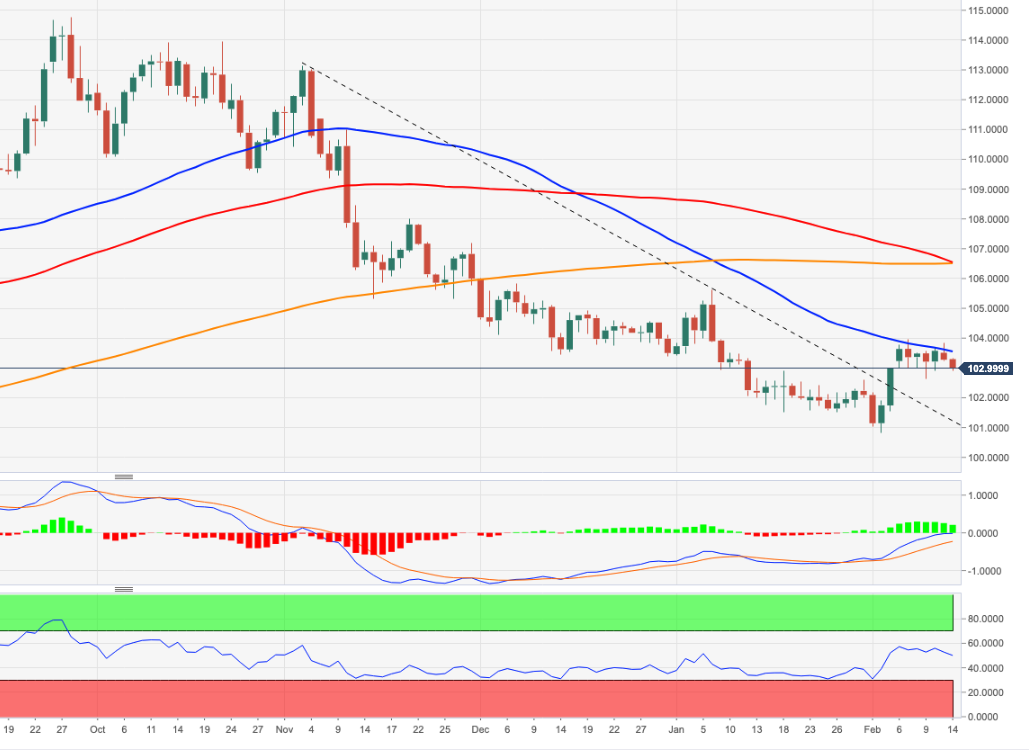
DXY adds to the bearish note recorded on Monday and puts the 103.00 support level to the test on Tuesday.

The recent price action leaves the door open to the continuation of the consolidative phase for the time being. However, a drop below last week’s low at 102.64 (February 9) should open the door to a deeper pullback in the short term to, initially, the 3-month support line, today near 102.35.

In the longer run, while below the 200-day SMA at 106.45, the outlook for the index remains negative.

DXY daily chart 
Dollar Index Spot

Overview
Today last price103.01
Today Daily Change35
Today Daily Change %-0.26
Today daily open103.28
 
Trends
Daily SMA20102.45
Daily SMA50103.42
Daily SMA100105.97
Daily SMA200106.73
 
Levels
Previous Daily High103.83
Previous Daily Low103.24
Previous Weekly High103.96
Previous Weekly Low102.64
Previous Monthly High105.63
Previous Monthly Low101.5
Daily Fibonacci 38.2%103.47
Daily Fibonacci 61.8%103.61
Daily Pivot Point S1103.06
Daily Pivot Point S2102.85
Daily Pivot Point S3102.47
Daily Pivot Point R1103.66
Daily Pivot Point R2104.05
Daily Pivot Point R3104.26

Author

Pablo Piovano

Born and bred in Argentina, Pablo has been carrying on with his passion for FX markets and trading since his first college years.

More from Pablo Piovano

Share:

Editor's Picks

AUD/USD sits near a one-month top, above 0.7000 amid fresh USD selling

AUD/USD holds above 0.7000 through the Asian session, trading near a one-month high touched earlier this Monday amid renewed US Dollar selling. US bond yields decline further amid a modest pullback in crude oil prices, capping the USD recovery from a three-week low. Moreover, bets for a November RBA rate hike support the Aussie, though upside seems capped ahead of the crucial two-day FOMC meeting, starting Tuesday.

USD/JPY struggles below 157.00 on weak USD; holds above one-month low ahead of Fed, BoJ meetings

USD/JPY attracts fresh sellers during the Asian session on Monday, stalling its recovery from the lowest level since September 18, touched Friday as a further decline in US bond yields weighs on the US Dollar. Meanwhile, the Japanese Yen benefits from a more hawkish BoJ, further weighing on the currency pair. The downside, however, seems limited as traders keenly await Fed and BoJ policy meetings later this week.

Gold sticks to modest recovery gains above $4,000 as Fed hike bets cap upside

Gold stages a modest recovery from the vicinity of a three-month low, trading above the $4,000 psychological mark through Monday’s Asian session amid a softer US Dollar. US President Donald Trump has ruled out immediate military action against Iran, triggering a modest pullback in crude oil prices. Furthermore, Federal Reserve officials have signaled no urgency to raise interest rates immediately.

Cardano's derivatives and on-chain data confirm bears in control

Cardano extends losses, trading below $0.202 after three consecutive weeks of more than 20% declines since early October. Selling pressure continues to build as weakening derivatives metrics, bearish on-chain signals and a deteriorating technical outlook point to further downside risks. Derivatives data shows a bearish bias for Cardano.

CFTC Report: WTI rally runs ahead of positioning
The week in one sentence: WTI prices surged while speculative longs were cut in the week to October 20, creating the clearest price/positioning divergence. Sterling and the Canadian Dollar led the constructive currency shift, while Yen longs also rebuilt. Speculators turned less constructive on the WTI, reducing their net exposure to around 89.3K contracts.
What November 3 means for the Fed's rate path and the US Dollar

The USD faces a decisive period ahead of the November 3 midterm elections. While markets anticipate another interest rate increase from the Fed in December, the battle for control of Congress could reshape fiscal policy expectations and, indirectly, the path of US monetary policy in 2027.
















