|

USD/CHF technical analysis: 4H 100MA, 2-week-old support-zone limit immediate declines

  • USD/CHF extends Thursday’s downpour, nears short-term key supports.
  • An upside break of 0.9985 could recall June month highs.

Given the failure to rise past-0.9980/85 area, USD/CHF carries the previous day’s declines while trading around 0.9913 ahead of the Europe markets open on Friday.

The bearish signal from 12-bar moving average convergence and divergence (MACD) indicates brighter chances of pair’s further declines to 100-bar moving average on the four-hour chart, at 0.9900 now, followed by a two-week-old rising trend-line near 0.9890.

Should sellers refrain from respecting immediate support-line, 38.2% Fibonacci retracement of August-September upside, at 0.9860, and a month-long ascending trend-line close to 0.9835 will be on the bears’ radar.

Alternatively, 0.9950 and 0.9980/85 holds the key to pair’s rally towards early-June tops surrounding 1.0020, adjacent to mid-May bottoms nearing 1.0050.

USD/CHF 4-hour chart
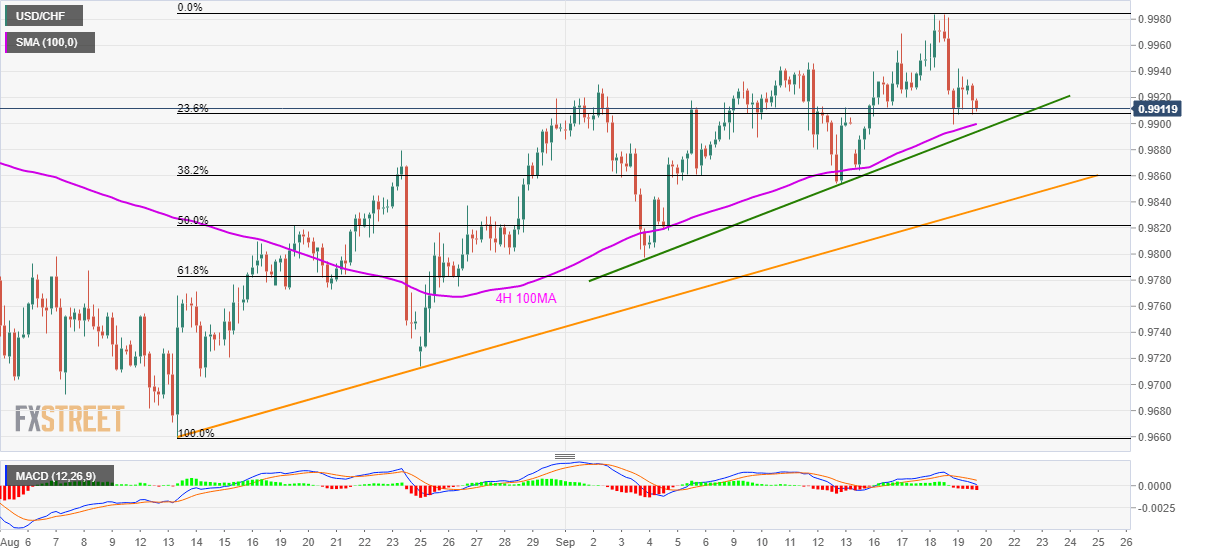
Trend: pullback expected

additional important levels

Overview
Today last price0.9913
Today Daily Change-15 pips
Today Daily Change %-0.15%
Today daily open0.9928
 
Trends
Daily SMA200.9879
Daily SMA500.9844
Daily SMA1000.9909
Daily SMA2000.995
 
Levels
Previous Daily High0.9984
Previous Daily Low0.9899
Previous Weekly High0.9947
Previous Weekly Low0.9854
Previous Monthly High0.9976
Previous Monthly Low0.9659
Daily Fibonacci 38.2%0.9931
Daily Fibonacci 61.8%0.9952
Daily Pivot Point S10.989
Daily Pivot Point S20.9852
Daily Pivot Point S30.9805
Daily Pivot Point R10.9975
Daily Pivot Point R21.0022
Daily Pivot Point R31.006

Author

Anil Panchal

Anil Panchal

FXStreet

Anil Panchal has nearly 15 years of experience in tracking financial markets. With a keen interest in macroeconomics, Anil aptly tracks global news/updates and stays well-informed about the global financial moves and their implications.


More from Anil Panchal
Share:

Editor's Picks

AUD/USD bounces back toward 0.6950 on fresh USD supply

AUD/USD bounces back toward 0.6950 in the Asian session on Friday. The US Dollar retreats from 17-month highs as traders take profits off the table ahead of the all-important US Nonfarm Payrolls report. Meanwhile, the Australian Dollar draws support from reviving expectations of a November interest rate hike amid elevated global yields and inflation risks.


USD/JPY struggles near 158.00 as USD retreats ahead of NFP

USD/JPY is struggling for fresh impetus near 158.00, moving away from the top end of its weekly range in the Asian session on Friday, after hotter-than-expected Tokyo CPI and amid a broad US Dollar retreat. Traders reposition themselves ahead of US Nonfarm Payrolls.

Gold fades the earlier optimism; back below $4,200

Gold could not sustain the post-NFP bull run past the $4,200 mark per troy ounce, receding toward the $4,180 region at the end of the week. The precious metal’s inconclusive price action comes amid fresh selling pressure hurting the US Dollar as investors assess the latest NFP data.

Week ahead: Fed minutes in the spotlight amid bond market rout
The first full week of October and the final quarter of the year get underway with little fanfare in terms of the economic agenda. But far from being short on excitement, the coming week will test market nerves, as government bond yields continue to soar on growing worries that the energy crisis will only get worse, fuelling inflation.
CFTC Report: Speculators turn more defensive as Oil exposure falls
The week in one sentence: During the week leading up to September 29, long positions in crude oil were significantly reduced, while short positions in the Canadian Dollar went up. In addition, the positioning of the Australian Dollar and the Japanese Yen declined, while Coffee buying stood out against a more general background of defensiveness.
The Euro is near a one-year low: Inflation could trigger its rebound, not its fall

EUR/USD has fallen to its lowest level since May 2025. The pair hit 1.1312 on Wednesday and trades well below the January peak of 1.2082. The decline reflects a powerful combination of US Dollar strength, geopolitical uncertainty and renewed concerns about Europe's exposure to higher energy prices.















