Breaking: Bank of England cuts policy rate by 25 bps to 3.75% as expected

The Bank of England announced on Thursday that it lowered the policy rate by 25 basis-points (bps) to 3.75% following the December meeting. This decision came in line with the market expectation. BoE Governor Andrew Bailey voted in favor of the rate cut, and the decision was taken via a 5 vs 4 split.
Follow our live coverage of the Bank of England rate decision and the market reaction.
Key takeaways from BoE policy statement
"We still think rates are on gradual downward path."
"But with every cut, how much further we go becomes closer call."
"Staff forecast zero growth in Q4 GDP (November forecast: +0.3% QQ), underlying growth around 0.2% QQ."
"Inflation now expected to fall back towards target more quickly in near term."
"Budget likely to cut inflation in April 2026 by around 0.5 percentage points."
"Budget likely to push inflation by around 0.1-0.2 percentage points in 2027, 2028."
"Inflation expected to ease in Q1 2026 to around 3%, closer to 2% in Q2."
"Expect inflation to rise temporarily in December 2025 due to tobacco duty and airfares."
"Budget could increase GDP by around 0.1%-0.2% over next couple years, fiscal tightening to weigh after three year horizon."
"Judgments around further policy easing will become a closer call."
"On the basis of current evidence, bank rate is likely to continue on a gradual downward path."
"Restrictiveness of monetary policy has fallen as bank rate has been reduced."
"Data on inflation persistence generally encouraging, continue to be risks in both directions."
"Most labour market data do not suggest rapid opening of slack."
"Uncertainty over estimate of neutral rate could make further easing a closer call for Monetary Policy Committee members."
Market reaction to BoE policy decisions
GBP/USD recovered from session lows with the immediate reaction and was last seen rising 0.1% on the day at 1.3386.
Pound Sterling Price Today
The table below shows the percentage change of British Pound (GBP) against listed major currencies today. British Pound was the strongest against the Euro.
| USD | EUR | GBP | JPY | CAD | AUD | NZD | CHF | |
|---|---|---|---|---|---|---|---|---|
| USD | 0.16% | -0.05% | 0.06% | -0.00% | -0.08% | 0.13% | -0.09% | |
| EUR | -0.16% | -0.22% | -0.11% | -0.15% | -0.24% | -0.04% | -0.25% | |
| GBP | 0.05% | 0.22% | 0.13% | 0.04% | -0.03% | 0.18% | -0.04% | |
| JPY | -0.06% | 0.11% | -0.13% | -0.06% | -0.13% | 0.05% | -0.14% | |
| CAD | 0.00% | 0.15% | -0.04% | 0.06% | -0.07% | 0.13% | -0.08% | |
| AUD | 0.08% | 0.24% | 0.03% | 0.13% | 0.07% | 0.21% | -0.01% | |
| NZD | -0.13% | 0.04% | -0.18% | -0.05% | -0.13% | -0.21% | -0.22% | |
| CHF | 0.09% | 0.25% | 0.04% | 0.14% | 0.08% | 0.01% | 0.22% |
The heat map shows percentage changes of major currencies against each other. The base currency is picked from the left column, while the quote currency is picked from the top row. For example, if you pick the British Pound from the left column and move along the horizontal line to the US Dollar, the percentage change displayed in the box will represent GBP (base)/USD (quote).
This section below was published as a preview of the Bank of England (BoE) policy announcements at 05:00 GMT.
- The Bank of England is expected to cut its bank rate to 3.75% from the current 4%.
- The latest data shows weak GDP growth, with unemployment rising and inflation cooling.
- GBP/USD retreated sharply after UK inflation fell by more than expected in November.
The Bank of England (BoE) will announce its last monetary policy decision of 2025 on Thursday at 12:00 GMT.
The market prices a 25-basis-point rate cut, which would leave the BoE’s Bank Rate at 3.75%. The BoE Governor Andrew Bailey will not meet the press this time, but the bank will publish the meeting minutes, which contain details of the committee’s discussions.
Previous monetary policy meetings have shown a widely divided committee, and Thursday’s is likely to be another knife-edge decision. This time, however, the moderating inflation and the weaker economic outlook are likely to prompt Governor Bailey to tip the scales towards a rate cut.
UK labour market deteriorates, price pressures ease
The Bank of England left its benchmark interest rate unchanged at 4% at its November 6 meeting amid an evenly split monetary policy committee, with four members voting for a quarter-point rate cut, and Bailey’s voice deciding.
Governor Bailey affirmed that the risk that above-target inflation becomes more persistent has prevailed, despite policymakers’ concerns that an over-restrictive policy might weigh on consumption and damage economic activity.
Recent data, however, might have convinced the BoE Governor that it is time to lower borrowing costs further.
UK Consumer Price Index (CPI) figures released on Wednesday revealed that inflationary pressures eased beyond expectations amid a significant slowdown in food prices. The yearly CPI grew by 3.2% in November, easing from 3.6% in October and 3.8% in September.
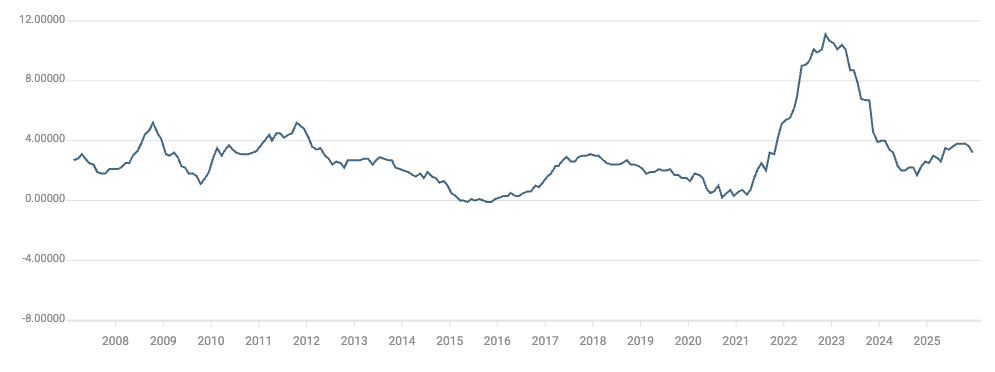
Beyond that, labour data released on Tuesday confirmed that unemployment keeps growing, while wage growth is moderating. Average Earnings Including Bonus grew at a 4.7% pace in the three months to October, above expectations but below the previous months’ rates, while the unemployment rate increased to 5.1%, the highest level in nearly five years.
The UK Gross Domestic Product (GDP) report released last week revealed that the economy contracted for the second consecutive month in November, weighed down by weak services and construction output. Figures released in November showed that the UK economy slowed to a 0.2% growth in the third quarter from 0.3% in the second.
On the positive side, preliminary Purchasing Managers Index (PMI) figures showed that business activity improved beyond expectations in December in both the manufacturing and the services sectors. These figures have eased concerns about a sharp economic downturn, but are unlikely to change BoE policymakers’ votes.
How will the BoE interest rate decision impact GBP/USD?
Against this background, the market anticipates that the BoE committee will overcome its divergences and cut interest rates to 3.75% on Thursday to support a weakening economic growth.
The market’s focus will thus be on the vote split among MPC members. A lower number of voters calling for a steady monetary policy would be taken as a dovish turn, and might boost hopes of further rate cuts in the near term. This is likely to send the Pound lower.
An evenly split committee, with Bailey keeping the tie-breaking vote again, suggests that the chances of further rate cuts in the near term are likely to remain low, which might provide some support for the Sterling.
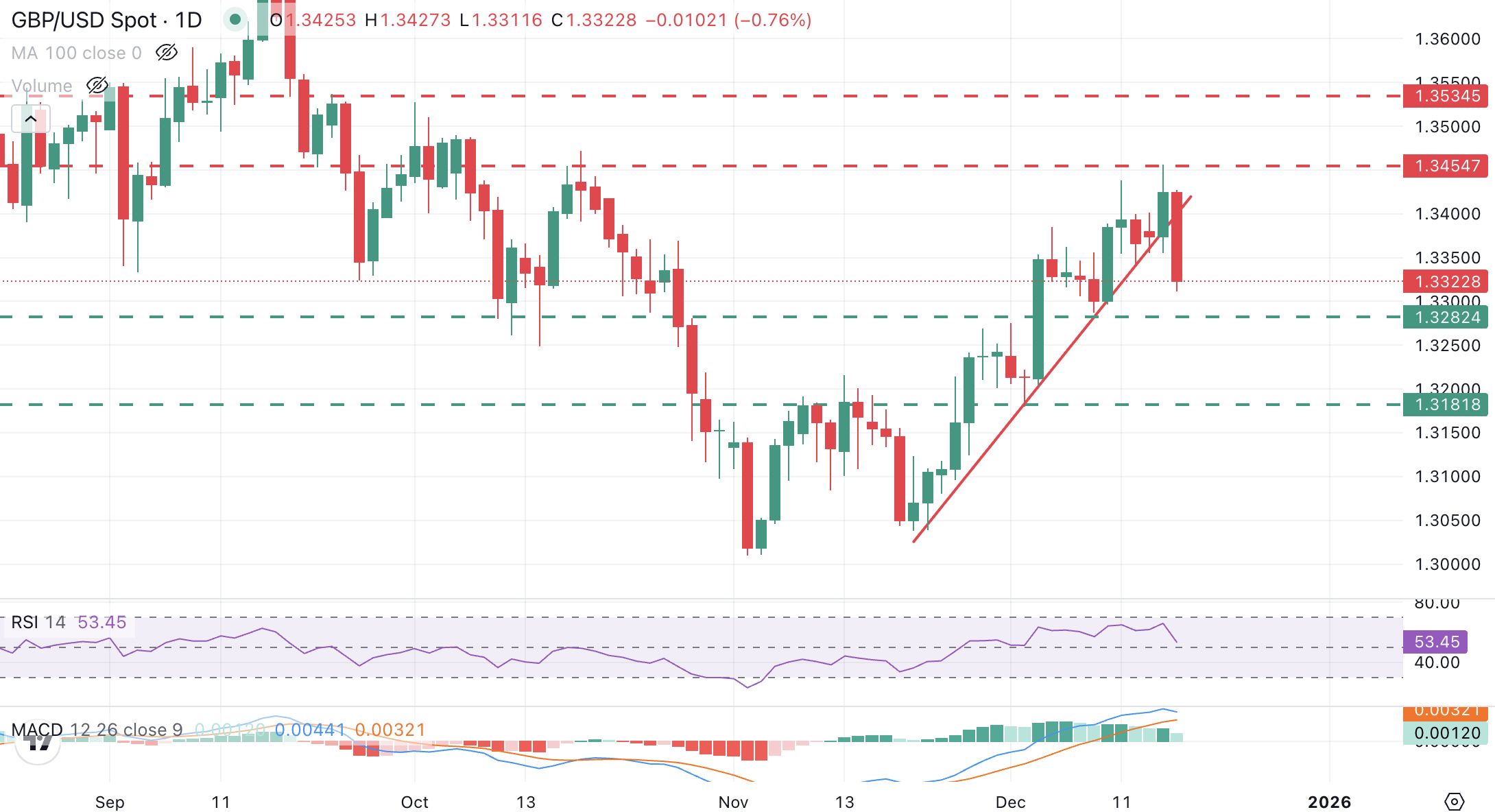
The current technical picture shows a bullish GBP/USD heading into the BoE’s decision, favoured by a broad-based US Dollar weakness, as investors expect the US Federal Reserve (Fed) to ease interest rates further than the BoE in 2026.
“GBP/USD retreated sharply on Wednesday as the market braces for a BoE cut on Thursday,” says Guillermo Alcalá, FX Analyst at FXStreet. The pair is under increasing bearish pressure, targeting the December 9 low near 1.3280 and the December 2 low at 1.3180.
On the upside, Alcalá sees potential resistance at the broken trendline near the mentioned 1.3400 area ahead of the December 16 high at 1.3455. “The pair would need to confirm above those levels to ease bearish pressure and shift the focus towards the late September-early October highs, near the 1.3535 level”, says Alcalá.
Pound Sterling FAQs
The Pound Sterling (GBP) is the oldest currency in the world (886 AD) and the official currency of the United Kingdom. It is the fourth most traded unit for foreign exchange (FX) in the world, accounting for 12% of all transactions, averaging $630 billion a day, according to 2022 data. Its key trading pairs are GBP/USD, also known as ‘Cable’, which accounts for 11% of FX, GBP/JPY, or the ‘Dragon’ as it is known by traders (3%), and EUR/GBP (2%). The Pound Sterling is issued by the Bank of England (BoE).
The single most important factor influencing the value of the Pound Sterling is monetary policy decided by the Bank of England. The BoE bases its decisions on whether it has achieved its primary goal of “price stability” – a steady inflation rate of around 2%. Its primary tool for achieving this is the adjustment of interest rates. When inflation is too high, the BoE will try to rein it in by raising interest rates, making it more expensive for people and businesses to access credit. This is generally positive for GBP, as higher interest rates make the UK a more attractive place for global investors to park their money. When inflation falls too low it is a sign economic growth is slowing. In this scenario, the BoE will consider lowering interest rates to cheapen credit so businesses will borrow more to invest in growth-generating projects.
Data releases gauge the health of the economy and can impact the value of the Pound Sterling. Indicators such as GDP, Manufacturing and Services PMIs, and employment can all influence the direction of the GBP. A strong economy is good for Sterling. Not only does it attract more foreign investment but it may encourage the BoE to put up interest rates, which will directly strengthen GBP. Otherwise, if economic data is weak, the Pound Sterling is likely to fall.
Another significant data release for the Pound Sterling is the Trade Balance. This indicator measures the difference between what a country earns from its exports and what it spends on imports over a given period. If a country produces highly sought-after exports, its currency will benefit purely from the extra demand created from foreign buyers seeking to purchase these goods. Therefore, a positive net Trade Balance strengthens a currency and vice versa for a negative balance.
Author

FXStreet Team
FXStreet
Composed of a group of economic journalists and FX experts, the FXStreet content team produces and oversees all content published on FXStreet. It provides a purely journalistic approach to the Forex market.