USD/CHF rebounds on hawkish Fed stance and upbeat US economic data
- USD/CHF gains as US Retail Sales support a hawkish Fed stance.
- Expectations that the Fed will cut rates in September decline, central bank divergence supports USD/CHF strength.
- USD/CHF eyes further gains as bearish momentum fades above 0.8000

The US Dollar (USD) is firming against the Swiss Franc (CHF) as upbeat US economic data and hawkish Federal Reserve (Fed) comments support demand for US yields.
Retail Sales data on Thursday reflected an increase in consumer spending for June, coming in at 0.6%, above the expected 0.1% rise.
The upside surprise in spending, despite tariff uncertainty and high interest rates, has provided a glimmer of hope for the US economy.
As the Federal Reserve continues to express concern over the potential impact of tariffs on inflation, this data, combined with a strong labour market, reflects a resilient economy.
However, as the August tariff deadline looms, downside risks remain. Higher tariffs on imports to the US remain a major concern for investors and policymakers alike. An increase in these levies is expected to increase costs for producers, raising the potential that these costs will be passed on to consumers.
Expectations that the Fed will cut rates in September decline, central bank divergence supports USD/CHF strength
Although the interest rate differentials are largely priced in, improved risk sentiment has also pushed out expectations of a rate cut in September.
According to the CME FedWatch Tool, the probability of a 25 basis point rate cut in September is now sitting at 52.7% , down from 65.4% this time last week. Meanwhile, the likehood that rates will remain at current levels at the same meeting has climbed to 46.0%, increasing from 29.7%.
Fed Governor Adriana Kugler's comments on Thursday reinforced the hawkish narrative, saying that monetary policy should remain restrictive for "some time." The main objective for the majority of Fed members is to ensure that inflation returns to the objective target of 2%, keeping price pressures constrained.
USD/CHF eyes further gains as bearish momentum fades above 0.8000
The USD/CHF daily chart is currently displaying signs of a short-term bullish reversal following a sustained downtrend.
Price action has recently broken above both the 20-day Simple Moving Average (SMA) at 0.7995, recovering above the 0.8000 psychological level and the 23.6% Fibonacci retracement level of the May-July decline at 0.8015.
This move is supported by a strengthening Relative Strength Index (RSI), which has risen above the 50 threshold, indicating a shift in momentum from bearish to neutral.
USD/CHF daily chart
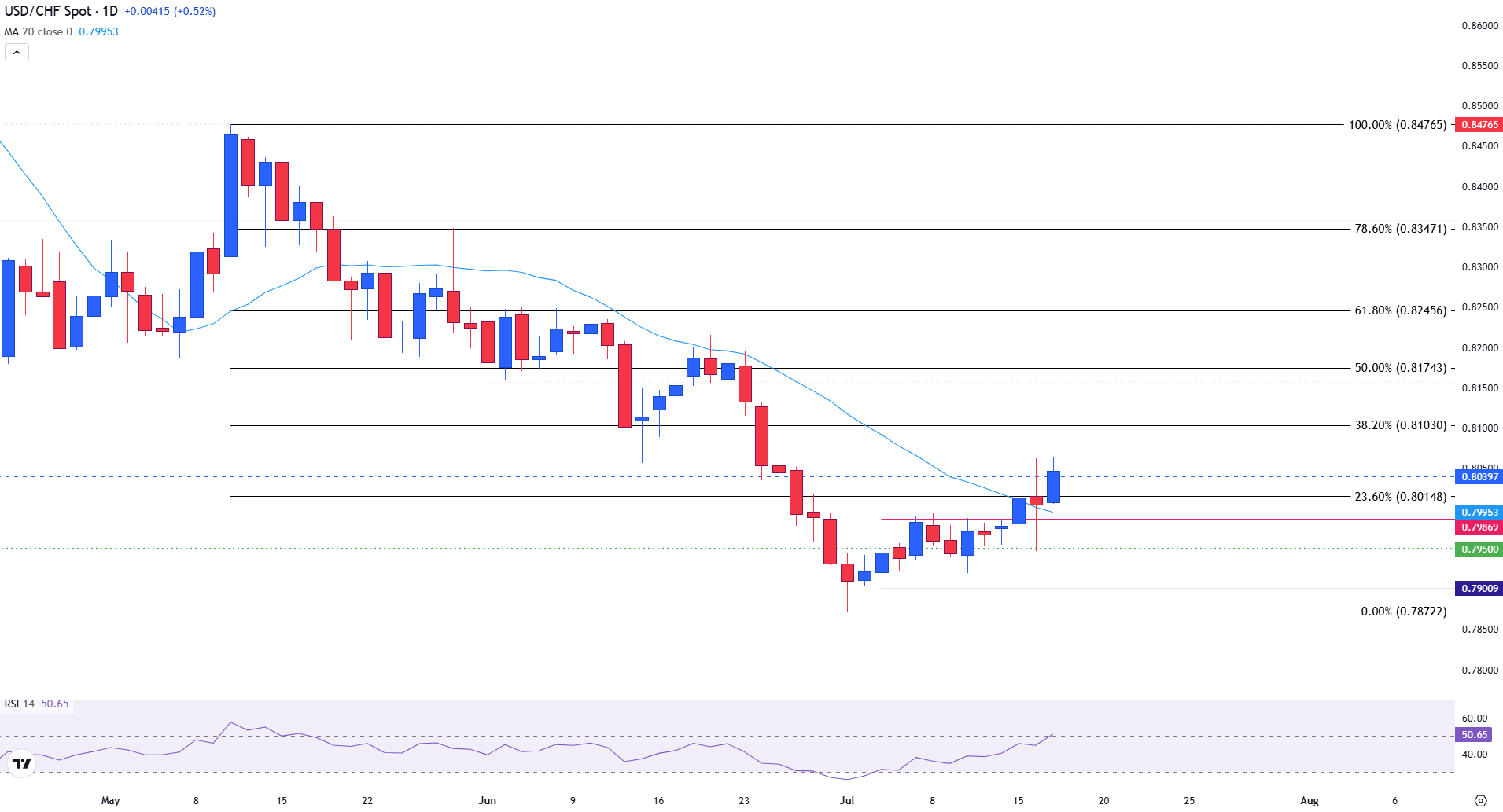
The next immediate resistance lies at the 38.2% Fibonacci retracement level near 0.8103, which may act as a short-term target for buyers. If this level is cleared, further upside toward the 50% and 61.8% retracement levels at 0.8174 and 0.8246, respectively, becomes more plausible.
On the downside, support is now seen at the previous resistance zone around 0.7995, with stronger support at 0.7950. A sustained move below these levels would invalidate the current bullish setup. Overall, the chart structure suggests a potential short-term upward continuation, provided the pair maintains support above the 0.7995–0.7950 range.
Interest rates FAQs
Interest rates are charged by financial institutions on loans to borrowers and are paid as interest to savers and depositors. They are influenced by base lending rates, which are set by central banks in response to changes in the economy. Central banks normally have a mandate to ensure price stability, which in most cases means targeting a core inflation rate of around 2%. If inflation falls below target the central bank may cut base lending rates, with a view to stimulating lending and boosting the economy. If inflation rises substantially above 2% it normally results in the central bank raising base lending rates in an attempt to lower inflation.
Higher interest rates generally help strengthen a country’s currency as they make it a more attractive place for global investors to park their money.
Higher interest rates overall weigh on the price of Gold because they increase the opportunity cost of holding Gold instead of investing in an interest-bearing asset or placing cash in the bank. If interest rates are high that usually pushes up the price of the US Dollar (USD), and since Gold is priced in Dollars, this has the effect of lowering the price of Gold.
The Fed funds rate is the overnight rate at which US banks lend to each other. It is the oft-quoted headline rate set by the Federal Reserve at its FOMC meetings. It is set as a range, for example 4.75%-5.00%, though the upper limit (in that case 5.00%) is the quoted figure. Market expectations for future Fed funds rate are tracked by the CME FedWatch tool, which shapes how many financial markets behave in anticipation of future Federal Reserve monetary policy decisions.
Author

Tammy Da Costa, CFTe®
FXStreet
Tammy is an economist and market analyst with a deep passion for financial markets, particularly commodities and geopolitics.