|

USD/CHF Price Analysis: Consolidates around 200-DMA as bears moved in

  • USD/CHF holds near 0.8939, minimal losses despite weaker US producer inflation data.
  • Technical outlook: Pair remains neutral to upward biased, consolidating around the 200-DMA at 0.8896.
  • Key levels: Support at 0.8800 and 0.8729; resistance at June 11 high of 0.8993 and 50-DMA at 0.9069.

The USD/CHF was subdued on Thursday, yet minimal losses of 0.06% were printed following the release of the softer US producer inflation report. The Greenback’s losses were capped by the Federal Reserve’s decision to hold rates and project one rate cut, as the disinflation process had stalled. The pair trades at 0.8939 at the time of writing.

USD/CHF Price Analysis: Technical outlook

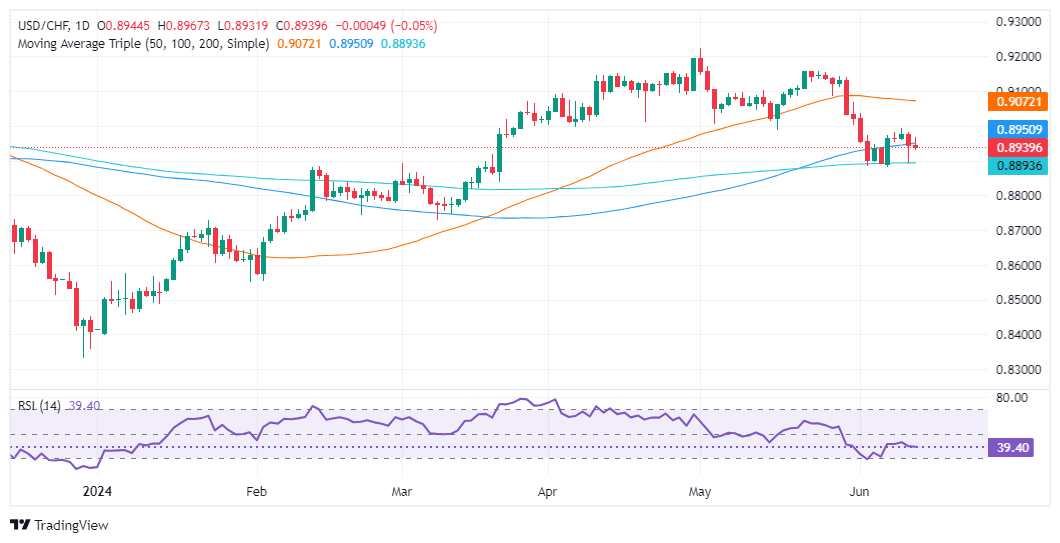
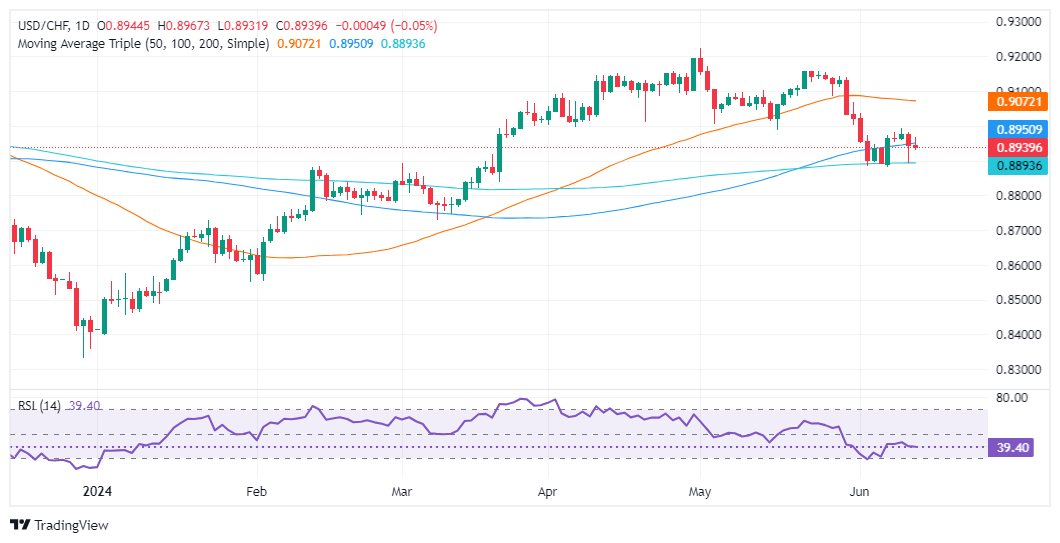
The daily chart portrays the pair as neutral to upward biased, yet it remains consolidated at around the 200-day moving average (DMA) at 0.8896.

Momentum favors sellers, but they take a respite as they push the USD/CHF below the 200-DMA. Once cleared, the next support would be the 0.8800 figure, followed by the March 8 cycle low of 0.8729.

Conversely. If USD/CHF pushes back above the June 11 high of 0.8993, that would exacerbate a rally past the 0.9000 figure. The next resistance level would be the 50-DMA at 0.9069.

USD/CHF Price Action – Daily Chart
USD/CHF

Overview
Today last price0.894
Today Daily Change-0.0004
Today Daily Change %-0.04
Today daily open0.8944
 
Trends
Daily SMA200.904
Daily SMA500.9074
Daily SMA1000.8948
Daily SMA2000.8894
 
Levels
Previous Daily High0.8984
Previous Daily Low0.8893
Previous Weekly High0.9036
Previous Weekly Low0.8881
Previous Monthly High0.9225
Previous Monthly Low0.8988
Daily Fibonacci 38.2%0.8928
Daily Fibonacci 61.8%0.8949
Daily Pivot Point S10.8897
Daily Pivot Point S20.885
Daily Pivot Point S30.8807
Daily Pivot Point R10.8988
Daily Pivot Point R20.9031
Daily Pivot Point R30.9078

Author

Christian Borjon Valencia

Markets analyst, news editor, and trading instructor with over 14 years of experience across FX, commodities, US equity indices, and global macro markets.


More from Christian Borjon Valencia
Share:

Editor's Picks

EUR/USD bears Flirt with 61.8% Fibo. support near 1.1775 area

The EUR/USD pair extends the previous day's late pullback from the 1.1835 region and attracts some follow-through selling during the Asian session on Tuesday. Spot prices currently trade around the 1.1775-1.1770 area, down nearly 0.15% for the day amid a modest US Dollar strength.

GBP/USD holds losses below 1.3500 due to BoE rate cut bets

GBP/USD edges lower after two days of gains, trading around 1.3480 during the Asian hours on Tuesday. The pair declines as the US Dollar rebounds from losses recorded over the previous two sessions. Traders will focus on the US ADP Employment Change four-week average later in the day, along with speeches from Federal Reserve officials.

Gold down but not out as key $5,140 support holds

Gold consolidates the advance to monthly top of $5,250 in Tuesday’s Asian trades. The US Dollar finds demand as liquidity returns and risk sentiment recovers, despite US tariffs uncertainty. Gold defends 61.8% Fibo resistance at $5,142 amid the pullback, daily RSI remains bullish.

Dogecoin, Shiba Inu, and Pepe extend losses on bearish signals

Meme coins are facing renewed selling pressure amid fading broad risk-on sentiment so far this week, with Dogecoin, Shiba Inu, and Pepe extending their losses after recent corrections.

Supreme Court nixes tariffs, Trump teases 15% global tariff

On February 20th, the Supreme Court ruled that Trump’s global tariffs under IEEPA authority were unconstitutional, effectively nullifying the framework. However, the relief was short-lived. Within hours, Trump floated a 15% blanket tariff under an alternative legal authority.

XRP recovers slightly as bearish sentiment dominates crypto market

Ripple is rising above $1.40 at the time of writing on Monday amid fresh tariff-triggered headwinds in the broader cryptocurrency market. The sell-off to $1.33, the token’s intraday low, can be attributed to macroeconomic uncertainty, geopolitical tensions and risk-averse sentiment among other factors.