USD/CAD struggles as Oil bulls retreat, US Dollar dribbles ahead of United States, Canadian Employment data
- USD/CAD remains indecisive after two-day downtrend, defends weekly gains.
- Federal Reserve policymakers’ dovish bias, softer United States data weigh US Dollar.
- Chatters surrounding China, Oil price cap on Russian exports test WTI bulls.
- Downbeat expectations from Canada, United States employment report tease Canadian Dollar buyers.

USD/CAD portrays the market’s indecision ahead of the monthly employment data from the United States and Canada during early Friday. In doing so, the Canadian Dollar fails to justify the retreat in the WTI crude oil, Canada’s key export item, amid a lackluster US Dollar. That said, the Loonie pair seesaws around 1.3430 by the press time, after a two-day downtrend.
Even if the USD/CAD pair remains inactive as of late, the hopes of slower rate hikes from the Federal Reserve (Fed) contrasts with the recently hawkish bias surrounding the Bank of Canada (BOC) to keep the bears hopeful. It’s worth noting that the looming Oil price cap from the Group of Seven (G7) nations and recovery in China’s Covid conditions hint at the further firming of Canada’s key earner, which in turn could weigh on the Loonie pair.
Federal Reserve policymakers contrast with Bank of Canada officials to favor USD/CAD bears
The dovish bias of the Federal Reserve (Fed) Chairman Jerome Powell, as well as downbeat comments from US Treasury Secretary Janet Yellen, initially raised hopes of easy rate hikes. Following that, Federal Reserve (Fed) Governor Michelle Bowman stated that (It is) appropriate for us to slow the pace of increases. Before him, Fed Governor Jerome Powell also teased the slowing of a rate hike while US Treasury Secretary Yellen also advocated for a soft landing. Further, Vice Chair of supervision, Michael Barr, also said, “We may shift to a slower pace of rate increases at the next meeting.” It’s worth noting that the recent comments from New York Fed’s John Williams seemed to have tested the US Dollar bears as the policymakers stated that the Fed has a ways to go with rate rises.
On the other hand, Bank of Canada (BOC) Governor Tiff Macklem testified in late November while saying, “We expect our policy rate will need to rise further.” Additionally, BOC’s Senior Deputy Governor Carolyn Rogers said, “It will take time to get back to solid growth with low inflation but we will get there.”
Differences between United States and Canada data also weigh on Loonie pair
On Thursday, United States Core Personal Consumption Expenditures (PCE) Price Index, the Federal Reserve’s preferred inflation gauge, matched 5.0% market forecasts on YoY but eased to 0.2% MoM versus 0.3% expected. Further, US ISM Manufacturing PMI for November eased to 49.0 versus 49.7 expected and 50.2 prior.
Earlier in the week, the US ADP Employment Change marked the lowest readings since January 2021 with 127K figure for November versus 200K forecast and 239K previous readings. Further, the second estimate of the US Gross Domestic Product (GDP) Annualized for the third quarter (Q3) marked 2.9% growth versus 2.6% initial forecasts.
Talking about Canada, Labor Productivity jumped to 0.6% in the third quarter (Q3) versus -0.1% expected and 0.1% prior (revised). Further, S&P Global Manufacturing PMI for November increased to 49.6 from 49.3 market expectations and 48.8 prior. Previously, Canada’s Gross Domestic Product Annualized for the third quarter (Q3) eased to 2.9% versus 3.5% expected and 3.2% (revised down) prior.
Oil buyers stay hopeful
WTI crude oil remains on the bull’s radar despite the latest retreat to $81.00. The reason could be linked to the comments from the Group of Seven Nations (G7) Price Cap Coalition, as well as hopes for China’s economic recovery.
Late on Thursday, Reuters quoted an Official from the G7 Price Cap Coalition as saying, “We are 'very very close' to agreement on $60-a- barrel price cap on Russian oil exports.” The diplomat also showed optimism about agreeing on refined products price cap by February 5.
Further, the consecutive three days of the downtrend of Chinese daily Covid infections from a record high allowed the policymakers to tease the “next stage” in battling the virus while announcing multiple easing of the activity-control measures.
Additionally, a likely inaction at this week’s meeting of the Organization of the Petroleum Exporting Countries and allies including Russia, known as OPEC+.
Considering Canada’s reliance on reliance on Crude Oil exports and likely hardships for the black gold supplies, as well as improvement in demand, the USD/CAD pair may witness further downside.
United States, Canada job numbers are the key
Given the likely downbeat outcome from both the Canadian and United States employment data, USD/CAD pair traders may try to find greater details and could react with more aggression in case of a surprise outcome.
That said, the headline US Nonfarm Payrolls (NFP) is likely to ease with a 200K print versus 261K prior while the Unemployment Rate could remain unchanged at 3.7%. It should be noted that a likely easing in the Average Hourly Earnings for the stated month could also weigh on the USD/CAD price.
On the other hand, Canada’s Net Change in Employment may decline to 5K versus 108.3K prior while the Unemployment Rate could increase to 5.3% from 5.2% previous readings.
USD/CAD technical analysis
Despite the latest inaction, the USD/CAD pair portrays a clear U-turn from the 50-DMA, as well as a downward-sloping resistance line from October 13, currently joining each other around 1.3570-75.
However, a failure to break a two-week-old ascending support line, near 1.3400 by the press time, keeps the Loonie pair buyers hopeful.
Even if the quote breaks the 1.3400 support line, a convergence of the 100-DMA and an ascending trend line from August 25, close to 1.3290 at the latest, appears a tough nut to crack for the USD/CAD pair sellers.
Alternatively, a clear upside break of the 1.3570-75 resistance confluence will need validation from the recent peak of 1.3645 to convince USD/CAD bulls.
Following that, a run-up towards the 23.6% Fibonacci retracement level of the Loonie pair’s August-October upside, near 1.3680, can’t be ruled out.
It should be noted that the USD/CAD pair’s advances past 1.3680 may witness a bumpy road around 1.3840 before the bulls could aim for the yearly high marked in October around 1.3980.
Overall, USD/CAD is likely to remain sidelined with a short-term downside bias.
USD/CAD: Daily chart
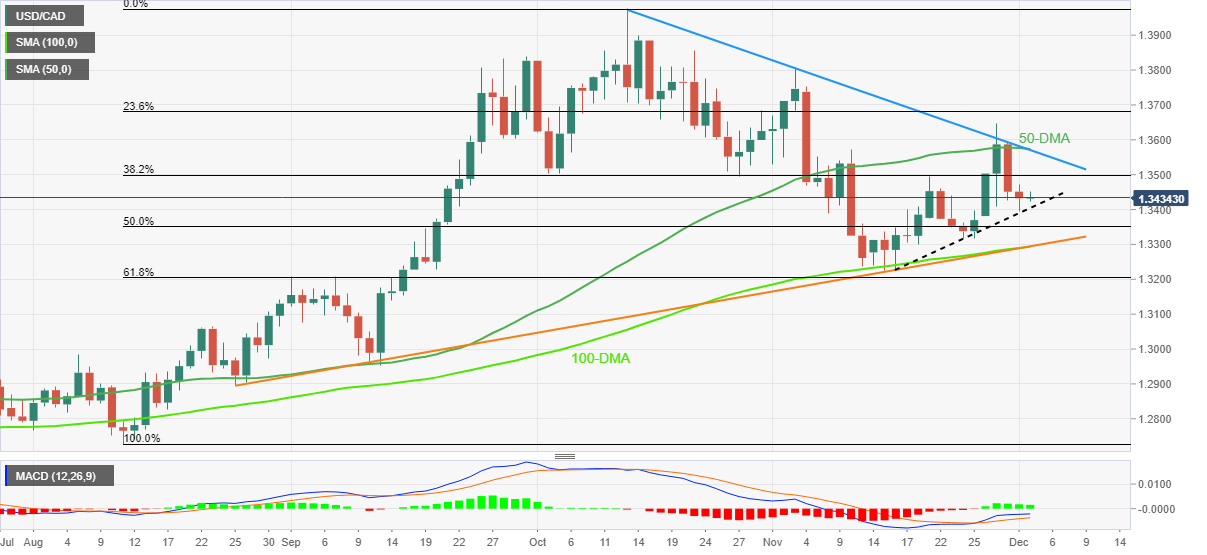
Trend: Limited downside expected
Author

Anil Panchal
FXStreet
Anil Panchal has nearly 15 years of experience in tracking financial markets. With a keen interest in macroeconomics, Anil aptly tracks global news/updates and stays well-informed about the global financial moves and their implications.
















