USD/CAD Price Forecast: Bulls might find resistance around 1.3800
- The US Dollar might struggle to extend gains above 1.3800 amid the positive market sentiment.
- The Canadian Dollar remains vulnerable following rate cuts by the Fed and the BoC.
- USD/CAD is correcting higher from a key support area above 1.3720.

The US Dollar is trading higher against the Canadian Dollar amid broad-based Greenback strength as investors digest recent rate cuts by the Fed and the BoC. The pair, however, might find resistance at 1.3800 as the moderate risk appetite weighs on the safe-haven USD.
The Federal Reserve cut rates by 25 basis points and hinted at further easing on Wednesday. Fed Chairman Powell, however, delivered a less dovish message, warning about the looming inflation and showing no rush to cut rates further, which provided some support to an ailing USD.
The Canadian Dollar, however, remains on the back foot as the Bank of Canada followed suit and cut rates to three-year lows at 2.5% amid concerns about a slowing economic growth and a deteriorating labour market.
Technical Analysis: The USD is on a bullish correction from 1.3725 lows
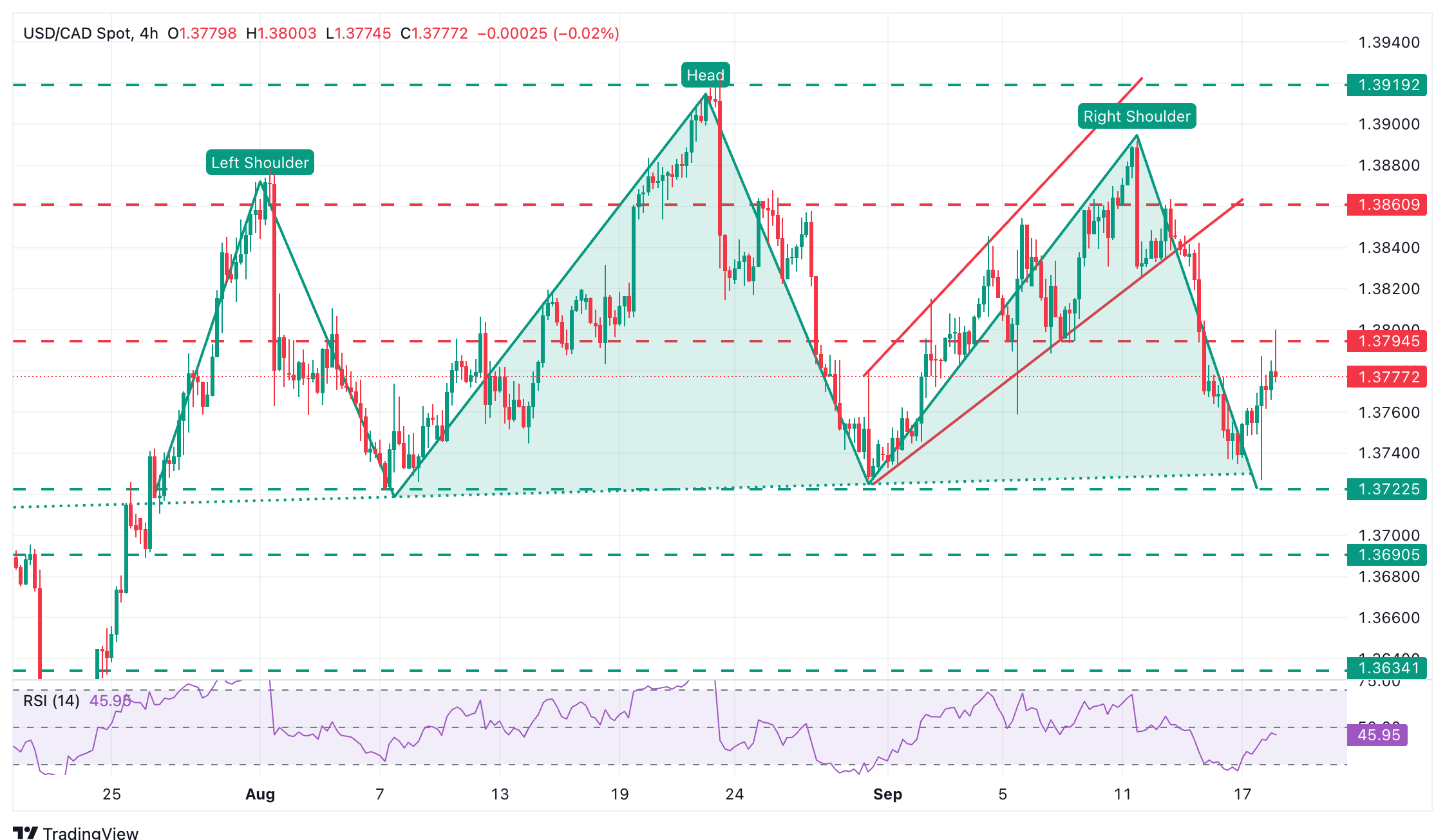
From a technical perspective, the Dollar reached the target of the broken wedge pattern at 1.3725 and is now correcting higher. Previous support at the 1,3790-1.3795 area is likely to act as resistance, with the positive market sentiment weighing on the USD’s recovery.
Further up, the next target is at the convergence of the reverse trendline with the September 12 high, at 1.3860, ahead of the September 11 high, at 1.3890.
To the downside, the 1.3720-1.3725 is a key support level (August 7, 29 lows). A clear break below here would trigger a Head and Shoulders pattern, increasing bearish pressure towards the July 28 low, at 1.3690, and the July 25 low, at 1.3635.
Bank of Canada FAQs
The Bank of Canada (BoC), based in Ottawa, is the institution that sets interest rates and manages monetary policy for Canada. It does so at eight scheduled meetings a year and ad hoc emergency meetings that are held as required. The BoC primary mandate is to maintain price stability, which means keeping inflation at between 1-3%. Its main tool for achieving this is by raising or lowering interest rates. Relatively high interest rates will usually result in a stronger Canadian Dollar (CAD) and vice versa. Other tools used include quantitative easing and tightening.
In extreme situations, the Bank of Canada can enact a policy tool called Quantitative Easing. QE is the process by which the BoC prints Canadian Dollars for the purpose of buying assets – usually government or corporate bonds – from financial institutions. QE usually results in a weaker CAD. QE is a last resort when simply lowering interest rates is unlikely to achieve the objective of price stability. The Bank of Canada used the measure during the Great Financial Crisis of 2009-11 when credit froze after banks lost faith in each other’s ability to repay debts.
Quantitative tightening (QT) is the reverse of QE. It is undertaken after QE when an economic recovery is underway and inflation starts rising. Whilst in QE the Bank of Canada purchases government and corporate bonds from financial institutions to provide them with liquidity, in QT the BoC stops buying more assets, and stops reinvesting the principal maturing on the bonds it already holds. It is usually positive (or bullish) for the Canadian Dollar.
Author

Guillermo Alcala
FXStreet
Graduated in Communication Sciences at the Universidad del Pais Vasco and Universiteit van Amsterdam, Guillermo has been working as financial news editor and copywriter in diverse Forex-related firms, like FXStreet and Kantox.