|

USD/CAD Price Analysis: On the back foot below 50-HMA, weekly resistance line

  • USD/CAD remains pressured near the lowest since January 2020.
  • Failures to cross a short-term resistance confluence favor sellers.
  • 200-HMA adds to the upside barriers for the bulls’ entry.
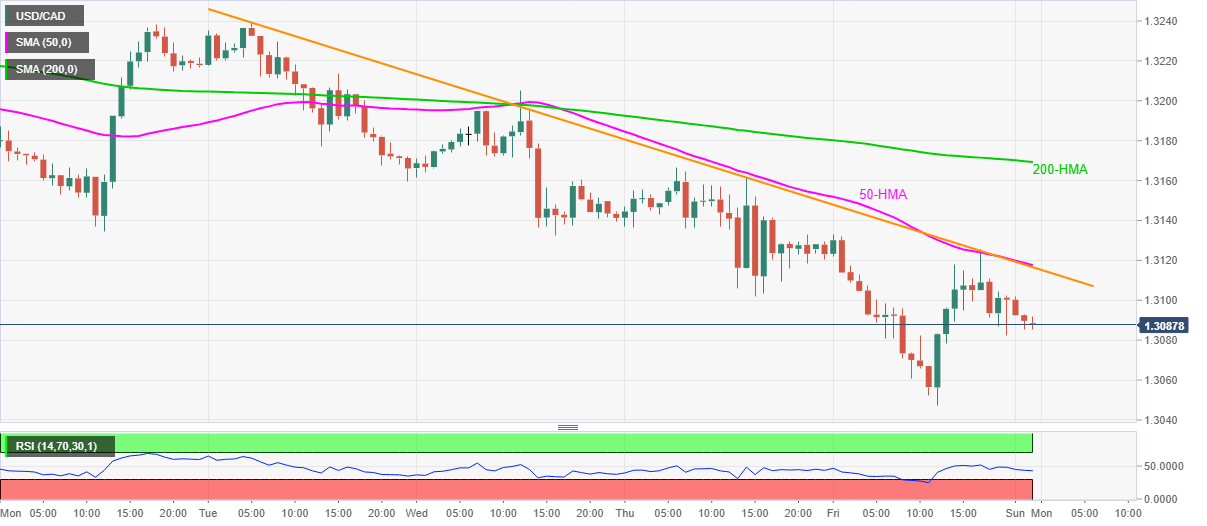
USD/CAD drops to 1.3085, down 0.10% on a day, during the pre-Tokyo open trading on Monday. In doing so, the loonie pair stays depressed for the fifth day in a row while taking rounds to the seven month low.

On Friday, the pair bounced off 1.3047, the multi-week low, but couldn’t cross a join of 50-HMA and a descending trend line from August 25.

As a result, sellers are currently targeting Friday’s low near 1.3050 before attacking the late-January bottom surrounding 1.3035/30 and the 1.3000 threshold. However, the pair’s further weakness might not refrain from attacking the yearly low surrounding 1.2950.

On the contrary, an upside break of 1.3115/20 resistance confluence will trigger the quote’s fresh rise towards a 200-HMA level of 1.3170.

Though, 1.3200 round-figures and multiple highs marked during August 20-25 can challenge the bulls beyond 200-HMA.

USD/CAD hourly chart
Trend: Bearish

Additional important levels

Overview
Today last price1.3086
Today Daily Change-14 pips
Today Daily Change %-0.11%
Today daily open1.31
 
Trends
Daily SMA201.3238
Daily SMA501.3412
Daily SMA1001.3634
Daily SMA2001.3528
 
Levels
Previous Daily High1.3133
Previous Daily Low1.3048
Previous Weekly High1.324
Previous Weekly Low1.3048
Previous Monthly High1.3646
Previous Monthly Low1.3331
Daily Fibonacci 38.2%1.308
Daily Fibonacci 61.8%1.31
Daily Pivot Point S11.3054
Daily Pivot Point S21.3008
Daily Pivot Point S31.2969
Daily Pivot Point R11.314
Daily Pivot Point R21.3179
Daily Pivot Point R31.3225

Author

Anil Panchal

Anil Panchal

FXStreet

Anil Panchal has nearly 15 years of experience in tracking financial markets. With a keen interest in macroeconomics, Anil aptly tracks global news/updates and stays well-informed about the global financial moves and their implications.


More from Anil Panchal
Share:

Editor's Picks

EUR/USD looks apathetic around 1.1770

EUR/USD comes under renewed pressure on Tuesday, deflating below the 1.1800 support and reversing two consecutive days of gains. The pair’s decline follows the persistent move higher in the US Dollar, as trade uncertainty dominates the sentiment ahead of President Trump’s SOTU speech.

GBP/USD regains 1.3500 and above

GBP/USD extends its advance for the third day in a row on Tuesday, this time retesting the area beyond the 1.3500 hurdle. Cable’s uptick comes despite decent gains in the Greenback and the dovish message from the BoE’s Bailey at the UK Parliament.

Gold appears offered around $5,150

Gold is giving back a good portion of the recent multi-day rally, receding to the $5,150 zone per troy ounce amid the decent bounce in the US Dollar and mixed US Treasuty yields. In the meantime, markets’ attention remain on upcoming comments from Fed speakers.

Ripple’s DeFi shift in focus: Navigating XRPL EVM sidechain growth, XRPFi migration and liquidity

Ripple (XRP) has continued to trade under pressure, extending its decline by approximately 63% from the record high of $3.66 in July. The remittance token is trading above support at $1.35, while its upside appears limited by key supply zones, starting with $1.40, at the time of writing on Tuesday.

The Citrini report: How a debatable AI narrative can shake Wall Street

That AI-related headline alone was enough to rattle investors.US stocks slid sharply on Monday after a widely circulated Citrini Research memo outlined a hypothetical “2028 Global Intelligence Crisis”, warning that rapid AI adoption could push US unemployment into double digits as early as by mid-2028.

XRP pressured by weak ETF flows and declining retail interest

Ripple (XRP) is edging lower, trading above its intraday low of $1.32 at the time of writing on Tuesday. The decline from its weekly opening of $1.39 reflects heightened volatility in the broader cryptocurrency market, accentuated by tariff-triggered uncertainty.