US yields slide as Japan’s signal shift in debt strategy
- US 10-year yield drops 6 bps to 4.448% as bond auctions attract strong demand.
- Japan’s Ministry of Finance surveys the market amid concern over long-end yield spikes.
- The market is eying $70B five-year and $44B seven-year note auctions later this week.

US Treasury yields fall across the whole curve due to concerns over an increase in global government debt supply, which sent yields rising last week, and retraced somewhat on expectations that Japan could begin issuing short-term debt.
Treasury yields retreat as Japan mulls debt issuance changes; solid two-year auction calms supply-driven rate jitters
Global yields were pressured as Japan's Ministry of Finance sent a questionnaire to market participants on Monday asking for their views on issuance and the current market situation, according to Bloomberg.
The jump in yields in the long-end of the curve keeps the Japanese government worried, after the yield on 20-year notes reached historical highs last week.
Debt auctions of US Treasuries were well received by market participants. According to Reuters, “The two-year auction hit a high yield of 3.955%, about nine basis points below the market at the time of the bidding deadline.”
The US Treasury sold $69 billion in two-year notes, marking the first of three auctions this week. Further auctions lie ahead, with the Treasury projected to issue $70 billion of five-year notes and $44 billion of seven-year notes, due respectively on Wednesday and Thursday.
In the meantime, yields on US debt retreated considerably on Tuesday. The US 2-year T-note yield, the most sensitive to interest rate changes, fell one and a half basis points.
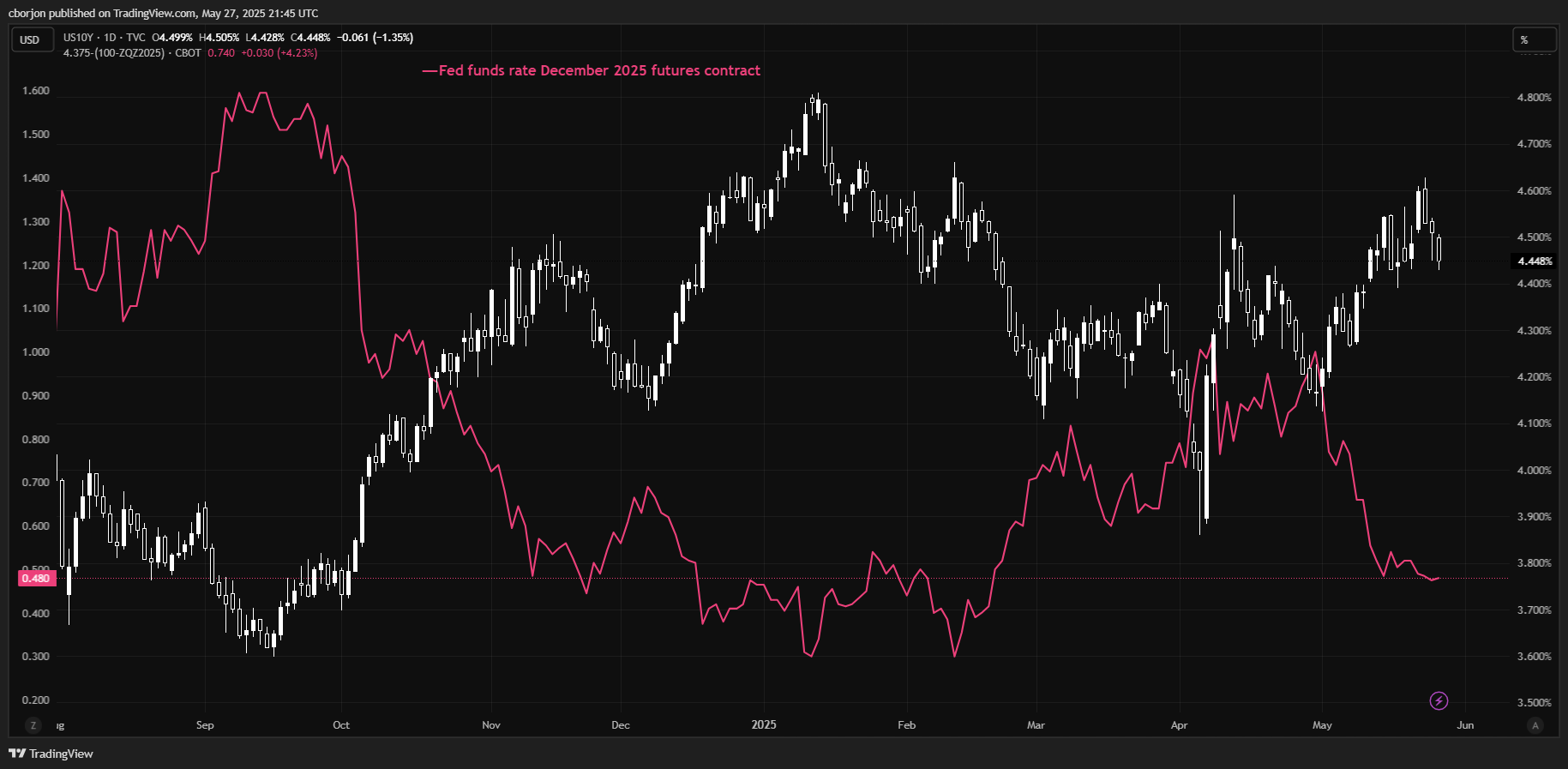
The US 10-year Treasury note yield fell six bps to 4.448%, even though market participants remaining skeptical that the Federal Reserve would lower rates in the first half of the year. The first-rate cut is expected for September, after the Jackson Hole Symposium in August.
US Consumer Confidence data improved in May, as revealed by the Conference Board (CB). Durable Goods Orders in April plunged -6.3% MoM following a rise of 7.6% in March.
US 10-year yield vs. Fed funds rate December 2025 easing expectations
Interest rates FAQs
Interest rates are charged by financial institutions on loans to borrowers and are paid as interest to savers and depositors. They are influenced by base lending rates, which are set by central banks in response to changes in the economy. Central banks normally have a mandate to ensure price stability, which in most cases means targeting a core inflation rate of around 2%. If inflation falls below target the central bank may cut base lending rates, with a view to stimulating lending and boosting the economy. If inflation rises substantially above 2% it normally results in the central bank raising base lending rates in an attempt to lower inflation.
Higher interest rates generally help strengthen a country’s currency as they make it a more attractive place for global investors to park their money.
Higher interest rates overall weigh on the price of Gold because they increase the opportunity cost of holding Gold instead of investing in an interest-bearing asset or placing cash in the bank. If interest rates are high that usually pushes up the price of the US Dollar (USD), and since Gold is priced in Dollars, this has the effect of lowering the price of Gold.
The Fed funds rate is the overnight rate at which US banks lend to each other. It is the oft-quoted headline rate set by the Federal Reserve at its FOMC meetings. It is set as a range, for example 4.75%-5.00%, though the upper limit (in that case 5.00%) is the quoted figure. Market expectations for future Fed funds rate are tracked by the CME FedWatch tool, which shapes how many financial markets behave in anticipation of future Federal Reserve monetary policy decisions.
Author

Christian Borjon Valencia
FXStreet
Markets analyst, news editor, and trading instructor with over 14 years of experience across FX, commodities, US equity indices, and global macro markets.