US stocks open lower as Trump threatens additional tariffs on BRICS nations
- US equities lose 0.5% to 0.8% as Trump takes aim at BRICS.
- Final trade offer letters are sent to negotiating partners on Monday.
- Bessent says nations may continue negotiations until tariffs begin on August 1.
- Trump and Bessent criticize Musk's move to found America Party.
US stock market indices opened lower on Monday following the Fourth of July holiday last Friday. US President Donald Trump threatened to lob another 10% tariff on BRICS-aligned countries, and the President said his final trade offers will be sent to respective countries at 12:00pm EST before his July 9 deadline.
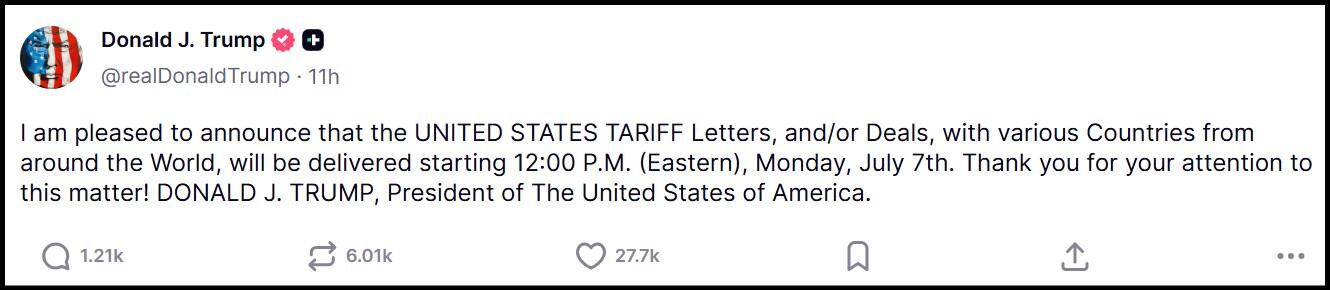
President Trump's Truth Social account on June 6, 2025
That Wednesday deadline, which comes from Trump's 90-day tariff pause on April 9, seems to have been pushed back somewhat after Treasury Secretary Scott Bessent said on Sunday that the administration would consider trade partners' offers until August 1, when the tariffs are scheduled to commence. In a certain sense, this then unofficially extends the tariff deadline by three weeks, which might aid equity markets in the interim.
The Dow Jones Industrial Average (DJIA), S&P 500 (SPX) and NASDAQ Composite (IXIC) all pulled back between 0.5% and 0.8% in Monday's morning session.
US stock market news: Dow Jones, S&P 500, NASDAQ
The BRICS organization is viewed by Trump and Washington as a competitor for global financial leadership with the G7, which represents the interests of seven mostly Western nations. Originally encompassing Brazil, Russia, India, China and South Africa — where the acronym BRICS comes from — Ethiopia, Iran, Egypt, the United Arab Emirates and Indonesia have all formally joined the organization. Another ten partner states, including Nigeria, Malaysia, and Vietnam, are likely to join the group eventually, and nations as diverse as Saudi Arabia, Turkey and Pakistan are considering invitations to join.

President Trump's Truth Social account on July 6, 2025
Because Trump's threat singles out "Any Country aligning themselves with the Anti-America policies of BRICS", it would appear that the 10% additional tariff would impact at least 20 nations and possibly as many as 29.
Vietnam was able to obtain a trade deal last week that left it with a 20% tariff on exports to the US, which was better than the 46% rate that the Trump administration unveiled in early April. However, Trump's new threat could push it up to 30%.
In other news, Elon Musk's announcement of a new political party — the America Party — over the weekend has battered Tesla's (TSLA) share price. Tesla stock sank as much as 8% on Monday after Bessent and Trump both belittled Musk's third-party concept, which the Tesla CEO said was necessary after the President's Republican Party passed a tax bill that balloons the nation's deficit.
Azoria CEO James Fishback delayed his firm Azoria Partners' Tesla-focused ETF after Fishback criticized Musk's move and suggested the Tesla board should curtail his political overtures.
A bright spot for equities is that the Bessent said on CNN's State of the Union program on Sunday, “We’re going to be very busy over the next 72 hours." This was taken to mean that this week might see trade deals formalized with some 18 nations with which the US is negotiating. South Korea has asked for a deadline extension, and Trump has complained about negotiations with Japan over the past few weeks.
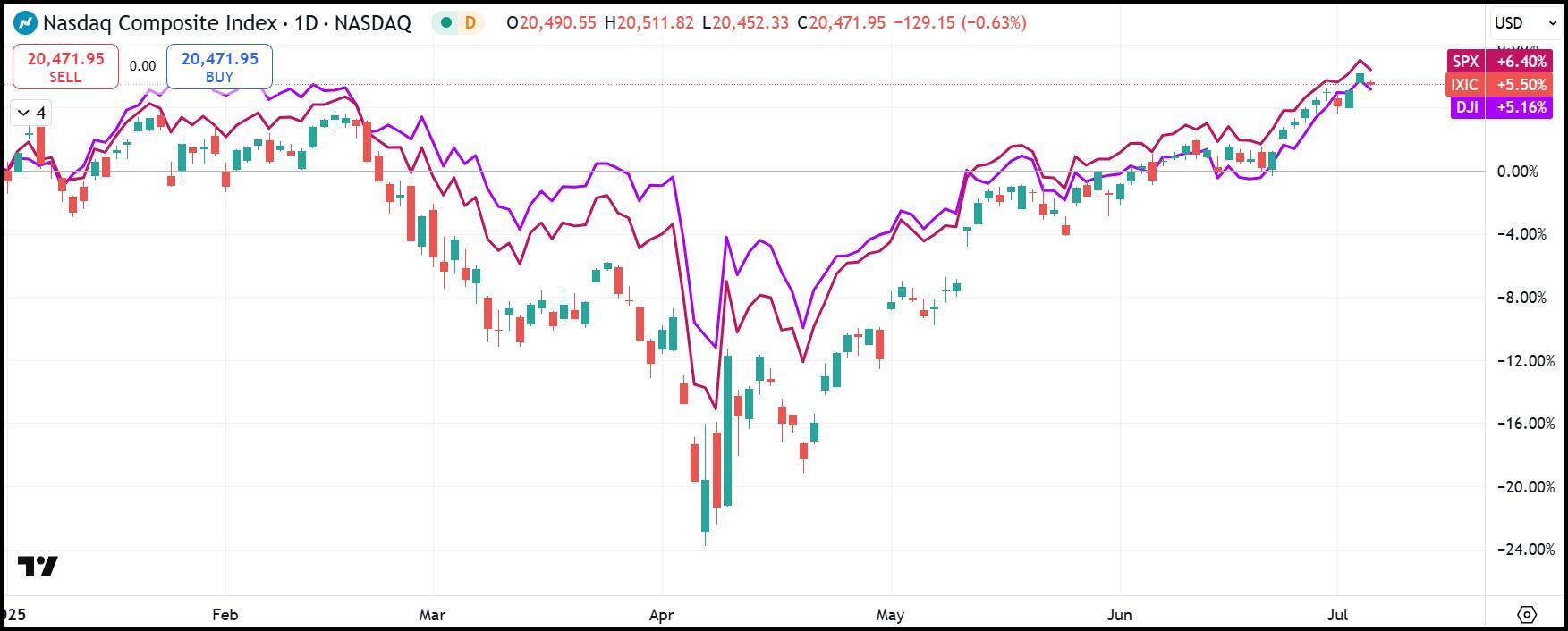
NASDAQ Composite (candlesticks), S&P 500 (red), Dow Jones (purple) YTD performance
Author

Clay Webster
FXStreet
Clay Webster grew up in the US outside Buffalo, New York and Lancaster, Pennsylvania. He began investing after college following the 2008 financial crisis.

















