US stock indices decline after Israeli attack on Iran
- Israel attacks Iran overnight, targeting nuclear officials and military sites.
- Trump pushes Iran to make a nuclear deal, but negotiations are likely over.
- Oil prices surge over 8%, which could push inflation higher.
- Dow Jones opens 1% lower, while US Treasury yields rise.

Israel launched unilateral strikes on Iranian officials, military sites and nuclear facilities on Thursday night, hostilities that the Trump administration warned about earlier this week but said it was not involved with. The steep rise in expectations that Iran will launch missiles and drones in defense has pushed oil prices over 8% on Friday, and US stocks are selling off in turn.
Some observers are already saying that higher oil prices could put an end to the falling US inflation witnessed earlier in the year. On Thursday, JPMorgan released a research note saying that an all-out war could push oil prices up to $120 and the US Consumer Price Index (CPI) to 5%.
The Dow Jones Industrial Average (DJIA) and NASDAQ Composite (IXIC) both traded 1% lower in response at Friday's open. The S&P 500 (SPX) was somewhat better with a -0.8% decline. The DAX in Germany and the CAC 40 in France both shed over 1% on Friday as well.
In contrast to the usual flight to safety trade, US Treasury yields are higher rather than lower. US oil and defense stocks are also making gains.
US President Donald Trump, whose administration was prepared to continue talks with Iranian officials on Sunday, pushed Iran to complete a peace deal, but that seems less likely now. Iran’s Defense Minister Aziz Nasirzadeh said in recent weeks that if Israel launches attacks on Iran, US military bases in the region will be targeted.
Dow Jones deal with fallout from Israeli attack on Iran
Of the 30 stocks in the Dow Jones index, only five opened on Friday with gains. These were Chevron (CVX), Merck (MRK), Verizon (VZ), Johnson & Johnson (JNJ) and Apple (AAPL). The rest sold off.
The index fell from Thursday's close just under 43,000 to open near 42,500. Visa (V) shed 4.6%, Sherwin-Williams (SHW) lost 3.9%, American Express (AXP) sank 2.1%, and Boeing (BA) lost 1.7%.
The credit card companies are also dealing with fallout from a Wall Street Journal article saying that Walmart (WMT) and Amazon (AMZN) are considering issuing stablecoins to counteract fees from credit cards. Boeing is dealing with reports that the Indian government is likely to ground the entire Dreamliner 787-8 fleet in the country while it investigates an Air India crash that took place on Thursday.
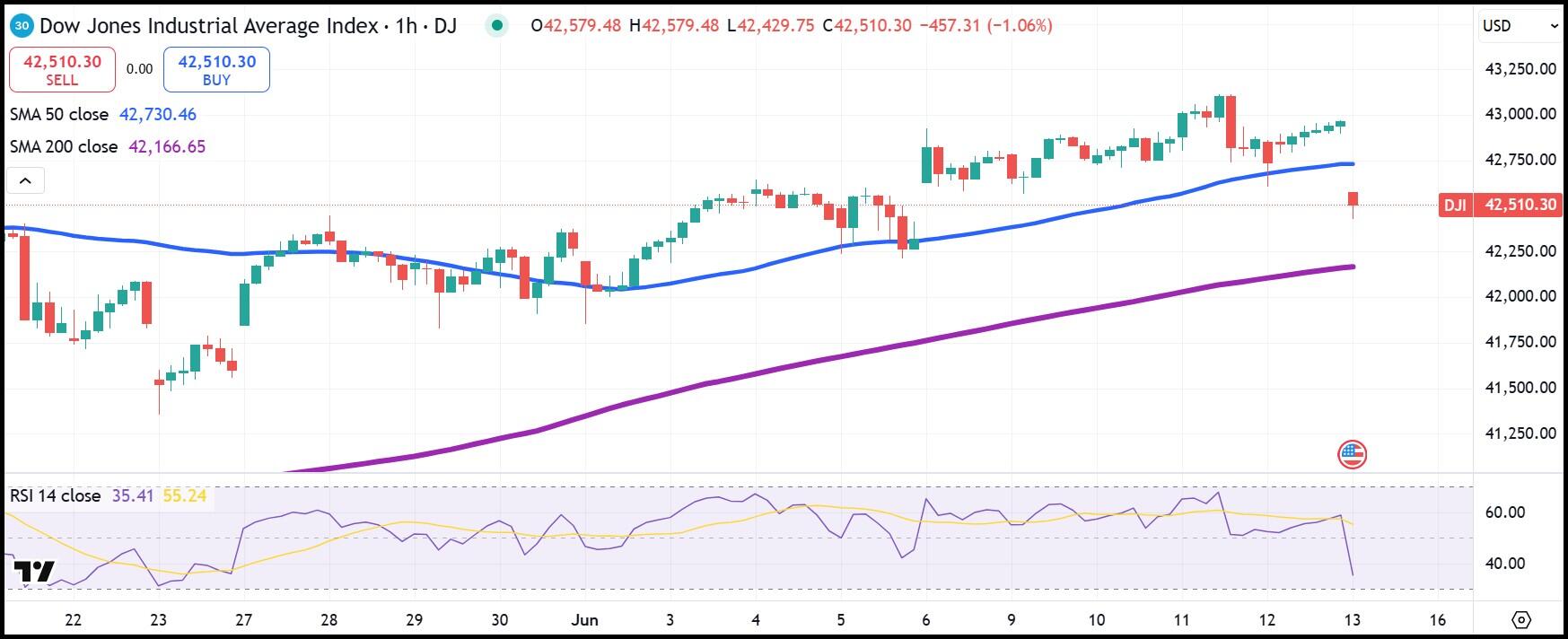
DJIA 1-hour chart
Author

Clay Webster
FXStreet
Clay Webster grew up in the US outside Buffalo, New York and Lancaster, Pennsylvania. He began investing after college following the 2008 financial crisis.

















