|

US Election 2024: Trump takes must-win North Carolina, Republicans win Senate control

Republican nominee Donald Trump is leading the US presidential race, most likely to become the 47th president, outperforming Democratic nominee Kamala Harris in most of the battleground states after taking the must-win swing state of North CarolinaThe resurgence of Trump trades has supported the renewed upside in the US Dollar (USD) and global stocks.

The current electoral vote tally is 227 for Trump and 189 for Harris, with the former US President taking hold of the other swing states - Arizona, Georgia, Michigan, Pennsylvania and Wisconsin. Fox News called a Trump victory for Pennsylvania and Wisconsin. 
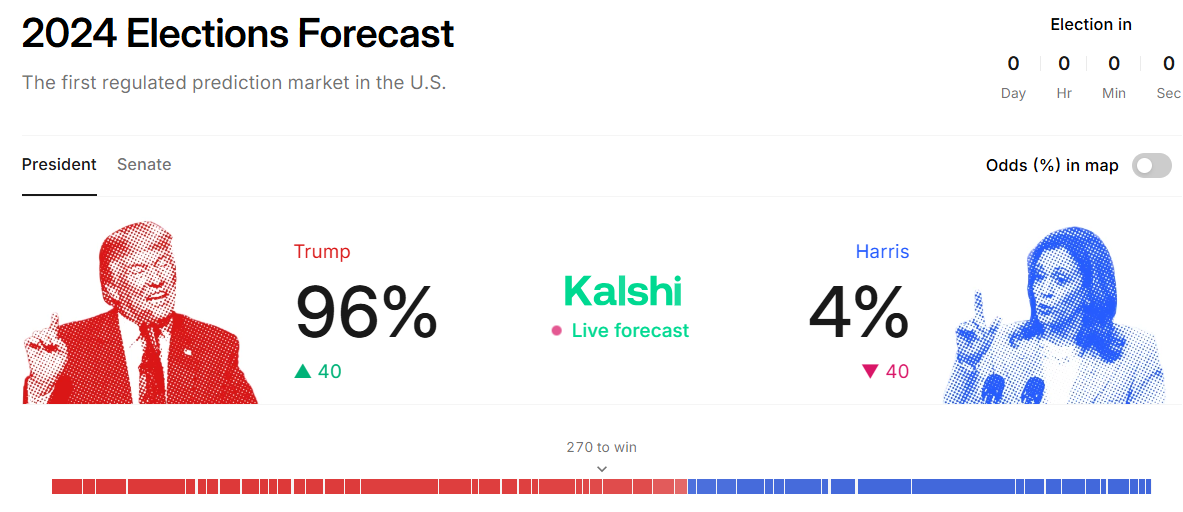
Meanwhile, Fox News also called Republicans in control of the US Senate. Republicans won a key Senate seat in Ohio, with Trump-endorsed nominee Bernie Moreno projected to defeat Democratic Sen. Sherrod Brown, according to CNN News, flipping yet another seat for the (Grand Old Party) GOP.

The main focus is on the control of the House. If Democrats take the House majority, it could be a ‘divided government, causing policy gridlock for the likely Trump administration. Democrats need to flip just four seats to win control of the lower chamber.

However, it appears that Republicans are still defending the control of the House by a narrow majority.

Market reaction

The US Dollar is consolidating the latest upswing against its major rivals. At the press time, the US Dollar Index (DXY) is trading at around 104.90, still adding 1.40% on the day.

Author

Dhwani Mehta

Dhwani Mehta

FXStreet

Residing in Mumbai (India), Dhwani is a Senior Analyst and Manager of the Asian session at FXStreet. She has over 10 years of experience in analyzing and covering the global financial markets, with specialization in Forex and commodities markets.


More from Dhwani Mehta
Share:

Editor's Picks

GBP/USD advaces beyond 1.3450 after BoE decision, US Q2 GDP

GBP/USD gains positive momentum on Thursday, surpassing 1.3450 and trading at fresh multi-week highs. The Bank of England decided to maintain the benchmark rate unchanged at 3.75%. The MPC voted 6-3 to keep rates on hold, with the 3 dissenters favoring a rate hike. US Q2 GDP missing expectations helped the pair advance, while renewed US Dollar weakness across the FX board pushed the pair further up ahead of the monthly close.

EUR/USD confortable around 1.1530, highest in six weeks

The EUR/USD pair trades around 1.1530 in the American session on Thursday, reaching fresh six-week highs. The US Dollar is in sell-off mode, with multiple factors weighing on the American currency. Not only did the Federal Reserve vote divided to keep rates on hold on Wednesday, creating doubts about a September hike, but US Q2 GDP missed expectations. A suspected JPY intervention adds pressure on the Greenback.

Gold recovers the $4,100 level as US Dollar weakens further

Gold trades just above $4,100 amid a US Dollar sell-off. The Greenback enjoyed some near-term demand following Wednesday's post-FOMC downfall, but was unable to retain its gains. The preliminary estimate of the US Q2 GDP showed the economy grew at an annual rate of 1.5%, missing the market's expectations of 2.1%.

Bank of Japan set to keep interest rates unchanged after suspected Yen intervention

Investors are turning their attention to the Bank of Japan’s monetary policy announcement on Friday, after the Japanese Yen staged a dramatic rebound during Thursday's American session. The move came amid growing speculation that Japanese authorities intervened in the foreign exchange market after USD/JPY tumbled from above 163.00 to below 158.00 within minutes.

Aave to sunset Sonic, Aptos, zkSync, Scroll reserves, affecting $98 million in supply

Aave is planning to sunset 75 low-activity reserves across its decentralized finance protocol as part of a broader effort to reduce operational, technical and economic risks across its network of deployments.

9-3: Is the Federal Reserve’s vote tally Warsh's new forward guidance?
The rate did not move. Neither did the statement, and that’s the more interesting fact. Set the July 29 Federal Open Market Committee (FOMC) statement beside the one issued on June 17, and the two documents are identical apart from a single verb and a paragraph at the bottom naming three dissenters.