US Dollar flat after softer JOLTS and ISM reading
- Traders show little interest in the Greenback, volatility in the DXY tightens.
- US President Trump is set to issue reciprocal tariffs for all countries on Wednesday.
- The US Dollar Index trades stable in the green around 104.30, while looking for any sort of driver.

The US Dollar Index (DXY), which tracks the performance of the US Dollar (USD) against six major currencies, is falling flat after the US data release. Clearly, market participants are not fond of the Greenback at this moment amidst tariff uncertainty. Richmond Federal Reserve (Fed) Bank President Thomas Barkin said the economic reading is wrapped in a thick fog and is unclear for the Fed to read where rates should go, while recession fears are still on the table, CNBC reports.
The economic data releases for this week could get things moving in the runup to the Nonfarm Payrolls data to be published on Friday. For this Tuesday, the US JOLTS Job Openings for Februaryand the US Institute for Supply Management (ISM) March Manufacturing data saw some softening releases.This could be the starting point of the US economy starting to roll over.
Daily digest market movers: Little by little softer
- Richmond Bank Fed President Thomas Barkin repeated that the economic situation in the US has become so unclear it is nearly impossible for the Fed to give projections.
- The US S&P Global Manufacturing Purchase Managers Index (PMI) data for March saw its final reading come in at 50.2, higher than the 49.8 expected.
- At 14:00 GMT, a bulk data release took place:
- The US ISM manufacturing data for March:
- The PMI component fell deeper into contraction, hitting 49.0, missing the 49.5 estimate and coming from 50.3.
- The Prices Paid element went to 69.4, above the 65 estimate and coming from 62.4.
- New Orders came in at 45.2, coming from 48.6 previously.
- The Employment Index fell deeper to 44.7, coming from 47.6 the last time.
- The US JOLTS Job Openings for February came in substantially softer at 7.568 million, missing the 7.63 million job postings estimated and against 7.74 million in January.
- The US ISM manufacturing data for March:
- Equities are all over the place this Tuesday. Asian futures closed off flat on the day, the European ones are rallying near 1.00%. US equities are turning lower by 0.50%.
- According to the CME Fedwatch Tool, the probability of interest rates remaining at the current range of 4.25%-4.50% in May’s meeting is 85.5%. For June’s meeting, the odds for borrowing costs being lower stand at 74.4%.
- The US 10-year yield trades around 4.14%, near a fresh monthly low from March.
US Dollar Index Technical Analysis: Where to go next
The US Dollar Index (DXY) sees other asset classes brace for the ‘Liberation Day’ set for Wednesday around 19:00 GMT. The fact that the Greenback is again unfazed by the announcement, while Gold spikes and US Bond yields drop, shows that currency traders are awaiting the impact of Trump’s tariffs on the US economy. There are high hopes that the DXY could finally move higher or lower with this data-filled week.
A return to the 105.00 round level could still occur in the coming days, with the 200-day Simple Moving Average (SMA) converging at that point and reinforcing this area as a strong resistance at 104.93. Once broken through that zone, a string of pivotal levels, such as 105.53 and 105.89, could limit the upward momentum.
On the downside, the 104.00 round level is the first nearby support, although it looks bleak after being tested on Friday and Monday. If that level does not hold, the DXY risks falling back into that March range between 104.00 and 103.00. Once the lower end at 103.00 gives way, watch out for 101.90 on the downside.
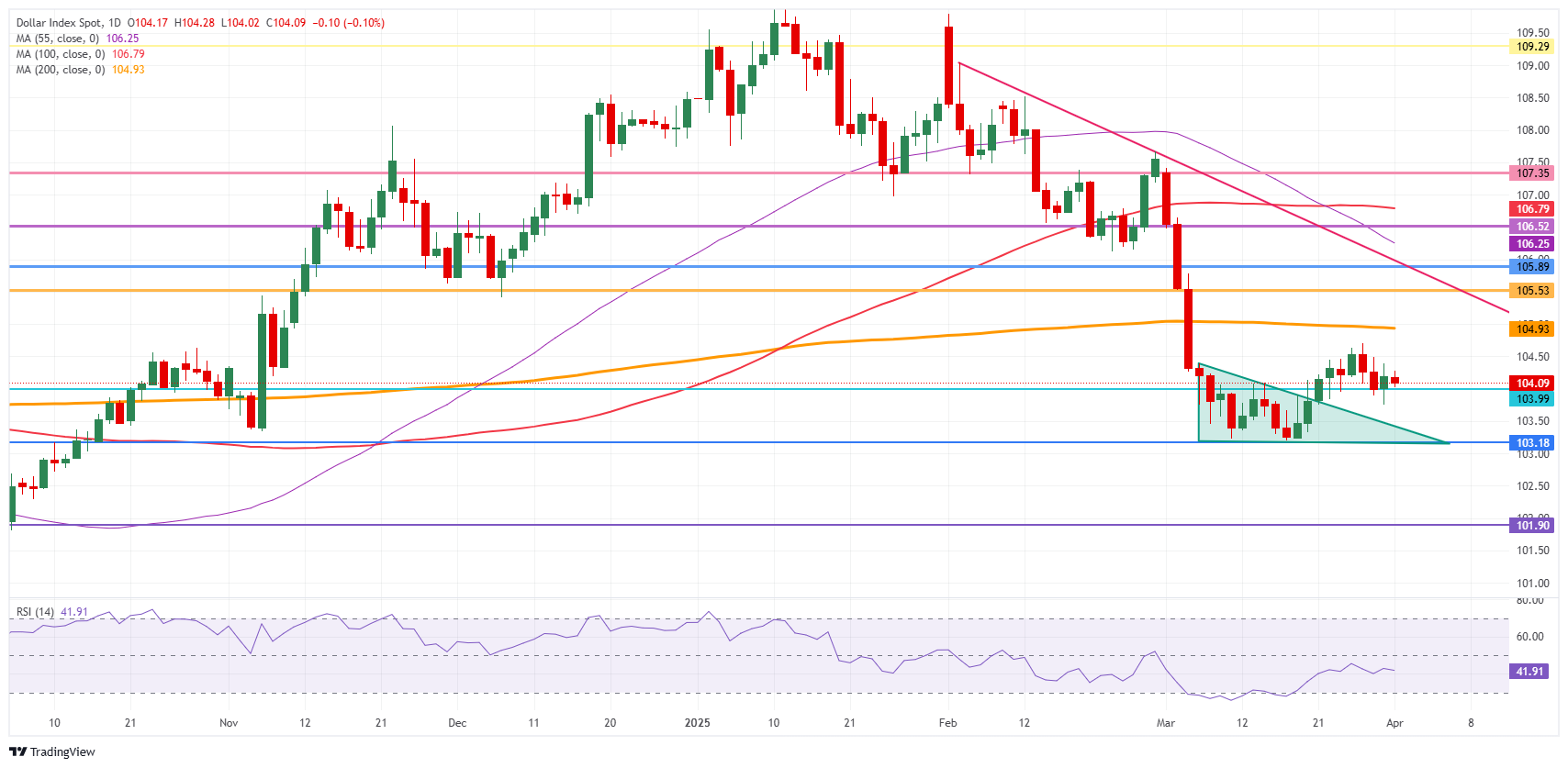
US Dollar Index: Daily Chart
Employment FAQs
Labor market conditions are a key element to assess the health of an economy and thus a key driver for currency valuation. High employment, or low unemployment, has positive implications for consumer spending and thus economic growth, boosting the value of the local currency. Moreover, a very tight labor market – a situation in which there is a shortage of workers to fill open positions – can also have implications on inflation levels and thus monetary policy as low labor supply and high demand leads to higher wages.
The pace at which salaries are growing in an economy is key for policymakers. High wage growth means that households have more money to spend, usually leading to price increases in consumer goods. In contrast to more volatile sources of inflation such as energy prices, wage growth is seen as a key component of underlying and persisting inflation as salary increases are unlikely to be undone. Central banks around the world pay close attention to wage growth data when deciding on monetary policy.
The weight that each central bank assigns to labor market conditions depends on its objectives. Some central banks explicitly have mandates related to the labor market beyond controlling inflation levels. The US Federal Reserve (Fed), for example, has the dual mandate of promoting maximum employment and stable prices. Meanwhile, the European Central Bank’s (ECB) sole mandate is to keep inflation under control. Still, and despite whatever mandates they have, labor market conditions are an important factor for policymakers given its significance as a gauge of the health of the economy and their direct relationship to inflation.
Author

Filip Lagaart
FXStreet
Filip Lagaart is a former sales/trader with over 15 years of financial markets expertise under its belt.