US Dollar goes anywhere as focus now shifts to CPI figures after Powell's cautious tone
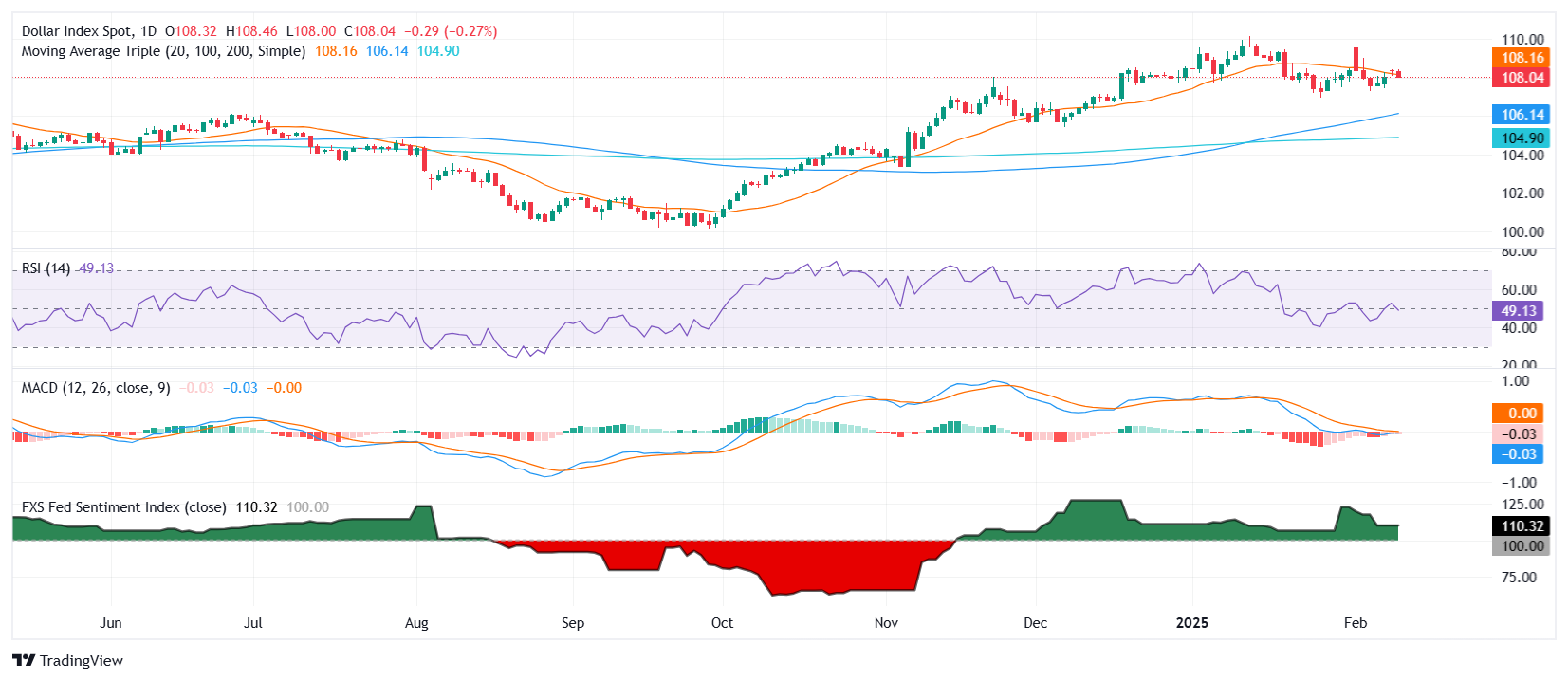
- The US Dollar Index trades with losses for the second consecutive session on Tuesday, hovering above 108.00 without clear direction.
- Federal Reserve Chair Jerome Powell signals no urgency to adjust monetary policy, keeping markets in a cautious stance.
- The CME FedWatch Tool shows that markets are pricing in a hold at March’s meeting.

The US Dollar Index (DXY), which measures the value of the US Dollar against a basket of currencies, remains down for the second day after hearing from the head of the US central bank. Federal Reserve (Fed) Chair Jerome Powell's testimony to Congress emphasized a data-dependent approach, indicating that rates will stay steady unless inflation or labor conditions shift. This notion reduced the chance of a rate cut at the March meeting.
Daily digest market movers: US Dollar loses traction after Powell’s cautious testimony
- The main market mover on Tuesday was Powell’s testimony before Congress, which wasn’t as hawkish as expected and might have weakened the USD.
- The Fed Chair confirms no immediate changes to policy, keeping the 2% core inflation target intact.
- Powell acknowledges inflation is still somewhat elevated but emphasizes patience in adjusting monetary policy.
- He also highlighted concerns over long-term rates, stating they are driven by fiscal deficit and inflation expectations.
- Equities remain mostly flat with investors digesting Powell’s neutral stance on interest rates and trade.
- The CME FedWatch Tool indicates a 90% probability that the Fed will maintain rates at 4.25%-4.50% in March.
- Elsewhere, the US 10-year yield climbs toward 4.55%, extending its rebound from a year-to-date low of 4.40% reached last week.
- In fact the Fed's sentiment index on the daily chart signlas that the bank's hawkish tone has eased somewhat.
DXY technical outlook: Dollar weakens as key support levels come into play
The US Dollar Index struggles to maintain momentum, slipping below the 20-day Simple Moving Average (SMA) around 108.50. The Relative Strength Index (RSI) is drifting lower, approaching bearish territory below 50, signaling declining momentum. The Moving Average Convergence Divergence (MACD) histogram is turning negative, indicating growing bearish traction.
If selling pressure intensifies, immediate support lies at 108.00, followed by the psychological level of 107.50. On the upside, resistance is seen at 108.80 and the 109.20 zone, which could cap short-term rebounds.
Central banks FAQs
Central Banks have a key mandate which is making sure that there is price stability in a country or region. Economies are constantly facing inflation or deflation when prices for certain goods and services are fluctuating. Constant rising prices for the same goods means inflation, constant lowered prices for the same goods means deflation. It is the task of the central bank to keep the demand in line by tweaking its policy rate. For the biggest central banks like the US Federal Reserve (Fed), the European Central Bank (ECB) or the Bank of England (BoE), the mandate is to keep inflation close to 2%.
A central bank has one important tool at its disposal to get inflation higher or lower, and that is by tweaking its benchmark policy rate, commonly known as interest rate. On pre-communicated moments, the central bank will issue a statement with its policy rate and provide additional reasoning on why it is either remaining or changing (cutting or hiking) it. Local banks will adjust their savings and lending rates accordingly, which in turn will make it either harder or easier for people to earn on their savings or for companies to take out loans and make investments in their businesses. When the central bank hikes interest rates substantially, this is called monetary tightening. When it is cutting its benchmark rate, it is called monetary easing.
A central bank is often politically independent. Members of the central bank policy board are passing through a series of panels and hearings before being appointed to a policy board seat. Each member in that board often has a certain conviction on how the central bank should control inflation and the subsequent monetary policy. Members that want a very loose monetary policy, with low rates and cheap lending, to boost the economy substantially while being content to see inflation slightly above 2%, are called ‘doves’. Members that rather want to see higher rates to reward savings and want to keep a lit on inflation at all time are called ‘hawks’ and will not rest until inflation is at or just below 2%.
Normally, there is a chairman or president who leads each meeting, needs to create a consensus between the hawks or doves and has his or her final say when it would come down to a vote split to avoid a 50-50 tie on whether the current policy should be adjusted. The chairman will deliver speeches which often can be followed live, where the current monetary stance and outlook is being communicated. A central bank will try to push forward its monetary policy without triggering violent swings in rates, equities, or its currency. All members of the central bank will channel their stance toward the markets in advance of a policy meeting event. A few days before a policy meeting takes place until the new policy has been communicated, members are forbidden to talk publicly. This is called the blackout period.
Author

Patricio Martín
FXStreet
Patricio is an economist from Argentina passionate about global finance and understanding the daily movements of the markets.