US Dollar pares back some losses for this week
- The Greenback is reclaiming some losses for this week after strong NFP numbers.
- Focus shifts now to Fed Chairman Jerome Powell speaking later this Friday.
- The US Dollar Index is back above 102.00 and looks to close above the level before the weekend.

The US Dollar Index (DXY), which tracks the performance of the US Dollar (USD) against six major currencies, rallied after some strong Nonfarm Payrolls numbers while markets look ahead for Federal Reserve (Fed) Chair Jerome Powell’s speech up next. China meanwhile lashed out at the US tariffs by imposing a 34% tariff on all US goods from April 10th, a day after the US tariffs will be imposed. Question will be if other countries join China in retaliation while the 'deal-making' US President Donald Trump was referring to on Thursday, does not seem to be taking place right now.
On the economic calendar front, the Nonfarm Payrolls release (NFP) came in upbeat at 228,000, far from the consensus view of 135,000. The most positive forecast was for 200,000, which makes the actual number an outside surprise. Now focus shifts to the Federal Reserve to see if Fed Chairman Powell can alter or support the current stance in the DXY.
Daily digest market movers: Pharma is coming
- As the day evolves, Trump mentioned on Air Force One that China has panicked by retaliating and that the pharma sector is up next for tariff implementations.
- US employment data for March has been released:
- Nonfarm Payrolls came in at 228,000, beating the 135,000 consensus and upbeat compared to 151,000 in February.
- The monthly Average Hourly Earnings remained stable at 0.3%.
- The Unemployment Rate came in at 4.2%, a touch higher than the 4.1% from February.
- At 15:25 GMT, Federal Reserve Chair Jerome Powell speaks about the economic outlook at the Society for Advancing Business Editing and Writing (SABEW) Annual Conference.
- At 16:00 GMT, Fed Governor Michael Barr will speak on AI and Banking.
- Fed Governor Chris Waller will speak at 16:45 GMT on Payments at a New York Fed Conference.
- Murder on the trading floor with losses in Europe around 3%-4% while US equities are dipping near 2%.
- According to the CME Fedwatch Tool, the probability of interest rates remaining at the current range of 4.25%-4.50% in May’s meeting is 68.1%, coming from 81.5% last week. For June’s meeting, the odds for borrowing costs being lower stand at 92.6%, whereas only last week, the odds were roughly 81.1%.
- The US 10-year yields trade around 3.94%, a fresh five-month low with the next low to bear near 3.69% from the beginning of October 2024.
US Dollar Index Technical Analysis: Could have been worse
The pendulum is swinging for the US Dollar Index, with strength on the left and weakness on the right. On the left, there have been years of US Dollar strength, which was perceived as a market standard. However, since the start of March – with the defense budget spending bill in Germany and US President Donald Trump in office – the pendulum for the DXY has swung. More US Dollar weakness is likely once the tariff impact on the US economy starts to take its effect. As stagflation and recession fears are picking up, the DXY could easily fall below 100.00 later this year.
With the sizable downward move on Thursday, some support levels have turned into resistance. The first level to watch out for is 103.18, which has been held as support throughout March. Above there, the 104.00 pivotal level and the 200-day Simple Moving Average (SMA) at 104.89 come into play.
On the downside, 101.90 is the first line of defense and it should be able to trigger a bounce as the Relative Strength Index (RSI) momentum indicator is issuing warnings of oversold conditions on the daily chart. Maybe not this Friday, but in the coming days, a break below 101.90 could see a leg lower towards 100.00.
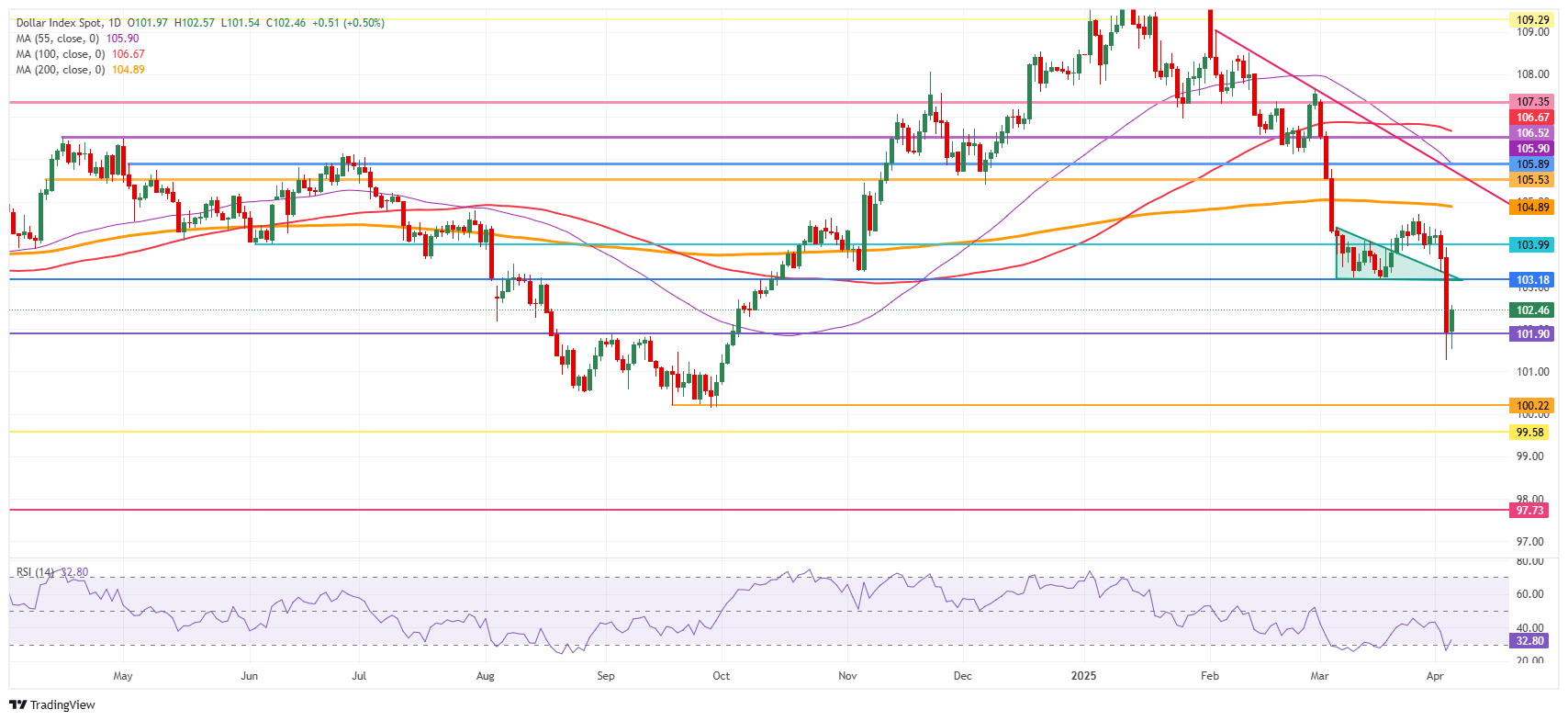
US Dollar Index: Daily Chart
Banking crisis FAQs
The Banking Crisis of March 2023 occurred when three US-based banks with heavy exposure to the tech-sector and crypto suffered a spike in withdrawals that revealed severe weaknesses in their balance sheets, resulting in their insolvency. The most high profile of the banks was California-based Silicon Valley Bank (SVB) which experienced a surge in withdrawal requests due to a combination of customers fearing fallout from the FTX debacle, and substantially higher returns being offered elsewhere.
In order to fulfill the redemptions, Silicon Valley Bank had to sell its holdings of predominantly US Treasury bonds. Due to the rise in interest rates caused by the Federal Reserve’s rapid tightening measures, however, Treasury bonds had substantially fallen in value. The news that SVB had taken a $1.8B loss from the sale of its bonds triggered a panic and precipitated a full scale run on the bank that ended with the Federal Deposit Insurance Corporation (FDIC) having to take it over.The crisis spread to San-Francisco-based First Republic which ended up being rescued by a coordinated effort from a group of large US banks. On March 19, Credit Suisse in Switzerland fell foul after several years of poor performance and had to be taken over by UBS.
The Banking Crisis was negative for the US Dollar (USD) because it changed expectations about the future course of interest rates. Prior to the crisis investors had expected the Federal Reserve (Fed) to continue raising interest rates to combat persistently high inflation, however, once it became clear how much stress this was placing on the banking sector by devaluing bank holdings of US Treasury bonds, the expectation was the Fed would pause or even reverse its policy trajectory. Since higher interest rates are positive for the US Dollar, it fell as it discounted the possibility of a policy pivot.
The Banking Crisis was a bullish event for Gold. Firstly it benefited from demand due to its status as a safe-haven asset. Secondly, it led to investors expecting the Federal Reserve (Fed) to pause its aggressive rate-hiking policy, out of fear of the impact on the financial stability of the banking system – lower interest rate expectations reduced the opportunity cost of holding Gold. Thirdly, Gold, which is priced in US Dollars (XAU/USD), rose in value because the US Dollar weakened.
Author

Filip Lagaart
FXStreet
Filip Lagaart is a former sales/trader with over 15 years of financial markets expertise under its belt.

















