US Dollar steadies after China hits markets with potential 6 trillion Yuan bond issuance
- The US Dollar trades up despite Fed's Kashkari confirming further rate cut path.
- Markets got surprised by comments out of China that a bond stimulus program could amount to 6 trillion Yuan.
- The US Dollar Index pops above 103.00 and is testing firm resistance levels on the upside.

The US Dollar (USD) is already fired up at the start of the week and ticks higher, despite several parts of the US markets closed for Columbus Day. Despite the bank holiday, three Federal Reserve (Fed) members are due to speak. Meanwhile, China surprised markets with comments that China might issue up to 6 trillion Yuan (CNH) in bonds over three years to further boost its economy, according to Caixin.
The economic calendar is thus empty due to the Columbus Day bank holiday in the US. About Fedspeak, traders will need to watch out for comments from Federal Reserve Governor Christopher Waller, who has a track record of leaving market-moving comments.
Daily digest market movers: China to flood markets with cheap paper
- China might embark in issuing a large portion of debt, up to 6 trillion Yuan, over three years, according to a Caixin article.
- Due to Columbus Day, the bond market is closed in the US. Equity Futures markets are open and trading.
- At 13:00 GMT, Federal Reserve Bank of Minneapolis President Neel Kashkari said it appears likely that “further modest reductions” in the central bank’s benchmark interest rate will be appropriate in the coming quarters, Bloomberg reports.
- Later at 21:00 GMT, Kashkari will speak again about the current state of the US economy at the Department of Economics of Torcuato di Tella University.
- Around 19:00 GMT, Federal Reserve Governor Christopher Waller speaks about the US economic outlook at a conference titled "A 50-Year Retrospective on the Shadow Open Market Committee and Its Role in Monetary Policy" in Stanford, California.
- Equities are starting to turn positive for this Monday with the US equity futures starting to move higher, into positive territory.
- The CME Fed rate policy expectation for the meeting on November 7 stands at 88.2% for a 25 basis point rate cut, while 11.8% is pricing in no rate cut. Chances for a 50 bps rate cut have been fully priced out.
- The US 10-year benchmark rate is not trading this Monday and closed on Friday at 4.10%.
US Dollar Index Technical Analysis: Greenback heads up
The US Dollar Index (DXY) is orbiting around 103.00 and looking for a chance to go higher. The question on the table is whether, with a very light US calendar this week, there will be any catalyst big enough to elevate the DXY to the next level. If the Fed speakers can not do it on Monday, it looks questionable if the US Dollar Index will be able to advance any further for now.
The psychological 103.00 is the first level to tackle on the upside. Further up, the chart identifies 103.18 as the very final resistance level for this week. Once above there, a very choppy area emerges, with the 100-day Simple Moving Average (SMA) at 103.24, the 200-day SMA at 103.77, and the pivotal 103.99-104.00 levels in play.
On the downside, the 55-day SMA at 101.88 is the first line of defence, backed by the 102.00 round level and the pivotal 101.90 as support to catch any bearish pressure and trigger a bounce. If that level does not work out, 100.62 also acts as support. Further down, a test of the year-to-date low of 100.16 should take place before more downside. Finally, and that means giving up the big 100.00 level, the July 14, 2023, low at 99.58 comes into play.
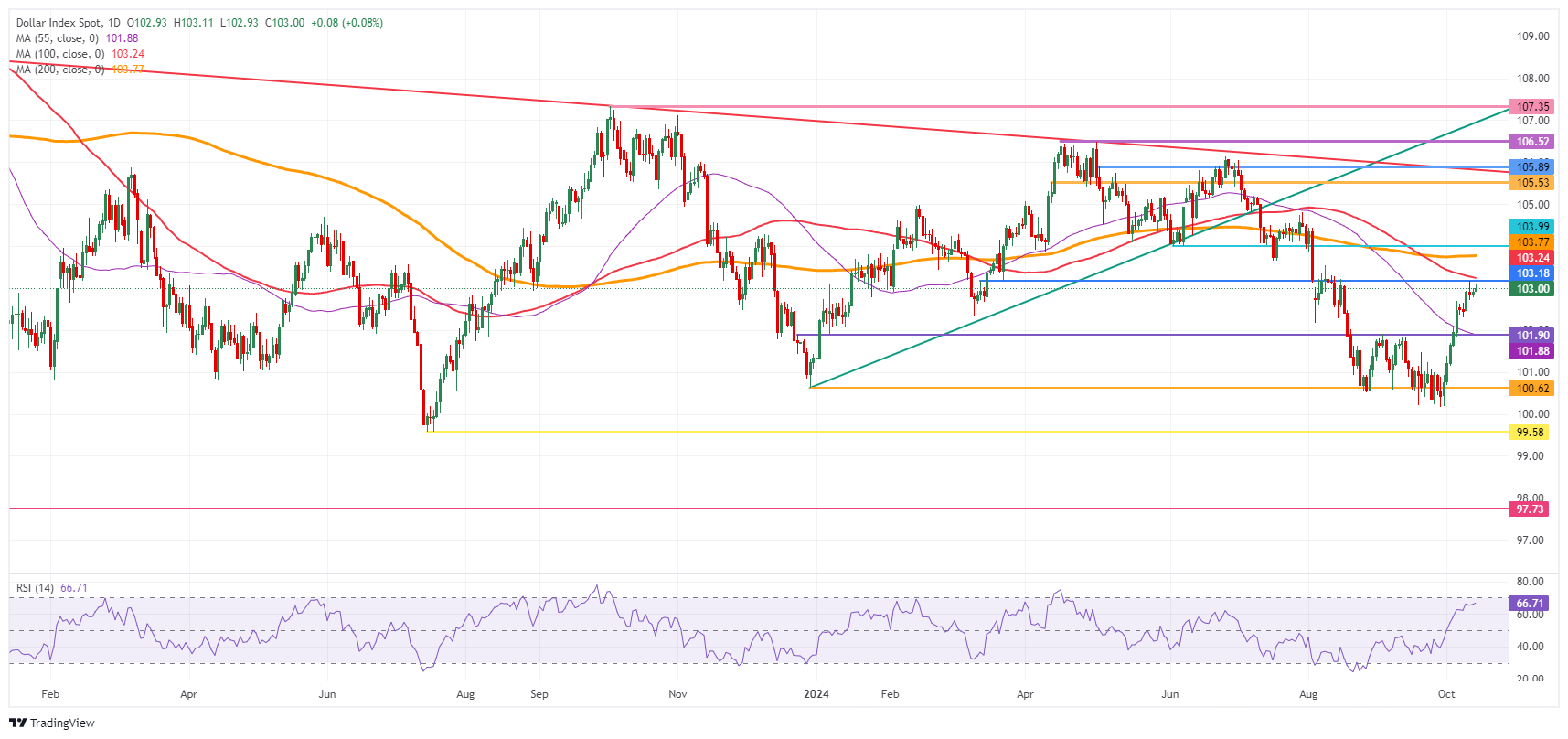
US Dollar Index: Daily Chart
Central banks FAQs
Central Banks have a key mandate which is making sure that there is price stability in a country or region. Economies are constantly facing inflation or deflation when prices for certain goods and services are fluctuating. Constant rising prices for the same goods means inflation, constant lowered prices for the same goods means deflation. It is the task of the central bank to keep the demand in line by tweaking its policy rate. For the biggest central banks like the US Federal Reserve (Fed), the European Central Bank (ECB) or the Bank of England (BoE), the mandate is to keep inflation close to 2%.
A central bank has one important tool at its disposal to get inflation higher or lower, and that is by tweaking its benchmark policy rate, commonly known as interest rate. On pre-communicated moments, the central bank will issue a statement with its policy rate and provide additional reasoning on why it is either remaining or changing (cutting or hiking) it. Local banks will adjust their savings and lending rates accordingly, which in turn will make it either harder or easier for people to earn on their savings or for companies to take out loans and make investments in their businesses. When the central bank hikes interest rates substantially, this is called monetary tightening. When it is cutting its benchmark rate, it is called monetary easing.
A central bank is often politically independent. Members of the central bank policy board are passing through a series of panels and hearings before being appointed to a policy board seat. Each member in that board often has a certain conviction on how the central bank should control inflation and the subsequent monetary policy. Members that want a very loose monetary policy, with low rates and cheap lending, to boost the economy substantially while being content to see inflation slightly above 2%, are called ‘doves’. Members that rather want to see higher rates to reward savings and want to keep a lit on inflation at all time are called ‘hawks’ and will not rest until inflation is at or just below 2%.
Normally, there is a chairman or president who leads each meeting, needs to create a consensus between the hawks or doves and has his or her final say when it would come down to a vote split to avoid a 50-50 tie on whether the current policy should be adjusted. The chairman will deliver speeches which often can be followed live, where the current monetary stance and outlook is being communicated. A central bank will try to push forward its monetary policy without triggering violent swings in rates, equities, or its currency. All members of the central bank will channel their stance toward the markets in advance of a policy meeting event. A few days before a policy meeting takes place until the new policy has been communicated, members are forbidden to talk publicly. This is called the blackout period.
Author

Filip Lagaart
FXStreet
Filip Lagaart is a former sales/trader with over 15 years of financial markets expertise under its belt.
















