US Dollar facing another intraday loss on the back of tariff war developments
- The US Dollar sees another leg lower on Tuesday, adding to the already downbeat day on Monday
- Traders sell the Greenback after US imposing tariffs and, meanwhile, already facing counterattacks from Canada and China.
- The US Dollar Index (DXY) does not find immediate support and could break even lower on Tuesday.

The US Dollar Index (DXY), which tracks the performance of the US Dollar (USD) against six major currencies, briefly broke below 106.00 in a volatile Tuesday after United States (US) President Donald Trump confirmed that tariffs on Canada, Mexico and China were not being delayed. Markets were still doubting on Monday if President Trump would still allow an extension just before the deadline. However, it was no surprise that the US imposed the earlier committed tariffs.
Meanwhile, Canada and China have already pushed back on the US unilateral tariffs. Later Monday night, Canada’s Prime Minister Justin Trudeau announced retaliatory tariffs on US goods. “Canada will start with 25% tariffs on US imports worth C$30 billion from Tuesday,” read the statement, while tariffs on other C$125 billion of products will come into effect in 21 days.
On early Tuesday, China announced its own levy on US agricultural goods. China’s Commerce Ministry stated that it would impose additional tariffs of up to 15% on imports of key farm products, including chicken, pork, soy and beef from the US. The Ministry said that the tariffs will take effect on March 10.
Daily digest market movers: Headlines all around
- United States secretary of the treasury Scott Bessent issued comments that US rates will come back down again and that he is confident Chinese manufacturers will 'eat' the tariffs.
- Recent US economic data, while US yields and the US Dollar are rolling off, suggest that the US economy could be heading into a period of slow to negative growth while inflation remains elevated due to tariffs. This is a perfect cocktail for either a recession or stagflation phase in the US economy, Bloomberg reports.
- The TechnoMetrica Institute of Policy and Politics (TIPP) Economic Optimism Index for March fell below 50 to 49.8, missing the 53.1 estimate, down from 52 in February.
- Near 18:00 GMT, Federal Reserve Bank of Richmond President Thomas Barkin delivers a speech titled "Inflation Then and Now" at the Fredericksburg Regional Alliance in Fredericksburg, United States.
- Around 19:20 GMT, Federal Reserve Bank of New York President John Williams is scheduled to participate in a discussion titled "The Cautious Path for Rate Cuts" at Bloomberg Invest 2025 in New York, United States.
- Equities are facing selling pressure across the board. A broad flight to safe havens is pushing traders into Gold for now.
- The CME Fedwatch Tool projects a 14.4% chance that interest rates will remain at the current range of 4.25%-4.50% in June, with the rest showing a possible rate cut.
- The US 10-year yield trades around 4.11%, further down from last week’s high of 4.574% and flirting with a five-month low.
US Dollar Index Technical Analysis: Seismic shift
If there is one thing very clear now, it is that both US yields and the US Dollar Index (DXY) are no fans of tariffs. The risk is now that more tariffs could hit from all sides in retaliation, which could hit the US Dollar even more as a stagflation scenario gets underway. With the yield differential between the US and other countries further narrowing, the strength of the Greenback would erode further, and the DXY could even fall back below 105.00 if sentiment continues to pick up in that direction.
On the upside, the 100-day Simple Moving Average (SMA) is the first resistance to watch for any rejection, currently at 106.87. In case the DXY can break above 107.35, the 108.00 round level is coming back in scope, with the 55-day SMA just below it.
On the downside, the 106.00 round level needs to hold as support. In case that big figure snaps, 105.89 and the 200-day SMA at 105.05 could start to be identified as the next levels on the downside.
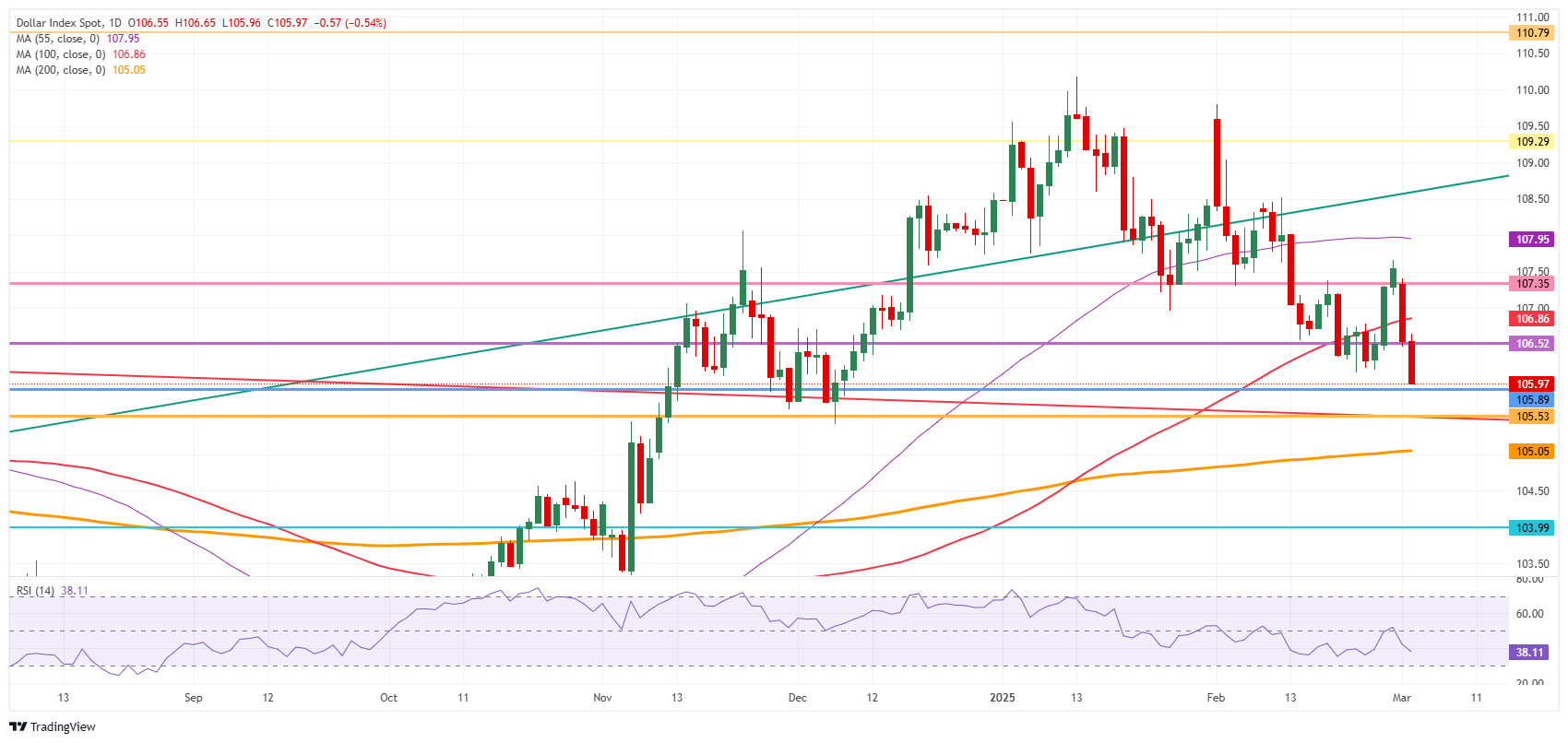
US Dollar Index: Daily Chart
Fed FAQs
Monetary policy in the US is shaped by the Federal Reserve (Fed). The Fed has two mandates: to achieve price stability and foster full employment. Its primary tool to achieve these goals is by adjusting interest rates. When prices are rising too quickly and inflation is above the Fed’s 2% target, it raises interest rates, increasing borrowing costs throughout the economy. This results in a stronger US Dollar (USD) as it makes the US a more attractive place for international investors to park their money. When inflation falls below 2% or the Unemployment Rate is too high, the Fed may lower interest rates to encourage borrowing, which weighs on the Greenback.
The Federal Reserve (Fed) holds eight policy meetings a year, where the Federal Open Market Committee (FOMC) assesses economic conditions and makes monetary policy decisions. The FOMC is attended by twelve Fed officials – the seven members of the Board of Governors, the president of the Federal Reserve Bank of New York, and four of the remaining eleven regional Reserve Bank presidents, who serve one-year terms on a rotating basis.
In extreme situations, the Federal Reserve may resort to a policy named Quantitative Easing (QE). QE is the process by which the Fed substantially increases the flow of credit in a stuck financial system. It is a non-standard policy measure used during crises or when inflation is extremely low. It was the Fed’s weapon of choice during the Great Financial Crisis in 2008. It involves the Fed printing more Dollars and using them to buy high grade bonds from financial institutions. QE usually weakens the US Dollar.
Quantitative tightening (QT) is the reverse process of QE, whereby the Federal Reserve stops buying bonds from financial institutions and does not reinvest the principal from the bonds it holds maturing, to purchase new bonds. It is usually positive for the value of the US Dollar.
Author

Filip Lagaart
FXStreet
Filip Lagaart is a former sales/trader with over 15 years of financial markets expertise under its belt.

















