|

US Dollar clings to gains near 101.60, FOMC on sight

The greenback, measured by the US Dollar Index (DXY) has surrendered part of its initial gains and is now gravitating in the 100.60 area.

US Dollar focus on FOMC

The index is posting gains for the fourth session in a row on Wednesday, always backed by rising expectations of a Fed move at the March meeting.

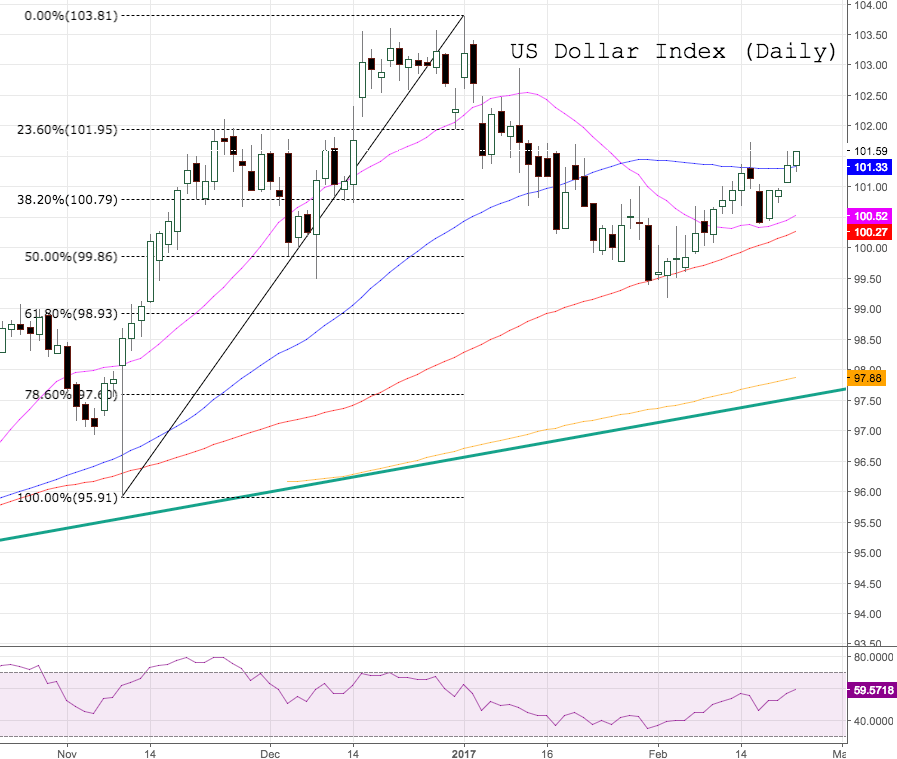
USD has so far managed to keep the trade north of the 101.00 handle, although gains have failed to clear the interim target in the 101.70 area, last week’s spike post-Yellen’s testimony.

Supportive Fedspeak as of late and auspicious results from the US docket have combined to further sustain the rally in the buck. However, the up move seems to have decoupled from US yields performance, probably showing some cautiousness among investors in light of the upcoming release of the FOMC minutes.

Consensus sees the Committee to reinforce the view of a rate hike sooner rather than later, reinforcing at the same time the case for a stronger buck. How much of this sentiment is already priced in remains to be seen, but it could surely act as a barrier for extra gains, at least in the near term.

Data wise in the US today, Existing Home Sales have surpassed estimates during January, increasing by nearly 5.70 million units, or 3.3% inter-month.

US Dollar relevant levels

The index is gaining 0.13% at 101.58 facing the next resistance at 101.75 (high Feb.15) ahead of 101.95 (23.6% Fibo of the November-January up move) and finally 10296 (low Jan.11). On the flip side, a break below 100.99 (high Feb.20) would aim for 100.52 (20-day sma) and then 100.40 (low Feb.16).
Author

Pablo Piovano

Born and bred in Argentina, Pablo has been carrying on with his passion for FX markets and trading since his first college years.


More from Pablo Piovano
Share:

Editor's Picks

AUD/USD holds above 0.6950 as bullish USD caps gains

AUD/USD edges lower during the Asian session on Tuesday, stalling a two-day recovery move from a two-month low, touched last week. An extended rout in the fixed income market keeps US bond yields elevated near multi-year highs. This, along with geopolitical uncertainties, helps the US Dollar retain its bullish tone despite receding October Fed hike bets. However, expectations for another RBA rate hike this month could act as a tailwind for the Aussie.

USD/JPY remains confined in a range; 158.00 holds the key

USD/JPY extends its consolidative move during the Asian session on Tuesday, trading below 158.00 amid diverging forces. Hawkish BoJ expectations support the Japanese Yen amid looming intervention risks. Meanwhile, geopolitical uncertainty and elevated US bond yields keep the US Dollar near its YTD high despite receding October Fed hike bets. This, in turn, holds back traders from placing aggressive directional bets.

$4,100: For how long can Gold defend that level?

Gold resumes the recent downtrend, approaching $4,100 early Tuesday. The US Dollar consolidates near 17-month highs amid high Treasury yields and a rebound in oil prices. From a short-term technical view, Gold’s path of least resistance appears to be down.


Zcash: NU7 upgrade sets the stage for ZEC to resume its rally
Zcash (ZEC) hovers around $1,348 at press time on Tuesday, sustaining its mild gains from Sunday. The network upgrade NU7 went live on Monday, boosting transaction speed and redirecting 60% of transaction fees into future rewards. The institutional outflow eased to roughly $3.50 million on Monday, down from $93.56 million last week, suggesting reduced pressure from redemptions.
The scarcity trade is gaining momentum – The biggest commodity moves may still be ahead
Something extraordinary is happening across global Commodity markets. Oil is above $100. Diesel has reached record prices. Copper has broken records. Global food prices are rising again. China is restricting fuel exports. Governments are releasing emergency reserves.
Eurozone inflation just hit 3.8%, its highest in three years. This chart shows why the ECB can’t simply hike its way out

The ECB would normally have a relatively straightforward answer to inflation running almost twice its target: raise interest rates. But these are not normal circumstances. This time, the bond market is already doing part of the tightening for it, leaving the ECB facing an increasingly difficult dilemma.