Upended Trump-Zelenskyy peace talks on top of positive inflation data make for a volatile Friday
- Stocks advanced on Friday morning on in-line PCE inflation data.
- Trump-Zelenskyy peace meeting goes awry after VP calls Ukrainian President "disrespectful".
- Surveys show that investors are unusually bearish at the end of February.
- Dow Jones index trades below the 100-day moving average.

The last day of February was unusually volatile as traders sought to digest multiple headlines as the session progressed.
Major stock market indices advanced at first on Friday after the Federal Reserve’s (Fed) favorite inflation report came in line with expectations for the January period. Previously, there had been worries that the Personal Consumption Expenditures (PCE) report would show an uptick in inflation like the December report did.
However, United States (US) stocks traded lower following a failed noon meeting in the Oval Office between US President Donald Trump and Ukrainian President Volodymyr Zelenskyy. The two heads of state were attempting to negotiate a possible end to the war between Ukraine and Russia, but now a deal appears further away. Shares of major indices saw new weekly lows in the middle of the session before recovering in the late afternoon.
Zelenskyy challenged Trump and Vice President JD Vance to offer security guarantees, which he said were necessary since he had already signed a ceasefire deal in 2019 that Russian President Vladimir Putin broke with his 2022 invasion of Ukraine. In response, Vance called Zelenskyy “disrespectful” for negotiating in front of reporters. The meeting got more intense and bizarre from there, and the Trump administration cancelled an afternoon press conference.
Additionally, a separate agreement to grant the US access to Ukrainian mineral rights in exchange for military aid fell through. The unsuccessful peace negotiations follow the US voting against a United Nations (UN) resolution earlier this week to condemn Russia’s invasion, as well as the leader of Germany’s Christian Democratic Union, which led in parliamentary elections this week, saying he would move toward independence from the US.
January inflation data improves, but tariffs and layoffs scare market
The PCE report for January, released before the opening on Friday, showed core inflation rising 2.6% YoY, which was in line with the consensus and much better than December’s report, which was revised upward to 2.9%.
Inflation has been a major worry at the start of this year as the Trump administration doubles down on tariffs. Trump reiterated that tariffs would go into effect on March 4. These include 25% tariffs on the US’ largest trading partners, Canada and Mexico, as well as an additional 10% on Chinese imports, pushing the latter’s rate up to 20%.
Analysts have noted increased trading flows as businesses fill up inventories ahead of the scheduled tariffs.
The tariffs add to consternation from the US labor market as Trump advisor Elon Musk — known for his leadership of Tesla (TSLA), SpaceX and X.com, among other firms — is using his newfound government power to lay off tens of thousands of federal workers, something that could have a deleterious effect on the wider private sector.
Initial Jobless Claims this week shot up to 242K, much higher than the 221K expected by economists.
What’s more, activists have called a general boycott on Friday, asking US consumers to halt all purchases as a protest against billionaires and large corporations raising prices.
Bearish sentiment pervades stock market
While major US indices are all lower than where they started the year, signs abound that investors are in for an extended downtrend.
Nvidia (NVDA), the leading light of the stock market rally over the past two years, sold off 8.5% on Thursday after reporting a solid quarter.
The Dow Jones Industrial Average (DJIA) is now trading below the ever-important 100-day Simple Moving Average (SMA).
Vanguard’s popular Information Technology ETF (VGT) moved below its 200-day SMA this week, while Microsoft (MSFT) exchanged hands near its August 5, 2024 market crash price.
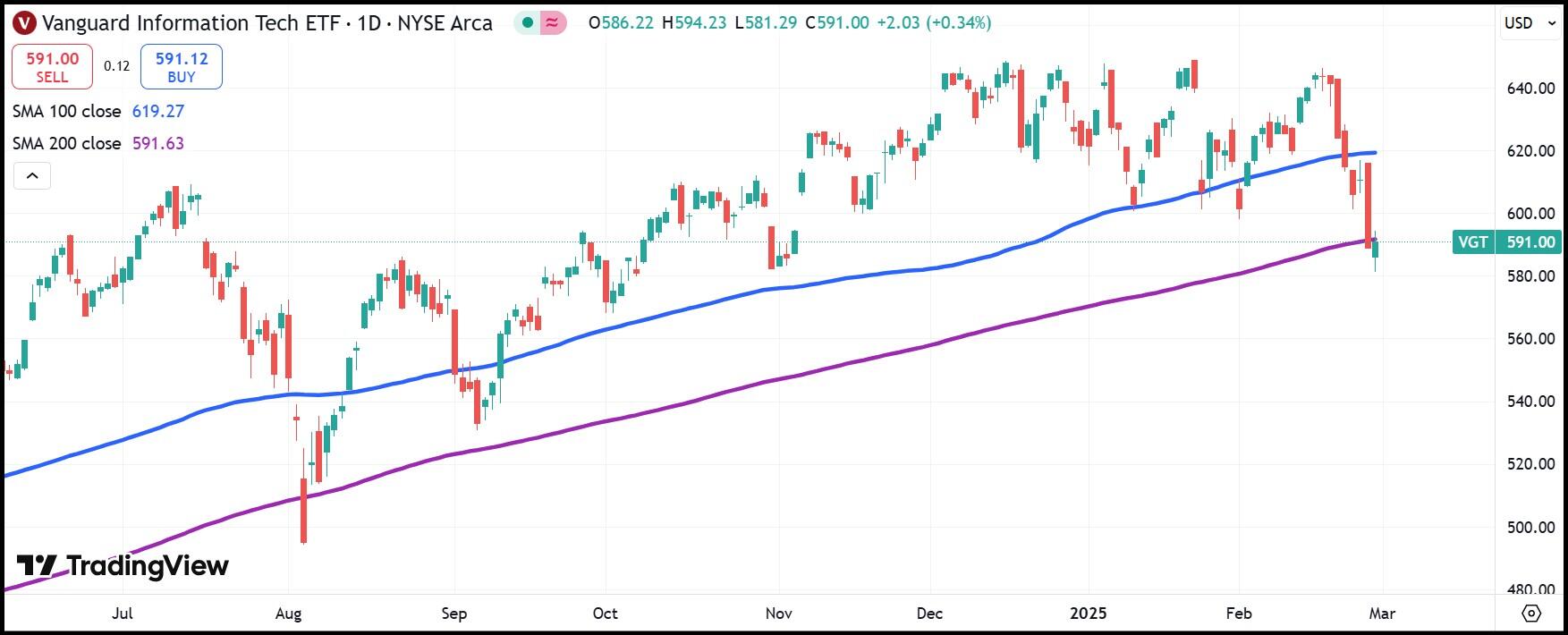
VGT daily stock chart
The American Association of Individual Investors said on Tuesday that its latest weekly survey of retail traders had bearish respondents surge from 40.5% the previous week to 60.6%. Bearish investors are those who expect the market to be lower six months from now.
Bank of America Securities’ February Global Fund Manager Survey (FMS) showed that 89% of fund managers it interviewed viewed the US stock market as “overvalued”, the largest proportion since April 2001.
Author

Clay Webster
FXStreet
Clay Webster grew up in the US outside Buffalo, New York and Lancaster, Pennsylvania. He began investing after college following the 2008 financial crisis.