UnitedHealth stock rises to four-month high. Is the recovery here?
- US Centers for Medicare & Medicaid Services awards bonus payments to health plans with four stars or more.
- UnitedHealth says 78% of its Medicare Advantage plans are expected to feature four stars or higher in 2027 payment year.
- UNH charges up 7% after projecting 2027 bonus payments.
- While much of the market is starting to show wear, UNH is flipping its 100-day moving average.
UnitedHealth Group (UNH), the closely followed and largest US health insurer, advances over 7% on Tuesday after the company offered a welcome outlook on 2027 bonus payments from the US government.
US Centers for Medicare & Medicaid Services (CMS) awards bonus payments to health plans with four stars or more, based on pre-specified criteria for quality. UnitedHealth said that their preliminary estimation is that 78% of their Medicare Advantage plans will receive four star or higher ratings.
The annual Nonfarm Payrolls Benchmark Revision threw the equity market into a bit of turbulence at 10:00am EST on Tuesday when the report showed that hiring figures for the 12 months through March 2025 were revised down by 911K. This equates to 75K fewer jobs per month compared to Nonfarm Payrolls (NFP) estimates during the final three quarters of 2024 and the first quarter of 2025, largely falling under the previous US President Joe Biden.
The stock market was largely muted on the news, but the Dow Jones Industrial Average (DJIA), which includes UNH, rose moderately, up 0.1%, while the NASDAQ Composite and S&P 500 narrowly lost prior gains.
UnitedHealth Group stock news
CMS rates health insurance plans based on operational measures such as call center metrics, pharmacy data and complaints, as well as standardized reports and surveys, including the Healthcare Effectiveness Data & Information Set (HEDIS) data and the Consumer Assessment of Healthcare Providers & Systems (CAHPS) measures.
The present 2027 bonuses are based on UnitedHealth's own analysis of CMS' preliminary ratings for 2026 healthcare plans.
Other good news this week includes UnitedHealth reaffirming the $16.00 adjusted earnings per share guidance that it previously issued on July 29. Sticking to that lowered level, which is down more than 40% from the guidance one year ago, is positive for shareholders since it includes results from the acquisition of home-health services company Amedisys. That acquisition is considered dilutive to this year's earnings, but it now appears that it won't push adjusted EPS below $16.00 per share.
While the market has come to terms with UnitedHealth's poor 2025 showing, investors are now looking ahead to a major turnaround in 2026 as higher premiums get instituted across the sector. Expect Wall Street analysts to raise their EPS estimates for next year, currently at $18.08, over the next several months.
UnitedHealth Group stock forecast
UNH stock is now trading above the key $342 level, which is where the health insurance stock gapped down on May 13. UnitedHealth's unexpected rise in healthcare costs at the start of the year led to lowered earnings guidance and the resignation of its CEO, a multi-month narrative that drove UNH from an all-time high above $630 achieved last November to a five-year low of $234 in early August.
Trading at lunchtime in the low $340s, bulls now have their work cut out for them. Markets love to close gaps, and the May 12 low is all the way up at $376.84. This means that UNH still needs to rally 10% in order to fill that gap. Without any recent volume between $342 and $376.84, expect bulls to fill that void quite quickly.
In a market with few obvious bullish opportunities after the NFP revision, UNH is a clear winner. An additional technical catalyst is that UNH has broken above the 100-day Simple Moving Average (SMA) for the first time since April 16. If the 50-day SMA overtakes its 100-day counterpart, this will be more confirmation that the recovery has legs.
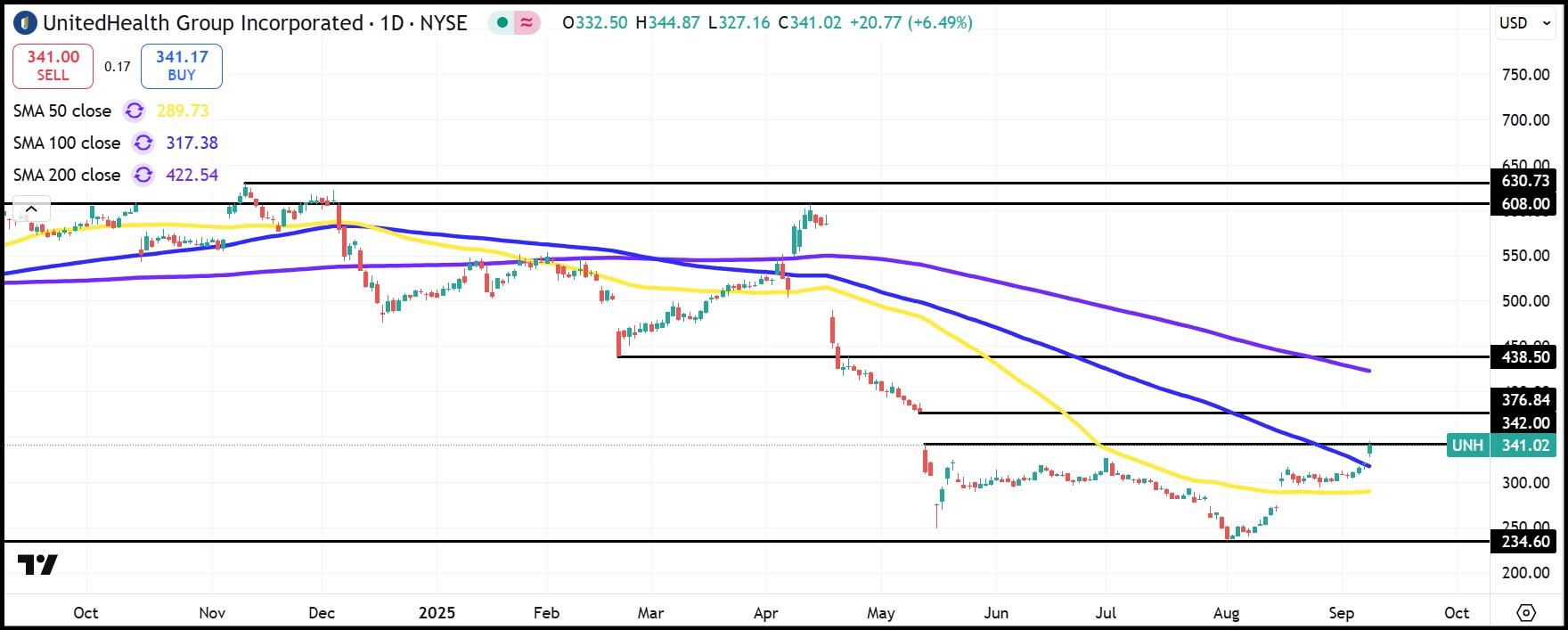
UNH daily stock chart
Author

Clay Webster
FXStreet
Clay Webster grew up in the US outside Buffalo, New York and Lancaster, Pennsylvania. He began investing after college following the 2008 financial crisis.

















