United States FX Today: The US Dollar hinges on CPI inflation data

The US Dollar (USD) is moving cautiously on Wednesday, down slightly on the day according to the US Dollar Index (DXY), as markets hold their breath ahead of the eagerly awaited publication of the August Consumer Price Index (CPI) in the United States (US).
The CPI will be released on Thursday at 12:30 GMT and could prove decisive for the Federal Reserve's next monetary policy decision, scheduled for September 16-17.
Despite lower-than-expected producer inflation (PPI) on Wednesday, with a monthly decline of 0.1%, the Greenback lost just 0.1% on the session.
The CPI report is now the final piece in the puzzle for calibrating rate cut expectations. According to the CME FedWatch Tool, the market is currently pricing in a 90% probability of a 25bp cut, and 10% chances for a 50bp cut.
Inflation still sticky
Economists agree on a shared diagnosis: US inflation remains tenacious, particularly in services.
According to Bank of America, consumer prices should have risen by 0.3% in August, both for the overall index and the "core" index (excluding energy and food). This would bring annual inflation to 2.9%, up from 2.7% in July, while core CPI would remain stable at 3.1%.
Goldman Sachs goes further, anticipating core CPI at 3.13% year-on-year, due to persistent upward pressure on prices for cars, airline tickets, and above all goods subject to tariffs imposed by US President Donald Trump.
"Tariffs continue to fuel inflation, particularly in categories such as communications, furniture and leisure," wrote the bank's economists.
For Morningstar's Frank Lee, these price rises are part of a "slow burn" logic: "This is not a one-off shock, but a gradual rise in costs and supply disruptions that are increasingly affecting households."
The Fed's dilemma: Between low employment and persistent inflation
The macroeconomic picture is becoming increasingly complex for the Fed. On the one hand, the labor market is weakening, as job creation has been massively revised downwards by 911,000 positions over the past 12 months, and the unemployment rate has climbed to 4.3%, the highest since 2021. On the other hand, inflation remains well above the 2% target.
"The combination of price, income and wealth concerns is toxic for growth," warns James Knightley, economist at ING.
The Fed will therefore have to arbitrate between its mandate of price stability and that of full employment. A rate reduction is likely, but a further rise in inflation could slow the pace of future cuts in the remainder of the year.
DXY technical analysis: Persistent downtrend
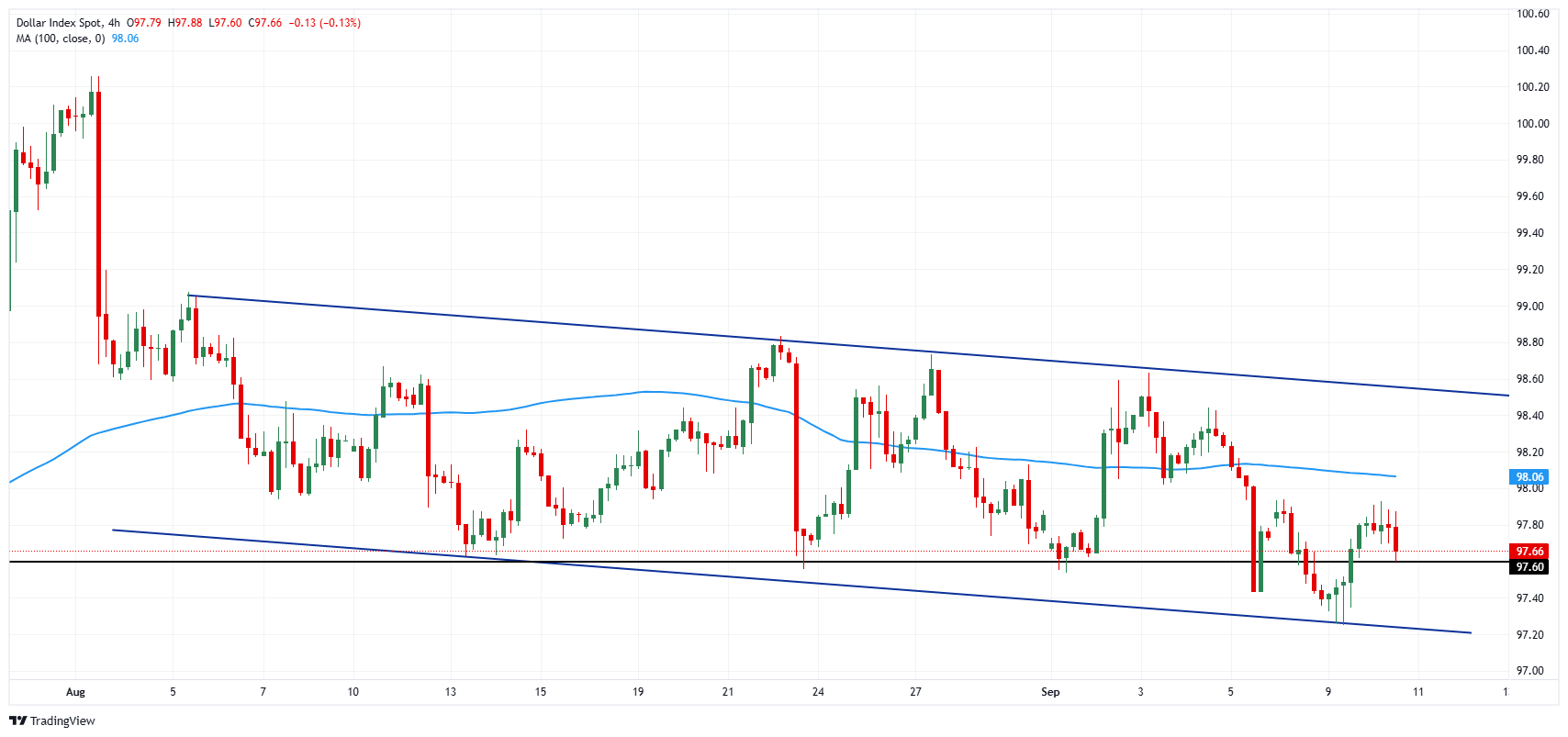
US Dollar Index 4-hour chart. Source: FXStreet
The US Dollar Index retreats slightly on Wednesday, testing a static support level at 97.60, which limits the downtrend for the time being.
However, the downtrend that has lasted since August remains in effect, with the Greenback in a bearish channel on the 4-hour chart.
A breakout from this channel, currently between 97.25 and 98.55, remains necessary before we can consider a more significant impetus, on the downside as well as the upside.
While the current trend is largely dictated by expectations of a Fed rate cut in September, Thursday's inflation data could provide key information on the extent of the rate cut to come, and above all, on the trajectory the Fed could follow for the rest of the year, which could have some influence on the US Dollar price.
The US Dollar is fragile, but awaiting CPI and the Fed
The US Dollar is holding up well while awaiting the inflation verdict. Between tariff tensions, persistent inflation and a weakening job market, the Fed will have to play a tricky game.
Thursday's report could well become the inflection point that redefines the trajectory of financial markets for the end of the year.
Author

Ghiles Guezout
FXStreet
Ghiles Guezout is a Market Analyst with a strong background in stock market investments, trading, and cryptocurrencies. He combines fundamental and technical analysis skills to identify market opportunities.

















