UK CPI inflation falls sharply to 1.7% YoY in September vs. 1.9% forecast
- United Kingdom's annual CPI advanced 1.7% in September vs. 1.9% forecast.
- British inflation eased to 0% MoM in September vs. 0.1% estimate.
- GBP/USD drops toward 1.3000 after UK CPI inflation data.
The United Kingdom (UK) annual Consumer Price Index (CPI) increased by 1.7% in September from 2.2% in August, according to the data released by the Office for National Statistics (ONS) on Wednesday.
Data came in below the estimated growth of 1.9%, moving back under the Bank of England’s (BoE) 2.0% target for the first time in over three years.
Core CPI (excluding volatile food and energy items) advanced by 3.2% YoY in September, compared to a 3.6% rise in August while missing the market consensus of 3.4%.
The UK September Services CPI inflation dropped to 4.9% YoY in September versus August’s 5.6%, below the key 5.0% level.
Meanwhile, the UK Consumer Price Index arrived at 0% MoM in September after rebounding 0.3% in August. The market forecast was for a 0.1% increase in the reported period.
GBP/USD reaction to the UK CPI inflation data
The UK CPI data smashes the Pound Sterling, as the GBP/USD pair drops back toward 1.3000. The pair is trading 0.40% lower on the day near 1.3015, as of writing.
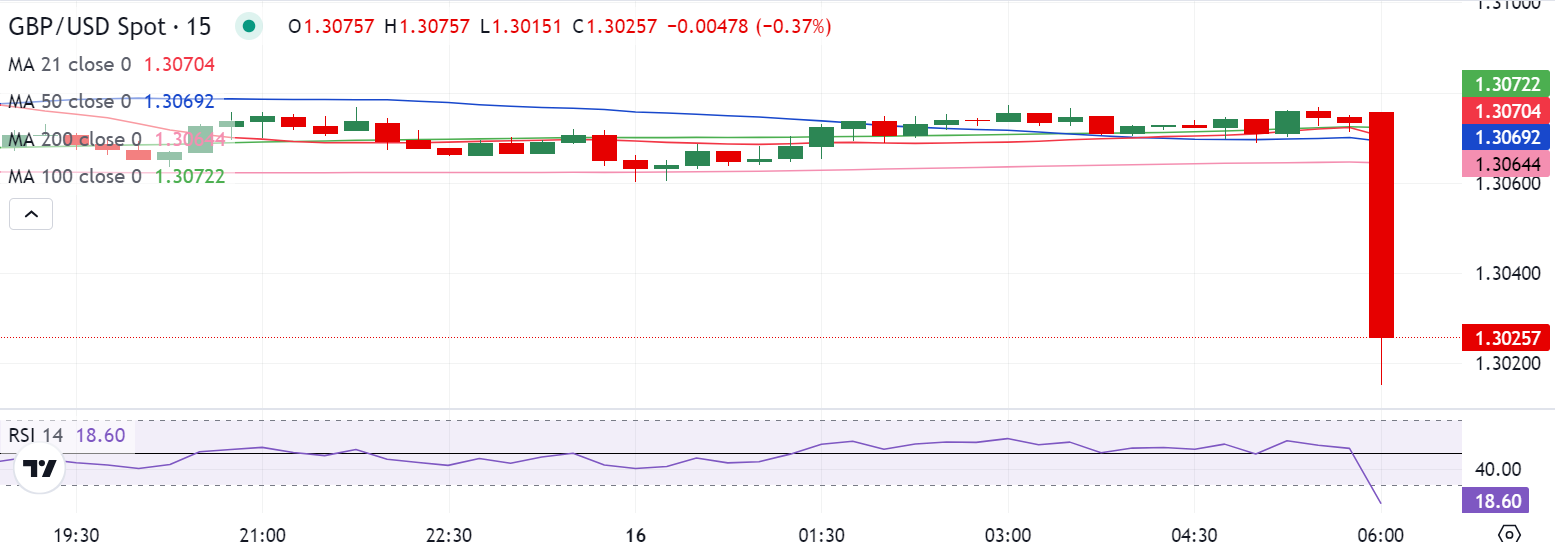
GBP/USD: 15-minutes chart
(This story was corrected on October 16 at 07:27 GMT to say that British inflation eased to 0% MoM in September vs. 0.1% estimate, not 0.2% estimate)
British Pound PRICE Today
The table below shows the percentage change of British Pound (GBP) against listed major currencies today. British Pound was the weakest against the US Dollar.
| USD | EUR | GBP | JPY | CAD | AUD | NZD | CHF | |
|---|---|---|---|---|---|---|---|---|
| USD | 0.10% | 0.36% | 0.07% | 0.00% | 0.13% | 0.30% | 0.06% | |
| EUR | -0.10% | 0.28% | 0.02% | -0.07% | 0.04% | 0.23% | -0.08% | |
| GBP | -0.36% | -0.28% | -0.29% | -0.33% | -0.23% | -0.05% | -0.29% | |
| JPY | -0.07% | -0.02% | 0.29% | -0.06% | 0.05% | 0.22% | 0.00% | |
| CAD | -0.01% | 0.07% | 0.33% | 0.06% | 0.10% | 0.28% | 0.04% | |
| AUD | -0.13% | -0.04% | 0.23% | -0.05% | -0.10% | 0.18% | -0.06% | |
| NZD | -0.30% | -0.23% | 0.05% | -0.22% | -0.28% | -0.18% | -0.25% | |
| CHF | -0.06% | 0.08% | 0.29% | -0.00% | -0.04% | 0.06% | 0.25% |
The heat map shows percentage changes of major currencies against each other. The base currency is picked from the left column, while the quote currency is picked from the top row. For example, if you pick the British Pound from the left column and move along the horizontal line to the US Dollar, the percentage change displayed in the box will represent GBP (base)/USD (quote).
This section below was published at 02:15 GMT as a preview of the UK Consumer Price Index (CPI) inflation data.
- United Kingdom’s Office for National Statistics will release the CPI report on Wednesday.
- The annual UK headline and core inflation are expected to ease in September.
- The UK CPI data could seal in a BoE November interest-rate cut, a scenario that would weigh on Pound Sterling.
The United Kingdom’s (UK) Office for National Statistics (ONS) will release the highly anticipated Consumer Price Index (CPI) data for September on Wednesday at 06:00 GMT.
The UK CPI inflation report could affirm expectations of 25 basis points (bps) interest-rate cut by the Bank of England (BoE) in November, injecting a fresh bout of volatility into the Pound Sterling.
What to expect from the next UK inflation report?
The UK annual Consumer Price Index is likely to increase by 1.9% in September, sharply slowing down from August’s 2.2% growth while moving back below the BoE’s 2.0% target.
The core CPI inflation is set to ease to 3.4% YoY in September from 3.6% in August.
Official data is expected to show that services inflation fell to 5.2% in September from 5.6% the prior month, according to a Bloomberg survey of economists.
The BoE projected the annual headline CPI at 2.1% and services CPI at 5.5% for September.
Meanwhile, the British monthly CPI is seen rising 0.1% in the same period, as against the previous increase of 0.3%.
Previewing the UK inflation data, TD Securities (TDS) analysts noted: “We look for UK inflation to continue its steady march downward. But rapidly falling energy prices still heavily distort the headline number, and services inflation is likely to remain above 5.0% YoY (TDS: 5.2%, mkt: 5.3%), leaving core well above a range the MPC is comfortable with.”
“Hotel and airfare prices remain key sources of volatility in the month,” the TDS analysts said.
How will the UK Consumer Price Index report affect GBP/USD?
Heading into the UK CPI event risk, Pound Sterling traders weigh in on the odds of the BoE rate cut next month, especially after the contradictory messages from BoE policymakers earlier in October.
BoE Chief Economist Huw Pill said that there is “ample reason for caution in assessing the dissipation of inflation persistence,” adding that the “need for such caution points to a gradual withdrawal of monetary policy restriction.” Just a day before Pill’s appearance, Governor Andrew Bailey noted that the UK central bank “could become a bit more activist on rate cuts if there’s further good news on inflation.”
Therefore, the UK CPI data could help confirm whether the BoE will resume its rate-cutting cycle after pausing in September.
An upside surprise to the headline and core inflation data would likely douse the market’s expectations of a rate cut next month, lifting the Pound Sterling. In such a case, GBP/USD could stage a decisive comeback from multi-week troughs.
Conversely, the GBP/USD downtrend could extend if the UK CPI readings meet forecasts or come in softer-than-expectations. Thus, the UK central bank’s progress on disinflation could confirm another rate reduction in November, throwing the British Pound under the bus.
Dhwani Mehta, Asian Session Lead Analyst at FXStreet, offers a brief technical outlook for the major and explains: “GBP/USD has entered a downside consolidative mode in the countdown to the UK CPI data release. The 14-day Relative Strength Index (RSI) holds near 40, suggesting that more losses remain in the offing.”
Dhwani adds: “The pair needs to find acceptance above the 50-day Simple Moving Average (SMA) at 1.3115 on a daily closing basis to negate the near-term bearish bias. The next upside targets are seen at the October 4 high at 1.3175 and the 21-day SMA at 1.3215. Alternatively, the immediate support is aligned at the 100-day SMA at 1.2950, below which the March 8 high of 1.2894 could be tested.”
BoE FAQs
The Bank of England (BoE) decides monetary policy for the United Kingdom. Its primary goal is to achieve ‘price stability’, or a steady inflation rate of 2%. Its tool for achieving this is via the adjustment of base lending rates. The BoE sets the rate at which it lends to commercial banks and banks lend to each other, determining the level of interest rates in the economy overall. This also impacts the value of the Pound Sterling (GBP).
When inflation is above the Bank of England’s target it responds by raising interest rates, making it more expensive for people and businesses to access credit. This is positive for the Pound Sterling because higher interest rates make the UK a more attractive place for global investors to park their money. When inflation falls below target, it is a sign economic growth is slowing, and the BoE will consider lowering interest rates to cheapen credit in the hope businesses will borrow to invest in growth-generating projects – a negative for the Pound Sterling.
In extreme situations, the Bank of England can enact a policy called Quantitative Easing (QE). QE is the process by which the BoE substantially increases the flow of credit in a stuck financial system. QE is a last resort policy when lowering interest rates will not achieve the necessary result. The process of QE involves the BoE printing money to buy assets – usually government or AAA-rated corporate bonds – from banks and other financial institutions. QE usually results in a weaker Pound Sterling.
Quantitative tightening (QT) is the reverse of QE, enacted when the economy is strengthening and inflation starts rising. Whilst in QE the Bank of England (BoE) purchases government and corporate bonds from financial institutions to encourage them to lend; in QT, the BoE stops buying more bonds, and stops reinvesting the principal maturing on the bonds it already holds. It is usually positive for the Pound Sterling.
Author

FXStreet Team
FXStreet
Composed of a group of economic journalists and FX experts, the FXStreet content team produces and oversees all content published on FXStreet. It provides a purely journalistic approach to the Forex market.