UK CPI inflation steadies at 3.8% YoY in September vs. 4.0% expected
- The United Kingdom's annual CPI rose 3.8% in September vs. 4.0% expected.
- British inflation arrived at 0% MoM in Seotember vs. 0.3% prior.
- GBP/USD holds losses near 1.3345 after UK CPI inflation data.

The United Kingdom (UK) headline Consumer Price Index (CPI) rose 3.8% over the year in September, at the same pace seen in August, the data released by the Office for National Statistics (ONS) showed on Wednesday.
Markets predicted a 4.0% growth in the reported period. The reading was well above the Bank of England’s (BoE) 2% inflation target.
The core CPI (excluding volatile food and energy items) rose 3.5% year-over-year (YoY) in the same period, compared to August’s 3.6% print, while missing the forecast of 3.7%.
Services inflation steadies at 4.7% YoY in September vs. 4.7% August.
Meanwhile, the monthly UK CPI inflation came in at 0% in September versus an increase of 0.3% prior.
GBP/USD reaction to the UK CPI inflation data
The Pound Sterling (GBP) attracts some sellers in an immediate reaction to the UK CPI inflation data. At the time of writing, the GBP/USD pair is trading 0.18% lower on the day to trade at 1.3345.
Pound Sterling Price This week
The table below shows the percentage change of British Pound (GBP) against listed major currencies this week. British Pound was the weakest against the New Zealand Dollar.
| USD | EUR | GBP | JPY | CAD | AUD | NZD | CHF | |
|---|---|---|---|---|---|---|---|---|
| USD | 0.52% | 0.62% | 0.88% | -0.16% | -0.25% | -0.37% | 0.46% | |
| EUR | -0.52% | 0.11% | 0.48% | -0.67% | -0.66% | -0.95% | -0.04% | |
| GBP | -0.62% | -0.11% | 0.12% | -0.77% | -0.76% | -1.05% | -0.16% | |
| JPY | -0.88% | -0.48% | -0.12% | -1.09% | -1.15% | -1.33% | -0.51% | |
| CAD | 0.16% | 0.67% | 0.77% | 1.09% | -0.04% | -0.29% | 0.62% | |
| AUD | 0.25% | 0.66% | 0.76% | 1.15% | 0.04% | -0.30% | 0.60% | |
| NZD | 0.37% | 0.95% | 1.05% | 1.33% | 0.29% | 0.30% | 0.90% | |
| CHF | -0.46% | 0.04% | 0.16% | 0.51% | -0.62% | -0.60% | -0.90% |
The heat map shows percentage changes of major currencies against each other. The base currency is picked from the left column, while the quote currency is picked from the top row. For example, if you pick the British Pound from the left column and move along the horizontal line to the US Dollar, the percentage change displayed in the box will represent GBP (base)/USD (quote).
This section below was published at 02:15 GMT as a preview of the UK Consumer Price Index (CPI) inflation data.
- The United Kingdom’s Office for National Statistics will publish the September CPI data on Wednesday.
- The annual UK headline inflation is expected to hit 4%, its highest level since early 2024.
- Core inflation and retail prices are also seen increasing, which might curb hopes of BoE rate cuts in the near term.
The United Kingdom (UK) Office for National Statistics (ONS) will publish the highly relevant Consumer Price Index (CPI) data for September on Wednesday at 06:00 GMT, with markets expecting an uptick in inflationary pressures.
UK consumer inflation is a key release for the Bank of England (BoE) and has a significant impact on the Pound Sterling (GBP). The central bank’s Monetary Policy Committee meets on November 6, and Wednesday’s inflation readings will be the last ones ahead of the interest rate decision.
What to expect from the next UK inflation report?
The UK headline Consumer Price Index is forecast to have accelerated to a 4% annual rate in September* from the 3.8% YoY seen in August. If these figures are confirmed, it will be the strongest inflation reading since January 2024, and twice as high as the BoE’s 2% target for price stability.
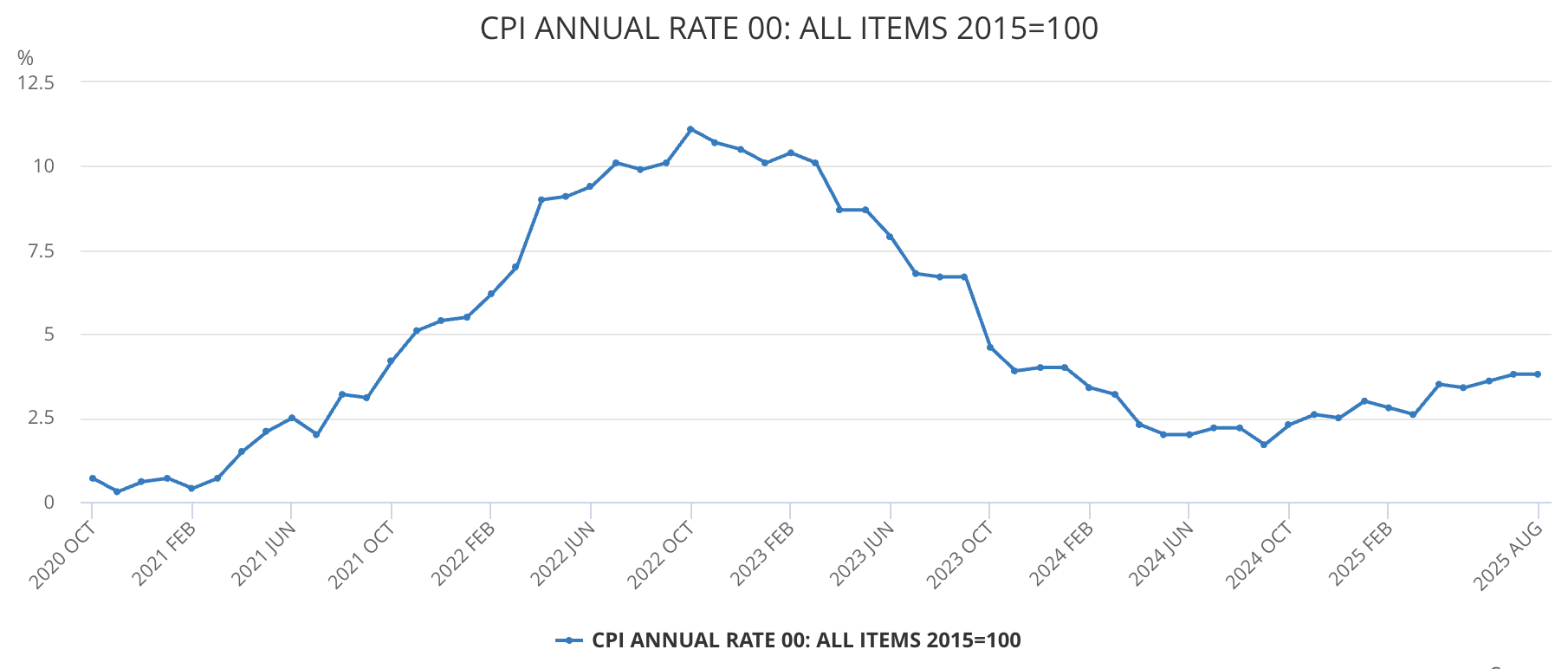
Source: National Statistics
The UK core CPI, considered more relevant for the central bank, as it strips off the seasonal impact of food and energy prices, is also expected to have heated, although at a milder pace. The UK’s core inflation is seen at 3.7% YoY in September, from the previous month’s 3.6% reading.
Monthly inflation is expected to have risen 0.2%, both headline and core CPI, following 0.3% advances in August.
Together with consumer inflation, National Statistics is expected to release the Retail Prices Index numbers, which are also expected to have picked up to a 4.7% YoY growth last month, from 4.6% in August. The Bank of England’s Chief Economist, Huw Pill, has endorsed this view, affirming that the bank “needs to recognise CPI stubbornness as more pressing,” and that “a more cautious pace of withdrawing monetary policy restrictions than seen over the past year may be appropriate.”
How will the UK Consumer Price Index report affect GBP/USD?
A 4% inflation reading, as the market consensus anticipates, is likely to trigger a significant repricing of the Bank of England's monetary easing prospects, which might provide some support to the British Pound.
Data released in previous weeks revealed that the UK labour market is stabilising, following declines in payrolls and vacancies earlier this year. National Statistics numbers showed that the Unemployment Rate ticked up to 4.8% in the three months to August, and net employment increased by 91K, following a 232K increment in July.
Beyond that, Gross Domestic Product (GDP) bounced up to 0.1% in August, buoyed by a 0.7% growth in Manufacturing Production. This reading partly reverses the 1.1% contraction seen in July and beats expectations of a 0.4% growth.
All in all, the figures reflect a solid economy that copes well in the face of an uncertain global trade scenario, allowing the Bank of England to hold rates at the current levels for some time.
At their latest monetary policy meeting in September, the UK central bank left its benchmark interest rate at 4%, with two dissenting members voting for a further rate cut. The meeting minutes already highlighted a more cautious approach to monetary easing amid persistent inflation risks.
In this context, a strong CPI, 4% or higher, would curb hopes of further rate cuts in the coming months and might give the Pound an additional impulse. Softer-than-expected data, on the contrary, might keep hopes of further monetary easing alive and add pressure on the GBP.
GBP/USD 4-hour chart
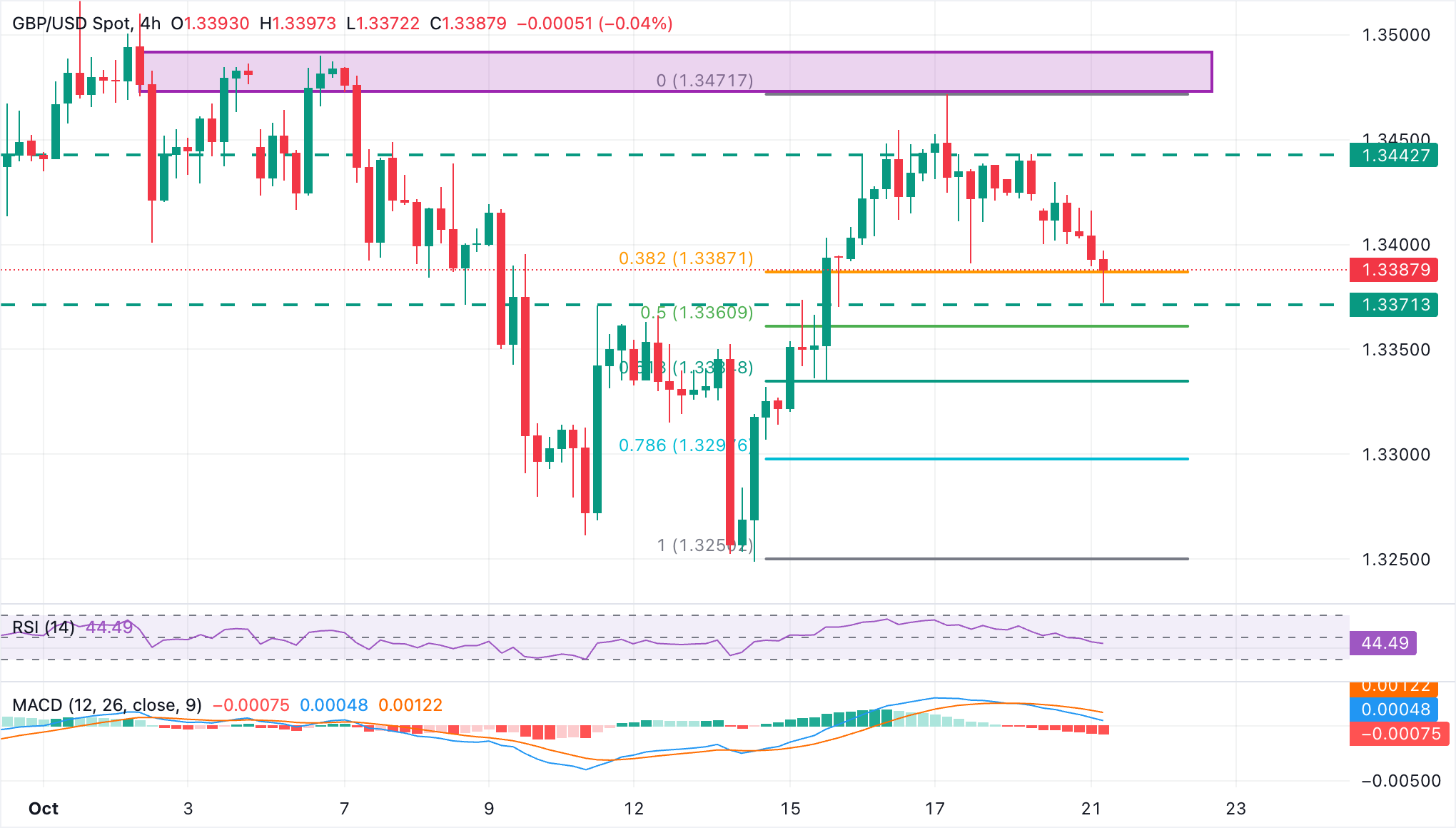
Regarding the GBP/USD pair, FXStreet analyst Guillermo Alcalá sees price action correcting lower after peaking at 1.3470 last week: “The GBP/USD recovery has been capped at the 1.3470 area, and the pair has been trading lower ever since, with the 61.8% Fibonacci retracement of the mid-October rally, at 1.3335 emerging as a plausible target for a bearish correction.”
On the upside, Alcalá sees a significant resistance area between 1.3470 and 1.3490: "Bulls, on the contrary, have remained capped below 1.3445, but the key resistance remains in the area between October 17 and 7 highs at 1.3470 and 1.3490, respectively."
Inflation FAQs
Inflation measures the rise in the price of a representative basket of goods and services. Headline inflation is usually expressed as a percentage change on a month-on-month (MoM) and year-on-year (YoY) basis. Core inflation excludes more volatile elements such as food and fuel which can fluctuate because of geopolitical and seasonal factors. Core inflation is the figure economists focus on and is the level targeted by central banks, which are mandated to keep inflation at a manageable level, usually around 2%.
The Consumer Price Index (CPI) measures the change in prices of a basket of goods and services over a period of time. It is usually expressed as a percentage change on a month-on-month (MoM) and year-on-year (YoY) basis. Core CPI is the figure targeted by central banks as it excludes volatile food and fuel inputs. When Core CPI rises above 2% it usually results in higher interest rates and vice versa when it falls below 2%. Since higher interest rates are positive for a currency, higher inflation usually results in a stronger currency. The opposite is true when inflation falls.
Although it may seem counter-intuitive, high inflation in a country pushes up the value of its currency and vice versa for lower inflation. This is because the central bank will normally raise interest rates to combat the higher inflation, which attract more global capital inflows from investors looking for a lucrative place to park their money.
Formerly, Gold was the asset investors turned to in times of high inflation because it preserved its value, and whilst investors will often still buy Gold for its safe-haven properties in times of extreme market turmoil, this is not the case most of the time. This is because when inflation is high, central banks will put up interest rates to combat it. Higher interest rates are negative for Gold because they increase the opportunity-cost of holding Gold vis-a-vis an interest-bearing asset or placing the money in a cash deposit account. On the flipside, lower inflation tends to be positive for Gold as it brings interest rates down, making the bright metal a more viable investment alternative.
Author

FXStreet Team
FXStreet
Composed of a group of economic journalists and FX experts, the FXStreet content team produces and oversees all content published on FXStreet. It provides a purely journalistic approach to the Forex market.

















