|

The earnings paradox: Why Lattice Semi (LSCC) plunged despite a double beat

Lattice Semiconductor Corporation (LSCC), a leader in low-power programmable logic solutions, reported earnings after the market closed on Monday. The company delivered a double beat, narrowly surpassing expectations on both earnings per share (by 0.55%) and revenue (by 0.25%). Despite this success and an increase in forward guidance, the stock initially plunged in after-hours trading, hitting a low of $65.00 before recovering overnight to stabilize in the $72 range.

So, why the immediate sell-off after a beat? The primary catalysts for the dip were two-fold: a decline in GAAP profit and investor disappointment that the Q4 guidance, while showing growth, was not aggressive enough to meet the market's high expectations.

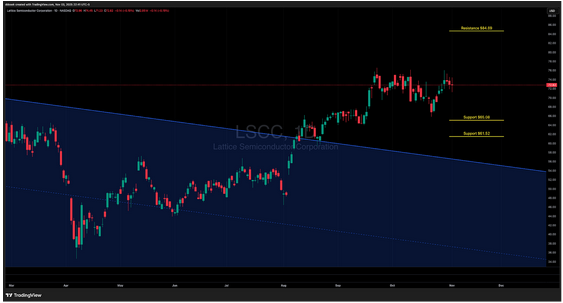
Zooming out to the charts, LSCC put in a significant daily topping tail at $76.61 back on September 23rd. Price has been contained beneath that exact level ever since. To the upside, this is the immediate resistance and the critical level that bulls must conquer. Should price break and hold above $76.61, the next major resistance target comes into play at $84.69. Considering that LSCC has broken out of a declining parallel and spent the last few months consolidating—even with the prior topping tail—the price action has demonstrated impressive resilience. The momentum gained from this recent consolidation phase could be precisely what's needed to push the stock to that next higher level.

However, if this bullish momentum fails to materialize or hold, the first key support level lies at $65.08. This is the level that was tagged during the initial after-hours sell-off. A daily confirmed break below $65.08 would effectively negate the current bullish pattern. Should that occur, we would look toward the next support at $61.52, a level where LSCC could potentially rebuild the necessary foundation for its next sustained rally.
Chart

Author

Drew Dosek

Drew Dosek

Verified Investing

Passionate technical and cycle analyst committed to empowering traders through data-driven insights.


More from Drew Dosek
Share:

Editor's Picks

GBP/USD declines as market caution lifts US Dollar

GBP/USD extends its gains for the second successive day, trading around 1.3200 during the Asian hours on Wednesday. The currency pair depreciated as the US Dollar gained momentum, driven by a combination of robust domestic economic data and a complex, mixed geopolitical landscape.

EUR/USD hits one-year low, eyes 1.1350 as bullish USD offsets oversold RSI

The EUR/USD pair drifts lower for the third straight day – also marking the fifth day of a negative move in the previous six – and drops to over a one-year low during the Asian session on Wednesday. Spot prices currently trade around the 1.1365 area, down nearly 0.15% for the day, and seem vulnerable to slide further amid a bullish US Dollar.

$4,050: Gold dives to fresh two-week low as Fed rate hike bets boost US Dollar

Gold drifts lower for the second straight day – also marking the fifth day of a negative move in the previous six – and drops to a nearly two-week low during the Asian session on Wednesday. Despite easing inflationary concerns in the face of the recent fall in Crude Oil prices, traders have been pricing in a greater chance of a rate hike by the US Federal Reserve. 

Bitcoin under pressure, Ethereum loses key support, XRP momentum weakens

Bitcoin, Ethereum and Ripple remain under pressure on Wednesday after falling slightly the previous day. BTC trades below $63,000, ETH slips below $1,700, while XRP momentum continues to weaken. The deteriorating price action in these top three cryptocurrencies suggests a potential continuation of the near-term correction.

"Rearranging the deckchairs on the Titanic": UK's fiscal crisis outlasts another Prime Minister

Keir Starmer's resignation as the UK Prime Minister comes ten years after the Brexit referendum vote, a coincidence that financial markets have been quick to note. The British Pound trades around 1.3220 against the US Dollar on Thursday.

Regime change: Inside Kevin Warsh's first move to make the Fed unreadable on purpose

The rate did not move. That was the least interesting thing about Kevin Warsh's first meeting in charge of the Fed. The FOMC held its benchmark at 3.50%-3.75% for the fourth straight meeting, exactly as priced, and then the new chair used his first press conference to dismantle the machinery the market has leaned on for a decade.