Tesla (TSLA) Stock Price and Forecast: Loses key $1,000 level amid Wall Street sell-off
- Tesla broke below key $1,000 amid a dismal market mood.
- Equity markets remain supportive with more all-time highs for the indices.
- TSLA is still seeing selling from CEO Elon Musk.

Update, December 14: Tesla shares tanked almost 5% to $966.41 on Monday, hitting the lowest levels in five days. The sell-off ensued as the broader Wall Street indices tumbled on fears over the spread of the Omicron covid variant and pre-Fed anxiety. The Fed is likely to deliver a hawkish decision on Wednesday in a bid to combat elevated inflation. The Nasdaq Composite Index (NASDAQ) lost 1.4% of its value, prompting Tesla's stock price to lose the $1,000 mark.
Tesla (TSLA) shares are still holding above the key $1,000 level as we approach the final lap of the year. Tesla is up an impressive 44% so far this year in what has been the year of the mega tech names. Indeed, Goldman Sachs notes this morning that five stocks account for more than half of the S&P 500's return since the end of April. Those names are all familiar big tech: Tesla, Microsoft, Alphabet, Nvidia and Apple. This so-called narrowing of the returns or a lack of market breadth is often cited as a bearish factor. Goldman adds that the market cap of the top 10 stocks in the S&P 500 make up 31% of the total S&P 500 market cap. That is the highest since 1980.
While all this is beginning to sound increasingly alarmist, fear not, Goldman said. They estimate that this narrowing trend is set to continue and to stick with growth stocks into 2022. Tesla should see more benefits if that strategy is maintained, adding further to the large headache the stock gives to investors. Price/earnings multiples are out the window with Tesla. It is pure momentum.
-637749981017864258.png)
Tesla (TSLA) chart, 15-minute
Tesla (TSLA) stock news
Not exactly stock specific, but Elon Musk is Time Magazine Person of the Year for 2021. Time's CEO said, "Person of the Year is a marker of influence, and few individuals have had more influence than Musk on life on Earth, and potentially life off Earth too."
The TIME CEO called the EV sector "a market that Musk almost single-handedly created, seeing long before others the demand for clean-energy transportation that the world’s climate crisis would eventually propel."
In other more specific news, Tesla has had to stop accepting orders for new Model S and Model X orders outside North America, according to Electrek. Tesla is rumored to have a large backlog of orders. Demand obviously remains strong as more and more countries offer incentives for electric vehicle purchases.
Tesla (TSLA) stock forecast
We are still forecasting Tesla to return to the gap at $910 before year end. $1,000 held again on Friday, but the level is seeing increasing bombardment. The more a level is tested, the weaker it becomes. We fear the next time it will go, and that will signal a sharp move to $910. The stock is already well capped by the 9 and 21-day moving averages, and only a break above $1,063 will change our bearish stance.
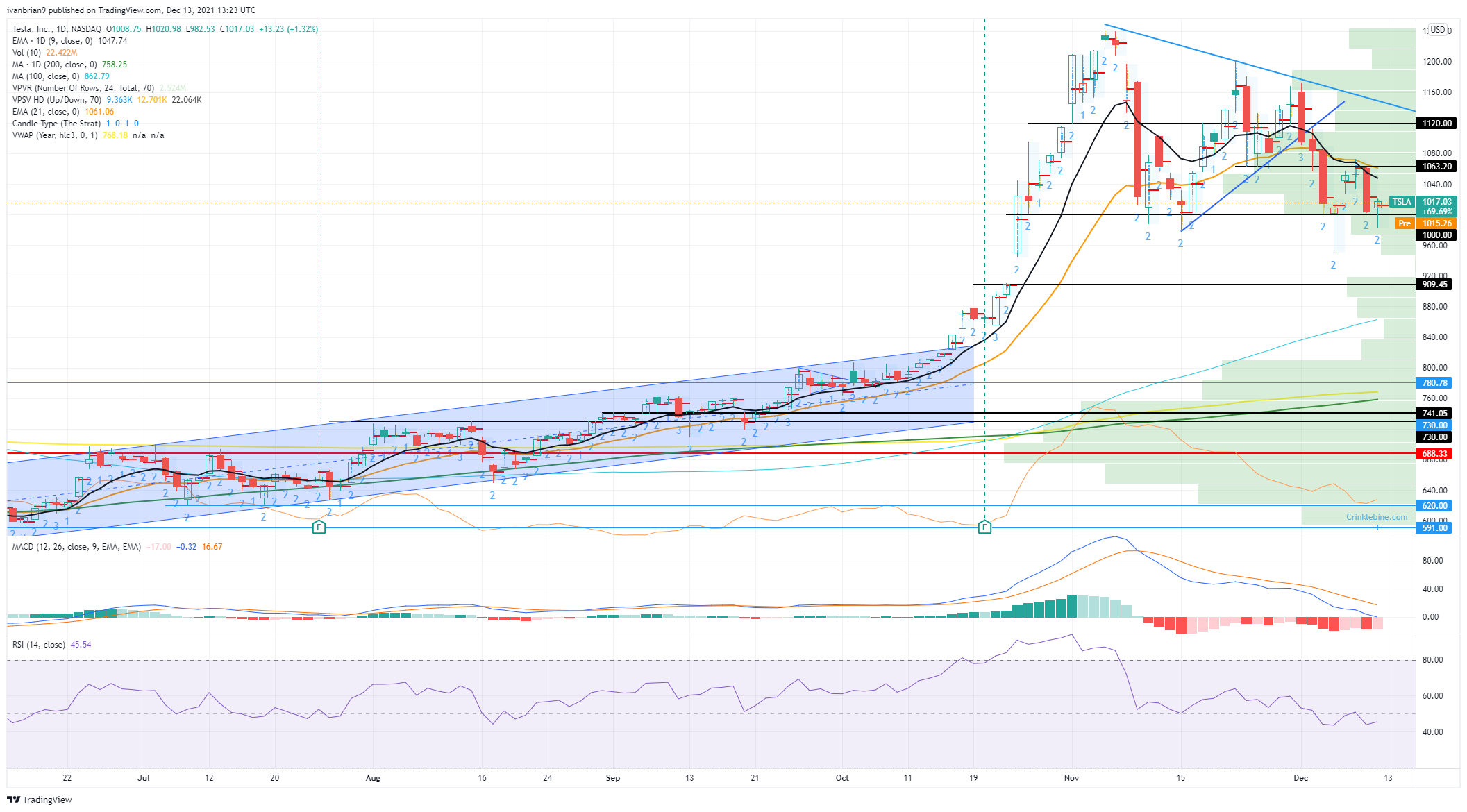
Tesla daily chart
Previous update:
Update: TSLA shared are down 4.42% quoting at $972.08 per share, as Wall Street took a dive at the beginning of the week. The Nasdaq Composite is down roughly 120 points, while the rest of the major indexes also trade in the red. Investors moved away from high-yielding assets ahead of the US Federal Reserve decision on monetary policy, as the central bank is expected to speed up tapering.
Like this article? Help us with some feedback by answering this survey:
Author

Ivan Brian
FXStreet
Ivan Brian started his career with AIB Bank in corporate finance and then worked for seven years at Baxter. He started as a macro analyst before becoming Head of Research and then CFO.