Tech stocks skid as Trump's aggravation with China, Marvell earnings lead to Friday pullback
- Trump blasts China for supposedly violating trade agreement.
- MRVL sells off nearly 8% as semiconductors see multiple compressions.
- Germany proposes a new 10% tax on US internet platforms.
- University of Michigan data shows improving consumer outlook in May.

US tech stocks are shedding weight on Friday following several negative news stories. The NASDAQ Composite has given up as much as 0.9%, while the Dow Jones Industrial Average (DJIA) is slightly positive.
Investors are less enthusiastic after US President Trump issued a rebuke of China in ongoing trade talks. The President didn't give any evidence but said, "The bad news is that China, perhaps not surprisingly to some, HAS TOTALLY VIOLATED ITS AGREEMENT WITH US. So much for being Mr. NICE GUY!"
The Trump administration agreed to lower its tariffs on China from above 145% to 30% on May 12, as China returned the favor by cutting 125% tariffs to 10%. On Thursday, however, Treasury Secretary Scott Bessent told Fox News that trade talks were "a bit stalled" and that China's Xi Jinping would need to speak directly with President Trump.
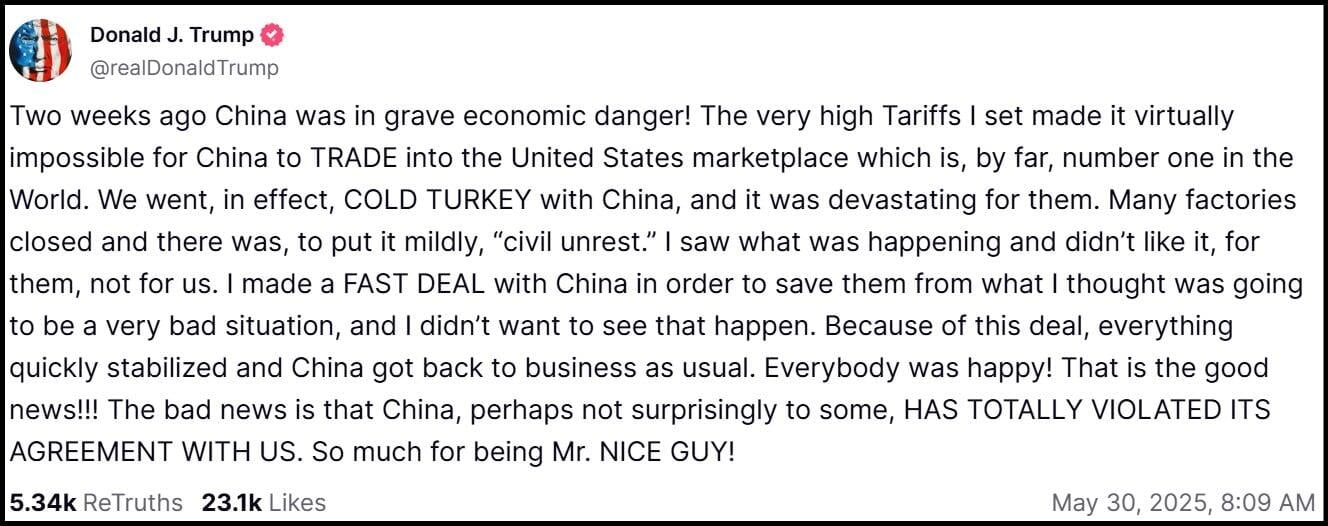
Trump Truth Social Post on May 30, 2025
Elsewhere, the United States Court of Appeals for the Federal Circuit issued a stay of the US Court of International Trade's Wednesday ruling that halted Trump's broad country-level tariffs. The tariffs will remain in place until a higher court rules on the matter of Trump's powers to wield tariffs unilaterally.
Marvell Technology earnings news
Marvell Technology (MRVL) stock traded almost 8% lower on Friday after reporting quarterly results. The company that designs specialty semiconductors beat Wall Street consensus for adjusted earnings per share (EPS) by a penny, and revenue of $1.9 billion in fiscal Q1 arrived $16 million above consensus.
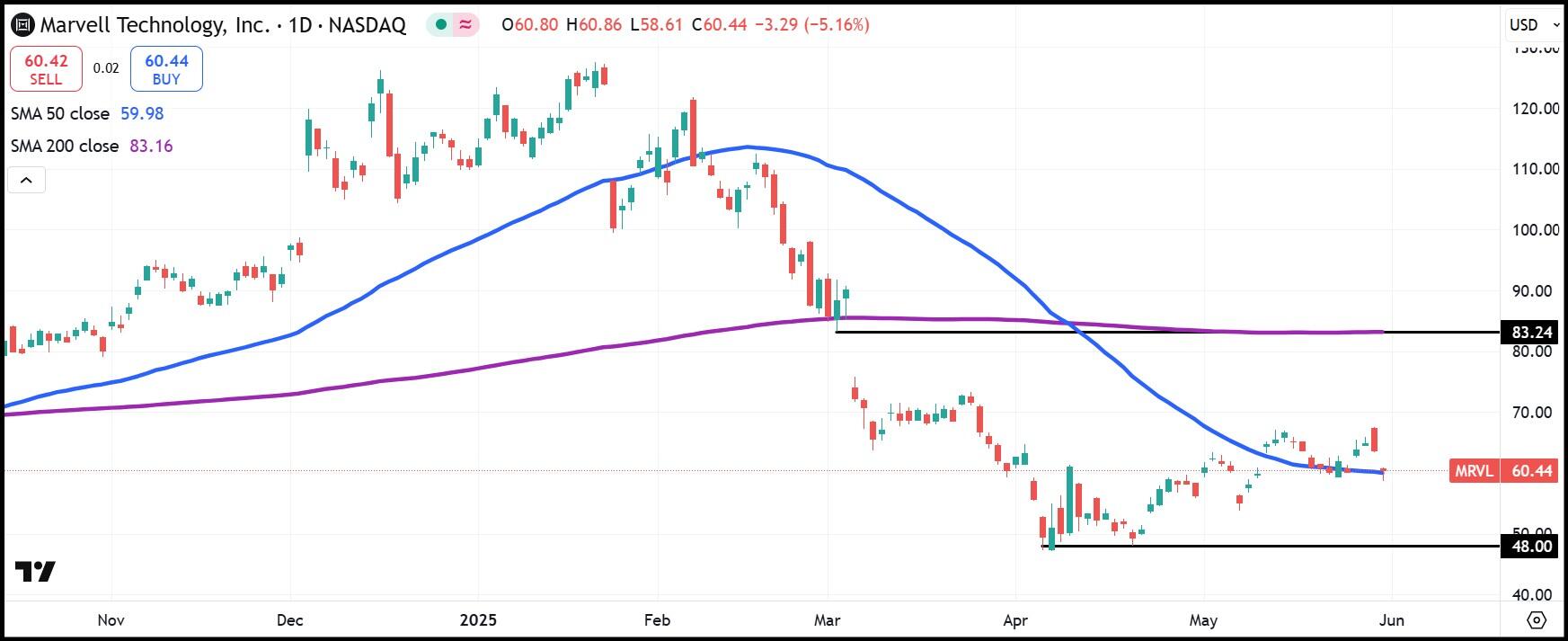
MRVL daily stock chart
However, investors were dismayed that Q2 revenue and earnings, while in line with expectations, don't show all that much growth. Analysts commented that without new, exciting news, the market was tending toward multiple compression in the semiconductor industry.
Needham lowered its price target on MRVL shares from $100 to $85.
Nvidia (NVDA), the leading semiconductor designer, was the worst-performing Dow Jones stock on Friday morning, sinking 1.6%.
Economic indicators mostly better, but proposed German tax
The Federal Reserve's (Fed) preferred inflation indicator came in-line with consensus on Friday. Core Personal Consumption Expenditures (PCE) in April arrived at 0.1% MoM and 2.5% YoY. However, March's monthly reading was revised up by 10 basis points to 0.1% as well.
Personal Income also ticked up 0.8% in April compared with the estimate of 0.3%.
Another bright spot was University of Michigan data that showed May Consumer Inflation Expectations and Consumer Sentiment improving compared with April.
However, the May Chicago Purchasing Managers Index (PMI) dropped surprisingly to 40.5 from 44.6 in April and compared to the 45.0 consensus. This shows a starker downtrend in the Chicago area manufacturing sector.
Investors are also somewhat annoyed by the German government announcing its intention to place a 10% tax on large internet platform companies like Alphabet (GOOGL) and Meta Platforms (META). The proposal is similar to an Austrian policy that taxes these companies at 5% of revenue.
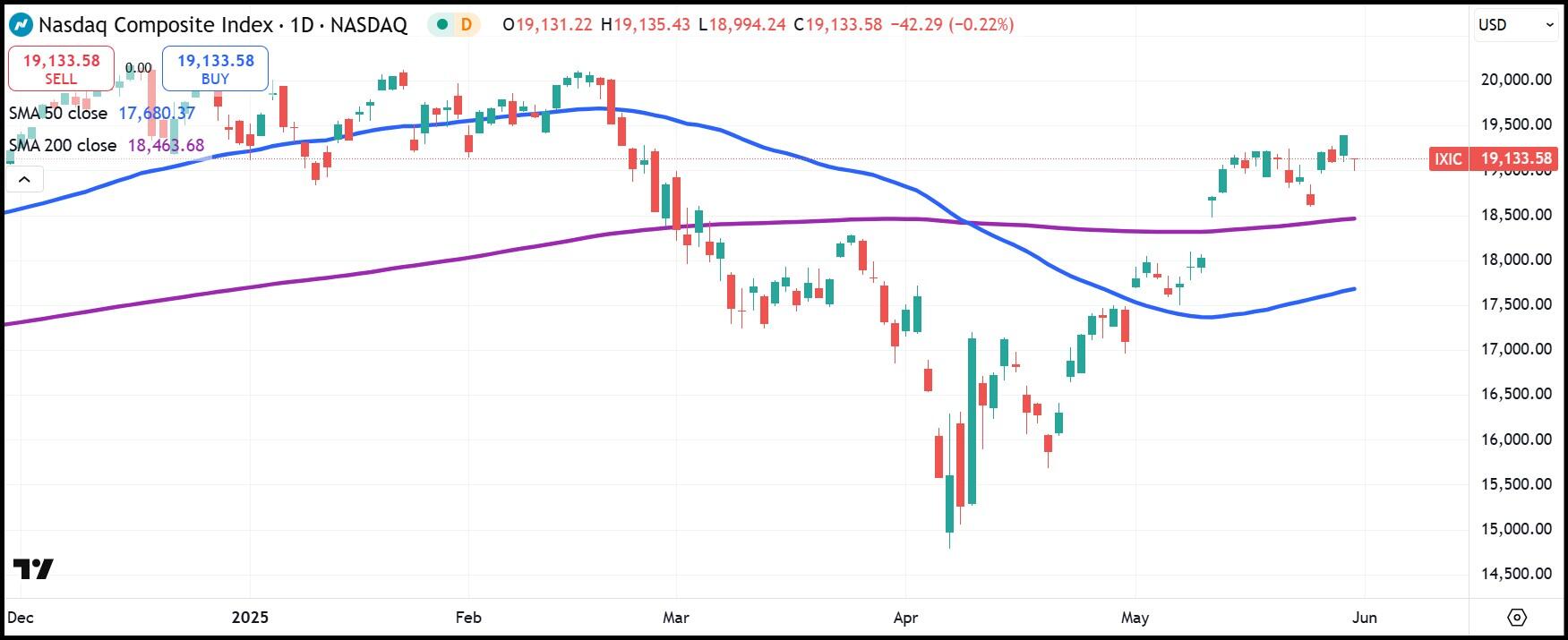
NASDAQ Composite daily chart
Author

Clay Webster
FXStreet
Clay Webster grew up in the US outside Buffalo, New York and Lancaster, Pennsylvania. He began investing after college following the 2008 financial crisis.