Stocks face more volatility ahead of Fed and earnings

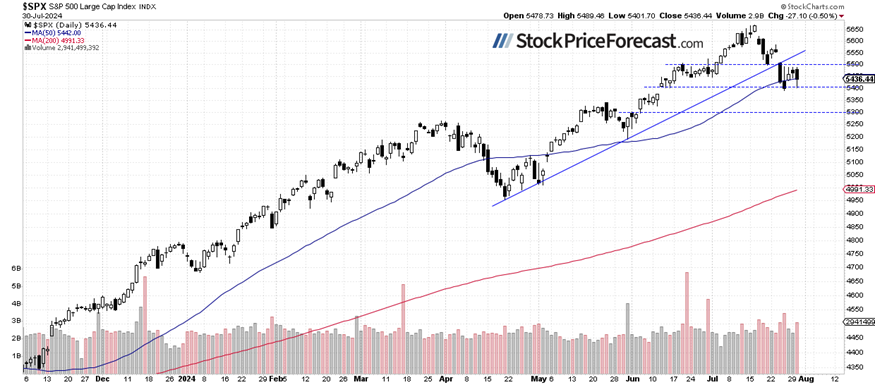
Stock prices fluctuated yesterday, with the S&P 500 index closing 0.50% lower, extending a short-term consolidation after recent declines. The index approached last week’s local low of 5,390.95 before rebounding from the 5,400 level. This morning, sentiment is improving, and the index is likely to open 1.0% higher, retracing yesterday’s decline.
Last Friday, I noted “Is the market forming a bottom pattern? It might be, but given the clear downtrend, the recent fluctuations are likely just a consolidation before another leg lower. We’re awaiting crucial earnings data next week and the important FOMC Rate Decision on Wednesday.”
Today, we will get an earnings release from META, and tomorrow, AMZN and AAPL will release their numbers, likely influencing market sentiment. The important FOMC release today will likely be met with volatility as well.
My speculative short position in S&P 500, opened on July 9, remains profitable.
Investor sentiment has recently worsened, as indicated by last Wednesday’s AAII Investor Sentiment Survey, which showed that 43.2% of individual investors are bullish, while 31.7% of them are bearish – up from 23.4% last week.
As I mentioned in my stock price forecast for July, “While more advances remain likely, the likelihood of a deeper downward correction also rises. Overall, there have been no confirmed negative signals so far, but the May gain of 4.8% and June gain of 3.5% suggest a more cautionary approach for July (…) The market will be waiting for the quarterly earnings season in the second half of the month. Plus, there will be a series of economic data, including the CPI release on July 11, the Advance GDP number on July 25, and the FOMC Rate Decision on July 31.”
The S&P 500 index continues to consolidate above the 5,400 level, as we can see on the daily chart.
Nasdaq 100 reached a new local low
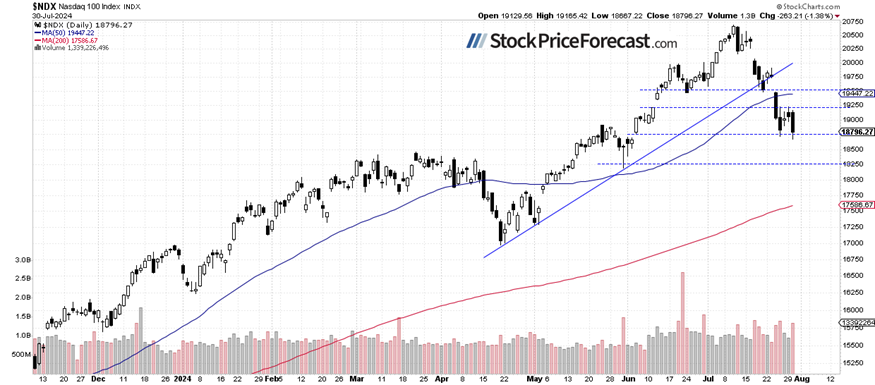
The technology-focused Nasdaq 100 index lost 1.38% yesterday after reaching a new local low of 18,667.22. It remained relatively weaker than the broader stock market. However, this morning, the Nasdaq 100 is likely to open 1.5% higher ahead of the Fed release and META’s earnings later in the day.
VIX remains relatively high
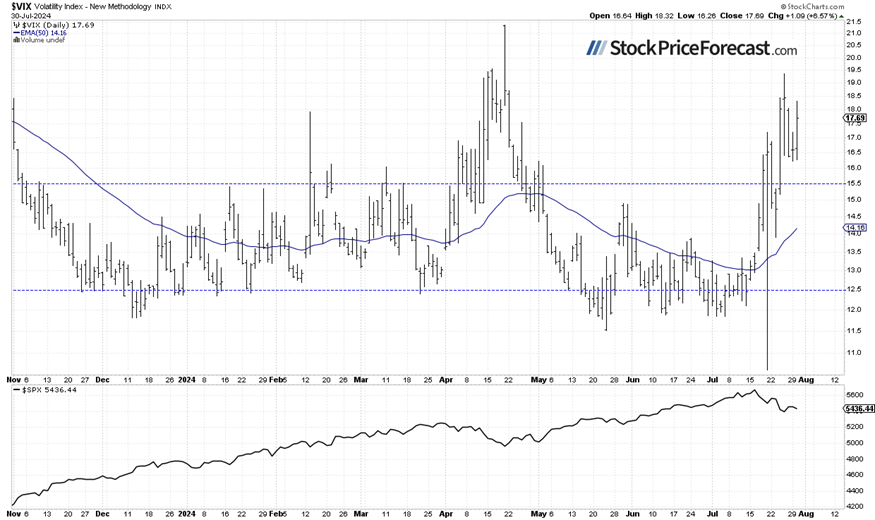
The VIX index, a measure of market fear, has been hovering around the 12-13 level since May. Last Thursday, it was as high as 19.36 following its recent advances, fueled by the decline in stock prices. Yesterday, it came back above 18 after retreating to 16.0-16.5, indicating ongoing uncertainty in the market.
Historically, a dropping VIX indicates less fear in the market, and rising VIX accompanies stock market downturns. However, the lower the VIX, the higher the probability of the market’s downward reversal. Conversely, the higher the VIX, the higher the probability of the market’s upward reversal.
Futures contract testing local highs again
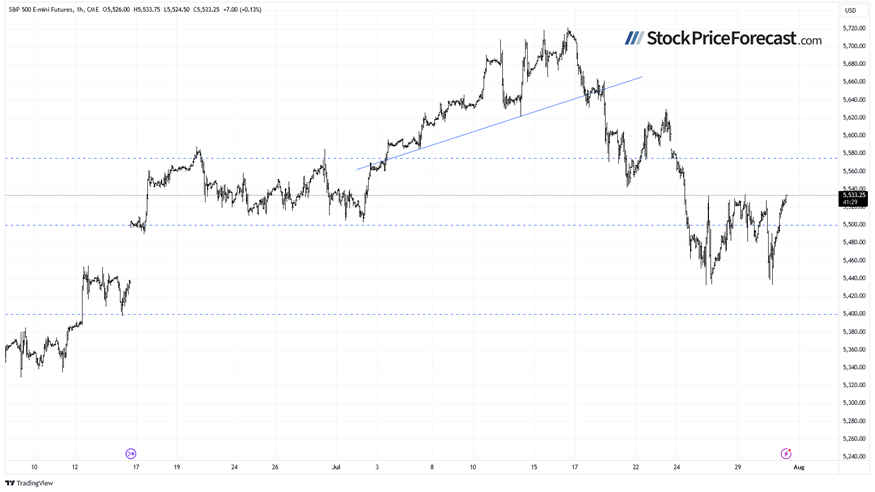
Let’s take a look at the hourly chart of the S&P 500 futures contract. The market continues to experience volatility following its recent decline. Yesterday, it dropped to 5,433, and this morning, it’s trading near recent highs around the 5,530 level. The resistance level is at 5,550, with support at 5,480-5,500.
Conclusion
Last Friday, I wrote: “This week’s sell-off raises questions: Was it just a correction? Or was it the beginning of a downtrend? Seasonal patterns suggest that the low is likely to happen in October, but the future does not always follow the past. For now, it looks like a downtrend, and in the short term, an upward correction may occur.”
The earnings season is in full swing, and today, we will get the FOMC release. Yesterday, I wrote that “the releases will likely lead to volatility, and maybe buying pressure for stocks.” It proved correct, as the sentiment is positive again this morning.
My speculative short position in the S&P 500 futures contract, opened on July 9, remains profitable.
For now, my short-term outlook remains bearish.
Here’s the breakdown:
The S&P 500 index is experiencing increased volatility following its recent sell-off.
Investors are waiting for key quarterly earnings releases from big-techs this week, and the Fed release tomorrow, among others.
In my opinion, the short-term outlook is bearish.
Want free follow-ups to the above article and details not available to 99%+ investors? Sign up to our free newsletter today!
Want free follow-ups to the above article and details not available to 99%+ investors? Sign up to our free newsletter today!
Author

Paul Rejczak
Gold Price Forecast
Paul Rejczak is a stock market strategist who has been known for the quality of his technical and fundamental analysis since the late nineties.