Stock Market Today: US equities shed weight as investors pull back from overbought territory
- Wall Street's main indexes push lower after opening in negative territory on Tuesday.
- Fed Chairman will testify on the semi-annual Monetary Policy Report this week.
- Tech shares suffer large losses, weighing heavily on Nasdaq Composite.

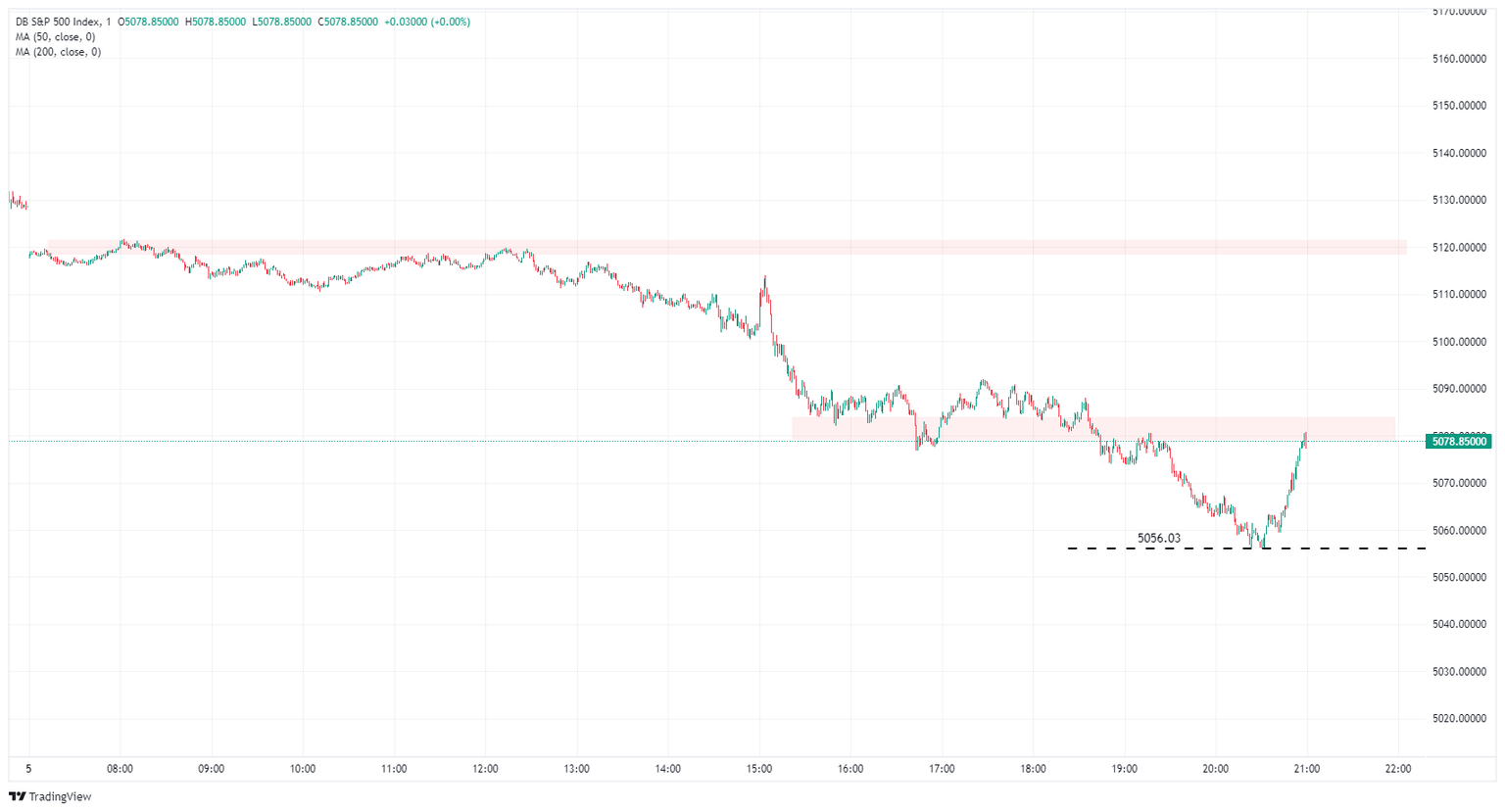
The S&P 500 (SPX) index fell 1.02% to close the session at 5,078.65. The Dow Jones (DJIA) dropped 1.04% to end at 38,585.19, while the Nasdaq (IXIC) lost 1.65% to finish at 15,939.59.
Stock market news
The Technology Sector was far and away the biggest loser on Tuesday, declining nearly 2.2% over the day. Meager gains capped the green index divisions, with the Energy Sector clawing up 0.74%, followed by the Consumer Staples Sector which gained 0.34%.
Target Corp. (TGT) soared a little over 12% on Tuesday to close at $168.58, with the day's second-best DeVita Inc. (DVA) climbing just over 7% to end at $134.65. Albermarie Corp. (ALB) tumbled nearly 18% to hit $109.40 at the closing bell.
Assessing the latest developments in equity markets, “the quiet start to the week for US equities did see the Magnificent 7 (-0.85%) under-perform, with slightly more moderate losses for the NASDAQ (-0.41%),” said Jim Reid, global head of economics and thematic research at Deutsche Bank, and continued:
“There were contrasting moves within the Magnificent 7, with Tesla down -7.16% amid new price cuts and discounts by EV maker, while Nvidia (+3.60%) overtook Saudi Aramco to become the third largest company in the world by market cap. On the other hand, the equal-weighted version of the S&P 500 was up +0.24% on the day, as utilities (+1.65%) and banks (+1.58%) outperformed. Back in Europe, the STOXX 600 (-0.03%) was flat on the day, but there was a noticeable underperformance from the FTSE 100 (-0.55%).”
Focus shifts to Fed Chairman Powell testimony
The data from the US showed on Tuesday that the ISM Services PMI declined to 52.6 in February from 53.4 in January. Other details of the report showed that the Prices Paid Index, the inflation component, declined to 58.6 from 64, while the Employment Index fell to 48 from 50.5, reflecting a decrease in the sector's payrolls.
The US Census Bureau reported that Factory Orders decreased by 3.6% in January, following the 0.3% contraction recorded in December. This reading came in worse than the market expectation for a decline of 2.9%.
Speaking on the policy outlook on Monday, Atlanta Federal Reserve (Fed) President Raphael Bostic said that he expects the Fed to lower the policy rate by 25 basis points twice in 2024. “Inflation is still widespread, with more than the usual share of items increasing above 5% with trimmed mean remaining stuck at 2.6%,” Bostic added, Reuters reports.
In its Semi-annual Monetary Policy Report published on Friday, the Fed reiterated that it’s not appropriate to reduce the policy rate until they have greater confidence inflation will move sustainably toward 2%.
Fed Chairman Jerome Powell will present the monetary policy report and respond to questions in a two-day testimony before the Congress, starting Wednesday.
On Friday, the US Bureau of Labor Statistics will release the February Nonfarm Payrolls (NFP) jobs report, the Unemployment Rate and wage inflation figures.
S&P 500 index, 1-minute chart
S&P 500 FAQs
The S&P 500 is a widely followed stock price index which measures the performance of 500 publicly owned companies, and is seen as a broad measure of the US stock market. Each company’s influence on the computation of the index is weighted based on market capitalization. This is calculated by multiplying the number of publicly traded shares of the company by the share price. The S&P 500 index has achieved impressive returns – $1.00 invested in 1970 would have yielded a return of almost $192.00 in 2022. The average annual return since its inception in 1957 has been 11.9%.
Companies are selected by committee, unlike some other indexes where they are included based on set rules. Still, they must meet certain eligibility criteria, the most important of which is market capitalization, which must be greater than or equal to $12.7 billion. Other criteria include liquidity, domicile, public float, sector, financial viability, length of time publicly traded, and representation of the industries in the economy of the United States. The nine largest companies in the index account for 27.8% of the market capitalization of the index.
There are a number of ways to trade the S&P 500. Most retail brokers and spread betting platforms allow traders to use Contracts for Difference (CFD) to place bets on the direction of the price. In addition, that can buy into Index, Mutual and Exchange Traded Funds (ETF) that track the price of the S&P 500. The most liquid of the ETFs is State Street Corporation’s SPY. The Chicago Mercantile Exchange (CME) offers futures contracts in the index and the Chicago Board of Options (CMOE) offers options as well as ETFs, inverse ETFs and leveraged ETFs.
Many different factors drive the S&P 500 but mainly it is the aggregate performance of the component companies revealed in their quarterly and annual company earnings reports. US and global macroeconomic data also contributes as it impacts on investor sentiment, which if positive drives gains. The level of interest rates, set by the Federal Reserve (Fed), also influences the S&P 500 as it affects the cost of credit, on which many corporations are heavily reliant. Therefore, inflation can be a major driver as well as other metrics which impact the Fed decisions.
Author
FXStreet Team
FXStreet