|

Star Peak Energy Transition Corp( STPK Stock) News soars by 70% amid SPAC merger with Stem

  • NYSE: STPK has surged by 69.09% on Friday after long days of steady trading.
  • Star Peak Energy Transition Corp announced it is merging with Stem to make the latter firm public. 
  • Stem´s battery technologies draw high interest which could further boost share prices.

First storage, then delivery – Star Peak Energy Transition Corp (NYSE: STPK) first raised funds as a blank check company, and some four months later, it is delivering on its promise. The Illinois-based shell company announced a Special Purpose Acquisition Company (SPAC) merger with Stem, which is an energy company.

Stem, founded back in 2009, focuses on battery storage and optimization – the latter using Athena, an artificial intelligence platform that is used to forecast energy demand. By correctly optimizing battery utilization, it lowers costs for those using its batteries. 

STPK originally raised $350 million in its IPO and the deal includes investments from Van Eck and Blackrock to reach a total of $608 million. The valuation of the merged firm will be around $1.35 billion – above the stock's current market capitalization of around $815 million.

STPK stock forecast
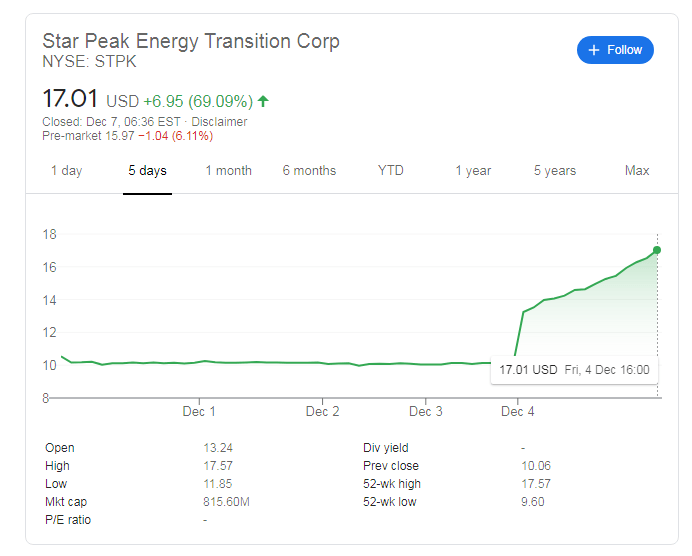
NASDAQ: STPK leaped by 69.09% on Friday to close at $17.01 after changing hands around $10 for a long period. Monday's premarket trading is pointing to a drop of around 7% or $1.21 – a much-needed profit-taking move. However, the intended higher valuation for the energy company provides hopes for additional gains.

Star Peak Energy Transition's sector is experiencing high interest and growth which has further grown after Joe Biden was elected President. The former Vice-President has vowed to push environmentally-friendly policies and nominated former Secretary of State John Kerry as a climate czar. If Democrats win control of the Senate, they will likely push for a $2 trillion investment toward the climate crisis, with some funds potentially trickling toward STPK. 

More NIO Stock Price and Forecast: Gets crushed again amidst investor concerns and rival downgrades

Author

Yohay Elam

Yohay Elam

FXStreet

Yohay is in Forex since 2008 when he founded Forex Crunch, a blog crafted in his free time that turned into a fully-fledged currency website later sold to Finixio.


More from Yohay Elam
Share:

Editor's Picks

AUD/USD holds firm near 0.7000 after Chinese inflation, trade data

AUD/USD stays firm near 0.7000 in Wednesday’s Asian session, picking up some bids after China's mixed inflation and upbeat trade data. CPI rose less than expected in September, while PPI inflation picked up. Meanwhile, the Chinese trade surplus unexpectedly widened in September. The pair remains underpinned by a broadly subdued US Dollar, despite the Middle East escalation, as focus remains on US CPI data.

USD/JPY consolidates near 158.50; looks to US CPI for fresh impetus

USD/JPY stays range-bound near 158.50 in the Asian session on Wednesday, with looming intervention risks supporting the Japanese Yen and capping upside amid a softer US Dollar. However, geopolitical uncertainties act as a tailwind for the safe-haven USD and the pair. Traders also seem hesitant ahead of the release of the latest US inflation figures.

Gold looks to $4100 and US CPI inflation amid geopolitical risks

Gold falls for the third straight day on Wednesday, as the recent recovery falters ahead of US inflation. US Dollar pauses correction amid rising Oil prices and stabilizing US Treasury bond yields. The daily bearish RSI remains a headwind for Gold buyers, with $4,100 seen at risk.

Strategy bitcoin buying model faces scrutiny as STRC costs climb
Strategy’s (MSTR) STRC financing strategy increased its Bitcoin (BTC) holdings in H1, but made its capital structure more expensive, prompting an examination of its effectiveness, according to a Tuesday report by K33. STRC recovered close to its $100 par value, closing at $99.90 after an extended period of heavy buybacks.
What happens after a US Treasury market crash
The global bond market is under severe pressure as US Treasury yields reach multi-decade highs, driven by persistent inflation risk, heavy government and corporate debt issuance, and expanding term premiums. Higher yields raise borrowing costs and tighten financial conditions, but a severe bond selloff can ultimately shift investor focus from inflation to growth and financial stability.
Has Bitcoin really escaped the macro forces it was built to fight?
Over 17 years ago, Satoshi Nakamoto designed Bitcoin (BTC) on the back of a global financial crisis as an alternative to the global monetary system outside the control of central banks, governments and traditional intermediaries. This raises a key question: has Bitcoin really become independent of the macroeconomic forces it was built to challenge?















