|

S&P 500 Index opens sharply lower, all majors sectors trade in red

  • Wall Street's main indexes are suffering heavy losses on Tuesday.
  • Risk-sensitive technology stocks underperform for the second straight day.

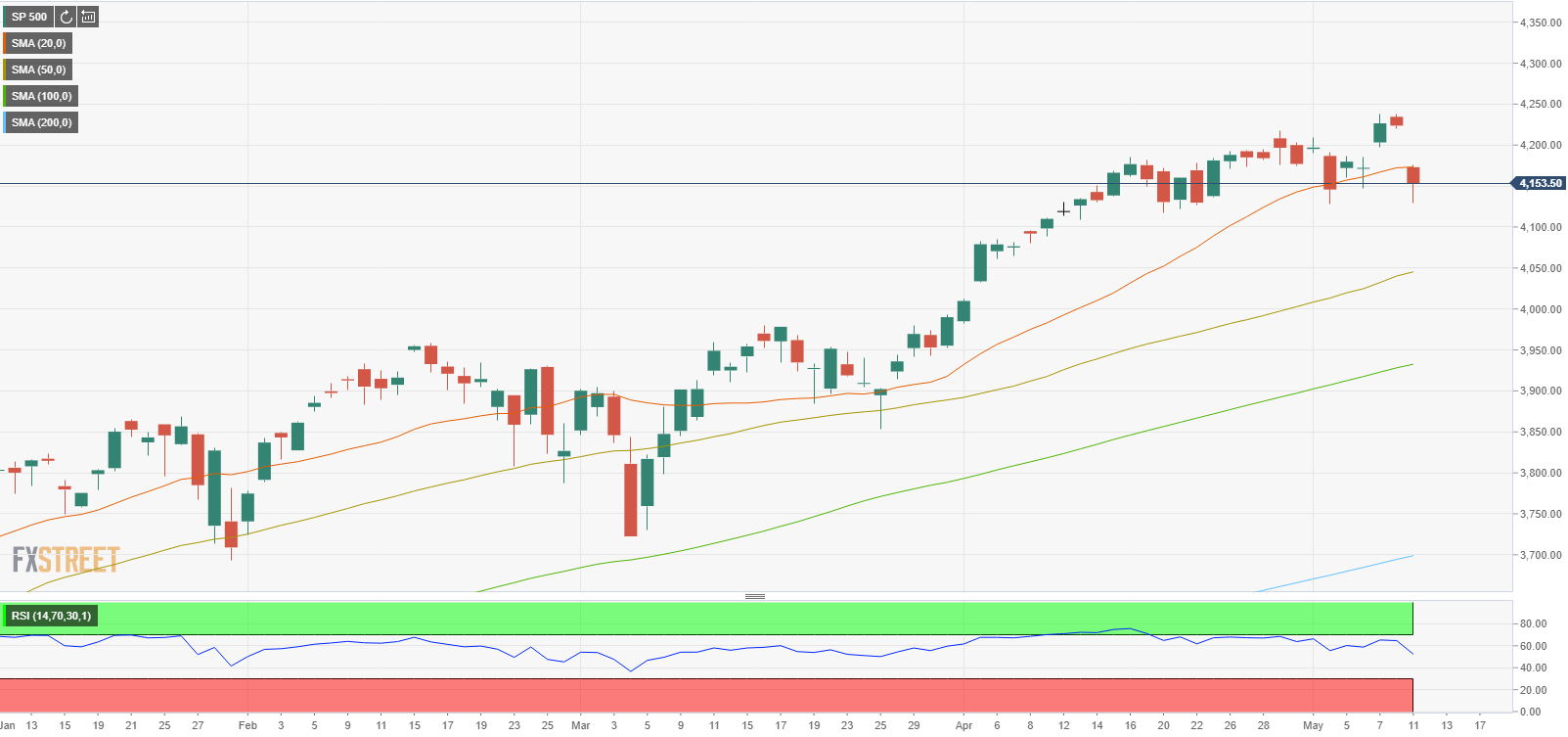
After falling on Monday, major equity indexes continue to push lower as safe-haven flows remain in control of financial markets. As of writing, the S&P 500 was losing 0.95% at 4,148, the Dow Jones Industrial Average was down 1% at 34,405 and the Nasdaq Composite was falling 0.9% at 13,238.

Reflecting the risk-averse market environment, the CBOE Volatility Index (VIX), Wall Street's fear gauge, is up nearly 12% on the day at 22.08.

All 11 major sectors of the S&P 500 trade in the negative territory after the opening bell. The risk-sensitive Technology Index is down 1.5%. On the other hand, the Financials Index is only losing 0.15% supported by a more-than-1% increase in the benchmark 10-year US Treasury bond yield.

S&P 500 (SPX) Nasdaq (QQQ) Day Ahead: Can the Fed stop the red.

S&P 500 chart (daily)
Author

Eren Sengezer

As an economist at heart, Eren Sengezer specializes in the assessment of the short-term and long-term impacts of macroeconomic data, central bank policies and political developments on financial assets.


More from Eren Sengezer
Share:

Editor's Picks

AUD/USD meets support near 0.7150

AUD/USD comes under renewed and quite strong selling pressure ahead of the Asia opening bell on Friday, drifting back toward multi-day troughs near 0.7150, where it seems to have met some decent contention for now. The Aussie’s decline follows the inflation-reignited uptick in the Greenback in response to robust US factory-gate prices in August.


USD/JPY consolidates around 153.50 as bears turn cautious ahead of US inflation

USD/JPY stabilizes above 153.50 during the Asian session on Thursday, but remains near a seven-month low set earlier this week as hawkish BoJ repricing continues to underpin the Japanese Yen. Meanwhile, rising September Fed rate-hike bets and escalating US-Iran tensions help ease US Dollar selling pressure, offering some support to the currency pair ahead of US inflation figures.

Gold remains weak, retargets $4,350

Gold keeps the choppy price action on Thursday, now slipping back toward the $4,350 region per troy ounce amid the robust bounce in the US Dollar as well as rising US Treasury yields across the curve, particularly following US Producer Prices and ahead of Friday’s more relevant US CPI data.

Bitcoin and Gold Outlook: BTC and XAU drop as US PPI broadens rate-hike bets
Cryptocurrency prices are broadly correcting, led by Bitcoin (BTC), which is trading around $77,000 on Thursday, marking four consecutive days of declines. Meanwhile, Gold (XAU) remains sideways, hovering around $4,365, with upside capped below $4,400.
ECB recap: A hawkish hike despite downside growth risks
The European Central Bank (ECB) increased the Deposit Facility Rate to 2.50%, the Refinancing Rate to 2.65% and the Marginal Lending Facility to 2.90%, effective from September 16. The decision was accompanied by a clear warning that the outlook remains highly uncertain, with risks tilted to the upside for inflation and to the downside for growth.
Venezuela’s 65-billion-barrel Oil deal could reshape America’s inflation fight
The United States (US) has secured unprecedented access to part of Venezuela’s vast Oil reserves. The timing is particularly significant as the war with Iran is disrupting Middle Eastern supplies, keeping energy prices elevated and reviving concerns about inflation.