EURUSD climbs to 1.1760 as Fed easing bets weigh on Dollar
- EUR/USD rises 0.42% to 1.1757, rebounding from 1.1706 as Dollar weakens on easing speculation.
- Fed officials flag CPI irregularities, but markets still price first 2026 rate cut around mid-June.
- ECB policymakers downplay hawkish signals, while traders await key US and Eurozone growth data.

EUR/USD edges higher during the North American session, up 0.42% amid growing speculation that the Federal Reserve would continue easing policy, amid a scarce economic docket in both sides of the Atlantic. The pair trades at 1.1757 after bouncing off daily lows of 1.1706.
Euro extends gains amid scarce data, as traders focus on dovish Fed expectations and mixed central bank rhetoric
Data in the US was scarce with traders digesting comments by Federal Reserve officials, led by Governor Stephen Miran and Cleveland’s Fed President Beth Hammack. Both remained on their dovish and hawkish stance, respectively yet coincided that the latest release of the Consumer Price Index (CPI) for November, presented some irregularities due to the 43-day US government shutdown.
Meanwhile, expectations that the Fed will cut rates next year remain high with the first 25 basis points reduction seen in June 17,
Across the pond, several members of the European Central Bank (ECB), led by Isabel Schnabel who commented that she “didn’t say rates should be raised.”
Ahead in the week, the docket in Europe will feature Gross Domestic Product (GDP) figures for Germany and Spain. In the US, the schedule will be busy, with the release of the ADP Employment Change 4-week average, followed by GDP figures for Q3, Industrial Production and Consumer Confidence data.
Daily digest market movers: US Dollar weakness, ECB comments boost the Euro
- US Dollar weakness keeps the shared currency underpinned. The US Dollar Index (DXY), which tracks the performance of the buck’s value against a basket of six peers, tumbles 0.45%, at 98.27 a tailwind for the Euro.
- Cleveland Fed President Beth Hammack struck a hawkish tone, warning that November’s CPI may have understated annual price pressures due to data irregularities. She added that the neutral interest rate could be higher than commonly assumed, arguing for caution on further easing.
- Separately, Fed Governor Stephen Miran also pointed to irregularities in CPI data linked to the government shutdown. He said recent data align with his assessment of current economic conditions and reiterated that additional policy rate reductions are likely in the future.
- Last Thursday, US inflation for November eased to 2.7% year-on-year, down from the prior 3% reading. However, economists cautioned that the data should be interpreted with care, as the 43-day US government shutdown may have distorted parts of the economic reporting.
- ECB Schnabel added that no rate hikes are expected for the foreseeable future, and that at “some point we will need to increase rates again.” She remained hawkish as she sees “more inflationary than disinflationary forces at work.”
- ECB’s Vujcic said that inflation and growth risks are balanced, adding that the next move in rates could be in either way. Meanwhile, Kazimir said that the ECB remains flexible and that he’s more concerned about long-term growth prospects.
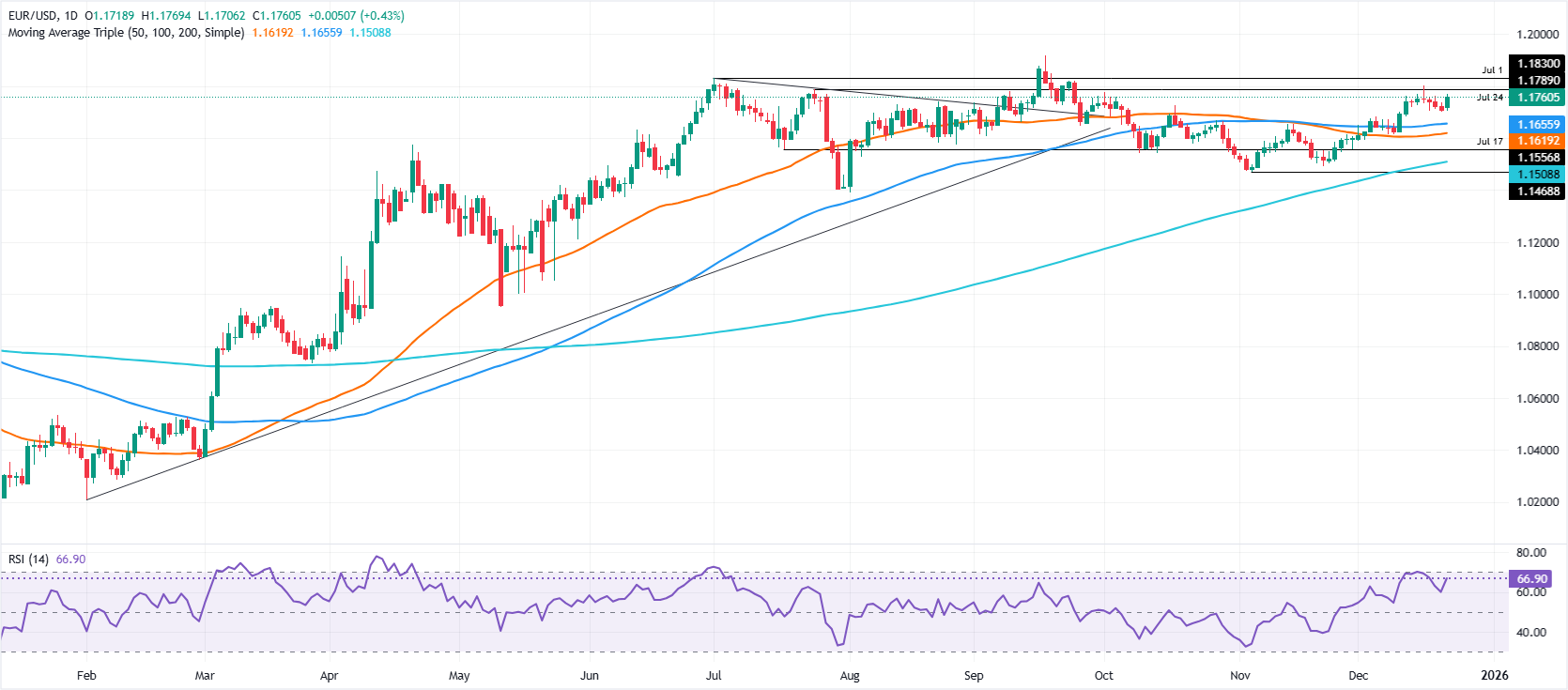
Technical outlook: EUR/USD consolidates within a 50-pip range
The EUR/USD technical picture suggests the pair has consolidated at around 1.1700-1.1750, with buyers reluctant to reclaim 1.1800, which would’ve opened the door to challenge the yearly peak of 1.1918.
Despite this, momentum is bullish as depicted by the Relative Strength Index (RSI). But if the single currency slides below 1.1700, expect a drop initially towards the 20-day Simple Moving Average (SMA) at 1.1679. Once surpassed, the next stop would be the 100-day SMA at 1.1656, and the 50-day SMA At 1.1621.
Euro FAQs
The Euro is the currency for the 20 European Union countries that belong to the Eurozone. It is the second most heavily traded currency in the world behind the US Dollar. In 2022, it accounted for 31% of all foreign exchange transactions, with an average daily turnover of over $2.2 trillion a day. EUR/USD is the most heavily traded currency pair in the world, accounting for an estimated 30% off all transactions, followed by EUR/JPY (4%), EUR/GBP (3%) and EUR/AUD (2%).
The European Central Bank (ECB) in Frankfurt, Germany, is the reserve bank for the Eurozone. The ECB sets interest rates and manages monetary policy. The ECB’s primary mandate is to maintain price stability, which means either controlling inflation or stimulating growth. Its primary tool is the raising or lowering of interest rates. Relatively high interest rates – or the expectation of higher rates – will usually benefit the Euro and vice versa. The ECB Governing Council makes monetary policy decisions at meetings held eight times a year. Decisions are made by heads of the Eurozone national banks and six permanent members, including the President of the ECB, Christine Lagarde.
Eurozone inflation data, measured by the Harmonized Index of Consumer Prices (HICP), is an important econometric for the Euro. If inflation rises more than expected, especially if above the ECB’s 2% target, it obliges the ECB to raise interest rates to bring it back under control. Relatively high interest rates compared to its counterparts will usually benefit the Euro, as it makes the region more attractive as a place for global investors to park their money.
Data releases gauge the health of the economy and can impact on the Euro. Indicators such as GDP, Manufacturing and Services PMIs, employment, and consumer sentiment surveys can all influence the direction of the single currency. A strong economy is good for the Euro. Not only does it attract more foreign investment but it may encourage the ECB to put up interest rates, which will directly strengthen the Euro. Otherwise, if economic data is weak, the Euro is likely to fall. Economic data for the four largest economies in the euro area (Germany, France, Italy and Spain) are especially significant, as they account for 75% of the Eurozone’s economy.
Another significant data release for the Euro is the Trade Balance. This indicator measures the difference between what a country earns from its exports and what it spends on imports over a given period. If a country produces highly sought after exports then its currency will gain in value purely from the extra demand created from foreign buyers seeking to purchase these goods. Therefore, a positive net Trade Balance strengthens a currency and vice versa for a negative balance.
Author

Christian Borjon Valencia
FXStreet
Markets analyst, news editor, and trading instructor with over 14 years of experience across FX, commodities, US equity indices, and global macro markets.














