S&P 500 Forecast: Bank earnings back in focus as index readies for CPI
- The S&P 500 lost 1.16% last week, while the Dow dropped 1.9%.
- Major banks begin reporting second-quarter results late this week.
- On Wednesday, June Consumer Price Index data reports the state of inflation.
- Goldman Sachs expects that S&P 500 revenue stalled in Q2.
The S&P 500 index will most likely remain subdued for several weeks as the market now largely expects the Federal Reserve to raise interest rates by 25 basis points at its Federal Open Market Committee (FOMC) meeting on July 26.
Two events that could shake the market out of its daze are the Consumer Price Index (CPI) data for June that arrives on Wednesday and then the debut of the second-quarter earnings season that begins with major banks on Thursday and Friday.
At the time of writing soon after Monday’s open, the S&P 500 is flat to up, while the Dow has risen 0.4% and the NASDAQ has dropped 0.4%. The Dow lost 1.9% last week – its worst weekly performance in nearly three years.
S&P 500 News: CPI expected to continue disinflation push
The US Bureau of Labor Statistics will release inflation data for June one hour before the market opens on Wednesday. Analysts are counting on the June CPI to continue lowering the level of inflation in the US market, which they hope will forestall some Fed rate hiking. As it stands, the market is nearly unanimous in expecting a 25-basis-point hike on July 26.
Continued disinflation, however, in the June CPI could bring the equity market more optimism. Analysts are predicting a sharp drop in YoY inflation. June consensus is 3.1% YoY, a major drop from May’s 4% reading.
Core CPI will still receive the major focus from Fed governors, and consensus there is less rosy. The average forecast comes in at 5% YoY, which is still a good deal better than the 5.3% figure back in May. Core CPI for June is also expected to grow 0.3% MoM compared with 0.4% in May.
Expect the market to rebound if inflation arrives well under the consensus forecast. Likewise, higher inflation data also supplies a real risk that the market could tank even if CPI is reported somewhat above the general forecast.
Big banks kick off Q2 earnings
JPMorgan Chase (JPM), Wells Fargo (WFC), State Street (STT), BlackRock (BLK) and Citigroup (C) all report earnings on Friday. JPMorgan, Citigroup and Wells Fargo have all recently passed the Fed’s banking stress tests with flying colors, and so investors will now listen to earnings presentations to glean what the big banks will do as far as raising dividends and hiking buybacks.
Wall Street expects JPMorgan, the largest bank in the US, to earn $3.90 in GAAP earnings per share (EPS) on $38.91 billion in revenue. The Wells Fargo consensus calls for GAAP EPS of $1.18 on revenue of $20.08 billion. Citigroup is expected to earn $1.40 in GAAP EPS on revenue of $19.58 billion.
Wells Fargo and Citigroup differ from JPMorgan since the former two have seen a majority of analysts hit them with downward revisions to earnings for the second quarter. JPMorgan, on the other hand, has only received upward revisions over the past 90 days.
Pepsi (PEP) and Conagra Brands (CAG) are the first major companies reporting this week, both on Thursday, and both hail from the consumer staples category. This category is often watched as a test of the health of consumers more broadly. A number of much smaller Russell 2000 stocks report earlier in the week, but they lack the high profile of these two.
Wall Street consensus sees Pepsi earning $1.98 per share on $21.73 billion in sales. However, of the 15 analyst revisions for earnings over the past three months, 14 of them were downward revisions to EPS.
S&P 500 FAQs
What is the S&P 500?
The S&P 500 is a widely followed stock price index which measures the performance of 500 publicly owned companies, and is seen as a broad measure of the US stock market. Each company’s influence on the computation of the index is weighted based on market capitalization. This is calculated by multiplying the number of publicly traded shares of the company by the share price. The S&P 500 index has achieved impressive returns – $1.00 invested in 1970 would have yielded a return of almost $192.00 in 2022. The average annual return since its inception in 1957 has been 11.9%.
How are companies chosen to be included in the S&P 500?
Companies are selected by committee, unlike some other indexes where they are included based on set rules. Still, they must meet certain eligibility criteria, the most important of which is market capitalization, which must be greater than or equal to $12.7 billion. Other criteria include liquidity, domicile, public float, sector, financial viability, length of time publicly traded, and representation of the industries in the economy of the United States. The nine largest companies in the index account for 27.8% of the market capitalization of the index.
How can I trade the S&P 500?
There are a number of ways to trade the S&P 500. Most retail brokers and spread betting platforms allow traders to use Contracts for Difference (CFD) to place bets on the direction of the price. In addition, that can buy into Index, Mutual and Exchange Traded Funds (ETF) that track the price of the S&P 500. The most liquid of the ETFs is State Street Corporation’s SPY. The Chicago Mercantile Exchange (CME) offers futures contracts in the index and the Chicago Board of Options (CMOE) offers options as well as ETFs, inverse ETFs and leveraged ETFs.
What factors drive the S&P 500?
Many different factors drive the S&P 500 but mainly it is the aggregate performance of the component companies revealed in their quarterly and annual company earnings reports. US and global macroeconomic data also contributes as it impacts on investor sentiment, which if positive drives gains. The level of interest rates, set by the Federal Reserve (Fed), also influences the S&P 500 as it affects the cost of credit, on which many corporations are heavily reliant. Therefore, inflation can be a major driver as well as other metrics which impact the Fed decisions.
Earnings of the week
Thursday, July 13 - PepsiCo (PEP), Delta Air Lines (DAL), Conagra Brands (CAG).
Friday, July 14 - UnitedHealth Group (UNH), JPMorgan Chase (JPM), Wells Fargo (WFC), State Street (STT), BlackRock (BLK), Citigroup (C).
What they said about the market – David Kostin
David Kostin, an equity strategist at Goldman Sachs, expects the second quarter to yield no S&P 500 revenue growth on a YoY basis. This would be the first quarter that happens in the last ten.
"Weaker commodity prices and falling inflation, which may limit firms’ pricing power, are incremental headwinds to S&P 500 sales growth."
S&P 500 forecast
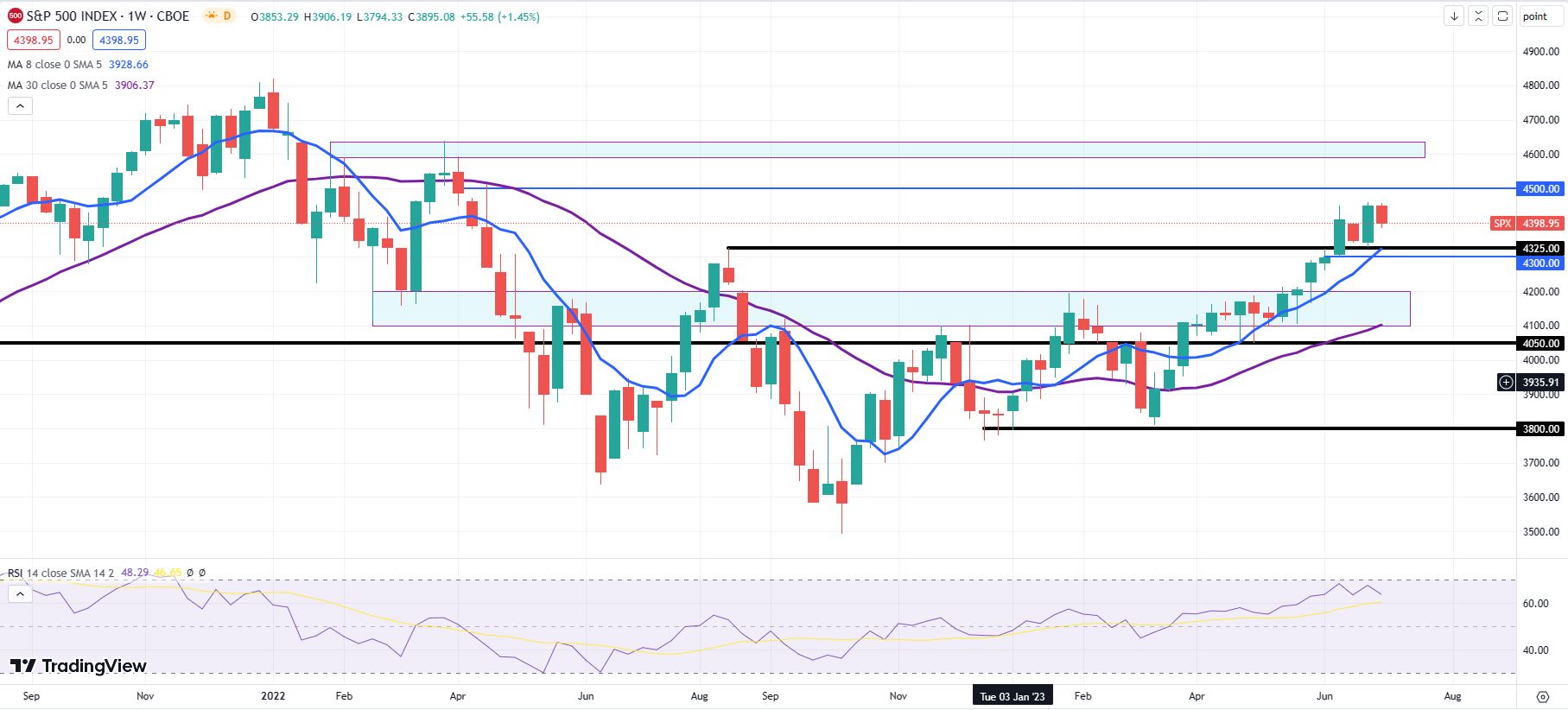
The S&P 500 just reached a year-to-date high two weeks back at 4,450. The index begins this week around 4,400, and Monday morning’s market displays an index with few backers. It has traded sideways for its first two hours of the regular session, while the Dow has been taking up most of the gains.
If this meager buying environment persists, then expect the S&P 500 to charge back to support at 4,300 or 4,325. That latter level is where the index found support on June 26. Medium and longer-term support are at 4,100 and 3,800, respectively.
The target for bulls remains 4,500, which stems from the April 2022 price action that encountered that level as stiff resistance. For now, the elevated Relative Strength Index (RSI) means most watchers expect a pullback for a better entry price.
S&P 500 daily chart
Author

Clay Webster
FXStreet
Clay Webster grew up in the US outside Buffalo, New York and Lancaster, Pennsylvania. He began investing after college following the 2008 financial crisis.