Silver Price Forecast: XAG/USD declines to near $31.50 ahead of Fed Powell’s speech
- Silver price slumps to near $31.50 despite a steep fall in the US Dollar.
- Investors await Fed Powell’s speech for fresh interest rate guidance.
- Market participants will pay close attention to a string of US labor market data.

Silver price (XAG/USD) falls sharply to near $31.50 in Monday’s European session. The white metal weakens even though the US Dollar (USD) has dropped to near its yearly lows ahead of Federal Reserve (Fed) Chair Jerome Powell’s speech, which is scheduled at 17:00 GMT.
The US Dollar Index (DXY), which tracks the Greenback’s value against six major currencies, appears as vulnerable near 100.20. 10-year US Treasury yields climb to near 3.77%. Higher yields on interest-bearing assets increase the opportunity cost of holding an investment in non-yielding assets, such as Silver.
Investors will pay close attention to Fed Powell’s speech as he is expected to provide fresh interest rate guidance. Market participants want to know whether the Fed will reduce interest rates again by a larger-than-usual cut of 50 basis points (bps) in the November meeting.
According to the CME FedWatch tool, traders are almost equally split for a 25 or 50 bps interest rate cut in November. The tool also shows that the Fed will reduce interest rates collectively by 75 bps in the remainder of the year.
This week, investors will focus on a slew of the United States (US) economic data, such as JOLTS Job Openings for August and the ADP Employment Change and Nonfarm Payrolls (NFP) data for September.
Silver technical analysis:
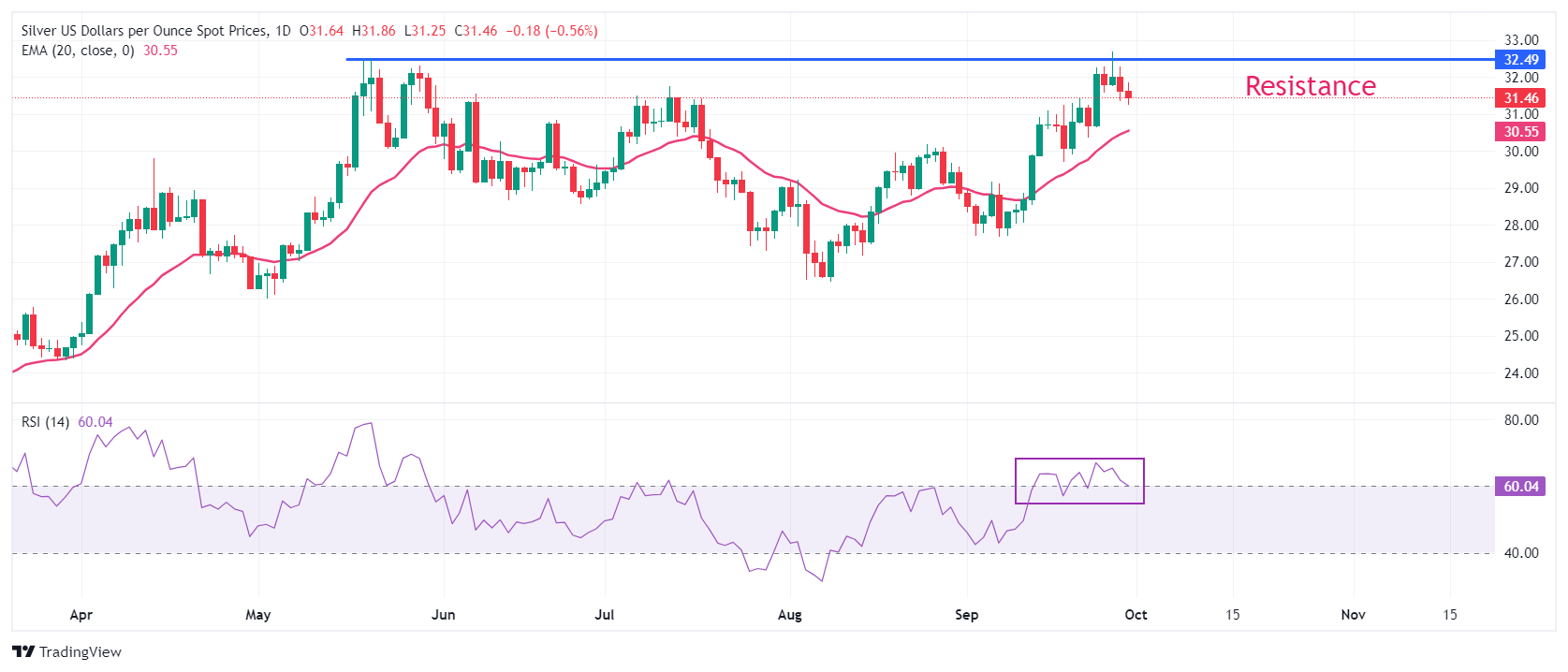
Silver price struggles to extend its upside above the horizontal resistance plotted from the May 21 high of $32.50 on a daily timeframe. The near-term outlook of the white metal remains firm as the 20-day Exponential Moving Average (EMA) at $30.55 is sloping higher.
The 14-day Relative Strength Index (RSI) oscillates in the bullish range of 60.00-80.00, suggesting that a bullish momentum is intact.
Silver daily chart
Silver FAQs
Silver is a precious metal highly traded among investors. It has been historically used as a store of value and a medium of exchange. Although less popular than Gold, traders may turn to Silver to diversify their investment portfolio, for its intrinsic value or as a potential hedge during high-inflation periods. Investors can buy physical Silver, in coins or in bars, or trade it through vehicles such as Exchange Traded Funds, which track its price on international markets.
Silver prices can move due to a wide range of factors. Geopolitical instability or fears of a deep recession can make Silver price escalate due to its safe-haven status, although to a lesser extent than Gold's. As a yieldless asset, Silver tends to rise with lower interest rates. Its moves also depend on how the US Dollar (USD) behaves as the asset is priced in dollars (XAG/USD). A strong Dollar tends to keep the price of Silver at bay, whereas a weaker Dollar is likely to propel prices up. Other factors such as investment demand, mining supply – Silver is much more abundant than Gold – and recycling rates can also affect prices.
Silver is widely used in industry, particularly in sectors such as electronics or solar energy, as it has one of the highest electric conductivity of all metals – more than Copper and Gold. A surge in demand can increase prices, while a decline tends to lower them. Dynamics in the US, Chinese and Indian economies can also contribute to price swings: for the US and particularly China, their big industrial sectors use Silver in various processes; in India, consumers’ demand for the precious metal for jewellery also plays a key role in setting prices.
Silver prices tend to follow Gold's moves. When Gold prices rise, Silver typically follows suit, as their status as safe-haven assets is similar. The Gold/Silver ratio, which shows the number of ounces of Silver needed to equal the value of one ounce of Gold, may help to determine the relative valuation between both metals. Some investors may consider a high ratio as an indicator that Silver is undervalued, or Gold is overvalued. On the contrary, a low ratio might suggest that Gold is undervalued relative to Silver.
Author

Sagar Dua
FXStreet
Sagar Dua is associated with the financial markets from his college days. Along with pursuing post-graduation in Commerce in 2014, he started his markets training with chart analysis.