Salesforce Inc. (CRM) Elliott Wave technical analysis [Video]
![Salesforce Inc. (CRM) Elliott Wave technical analysis [Video]](https://editorial.fxstreet.com/images/Markets/Equities/Industries/Pharma/paracetamol-capsules-637435383109464449_XtraLarge.jpg)

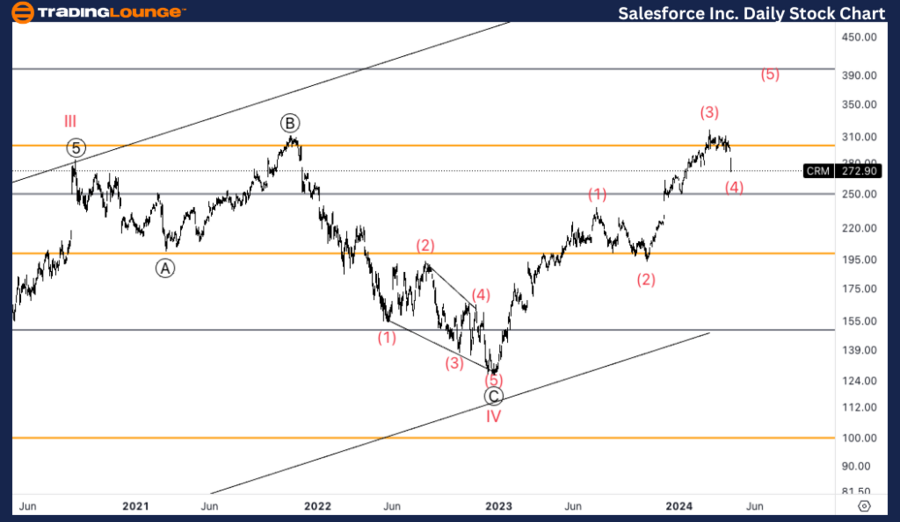
Salesforce Inc., (CRM) Daily Chart
CRM Elliott Wave technical analysis
Function: Counter Trend.
Mode: Corrective
Structure: Flat
Position: Intermediate wave (4)
Direction: Bottom in wave (4).
Details: We are reacting off TL3 at 300$, in what we labelled as wave (3) of Primary 1. We experienced a long term correction in wave IV which appears to be complete, and we are now looking for continuation higher.
CRM Elliott Wave technical analysis – Daily chart
Salesforce is currently exhibiting behavior typical of a counter trend phase with a corrective mode and flat structure, positioned in Intermediate wave (4). The direction is indicating a potential bottom in wave (4). We've observed a reaction off the key level, TL3 at $300, which we have identified as wave (3) of Primary 1. Following a prolonged correction in wave IV, which now appears complete, the outlook suggests a potential continuation higher.
CRM Elliott Wave technical analysis
Function: Counter Trend.
Mode: Corrective.
Structure: Flat.
Position: Wave C of (4).
Direction: Bottom in wave C.
Details: We seem to have a three wave move so far in wave (4), with a sideways wave B which because of its characteristics it gives us additional confidence we could be in a corrective structure.
CRM Elliott Wave technical analysis – Four-hour chart
The 4-hour chart further supports the daily findings but focuses on the specifics of the ongoing correction in Wave C of (4). This phase is also characterized as counter trend, corrective, and flat. The chart shows a three-wave structure for wave (4), with a sideways wave B. The nature of wave B provides additional confidence that we are indeed in a corrective structure, setting up expectations for a bottom in wave C.
.png.5e331c6345dda94e5f58232ab5b366c6.png)
Salesforce Inc. (CRM) Elliott Wave technical analysis [Video]
Author
Peter Mathers
TradingLounge
Peter Mathers started actively trading in 1982. He began his career at Hoei and Shoin, a Japanese futures trading company.