Gold holds steady as Fed rate-cut bets cool, geopolitical tensions underpin demand
- Gold trades sideways above $5,000, remaining capped inside this week’s consolidation range.
- Stronger US Nonfarm Payrolls data reinforce a hold-for-longer Fed outlook, keeping near-term rate-cut expectations in check.
- Elevated US-Iran tensions continue to underpin safe-haven demand, helping to cushion downside risks for Gold.

Gold (XAU/USD) holds in a narrow range on Thursday as stronger US employment data prompts traders to push back expectations for an early Federal Reserve (Fed) interest rate cut. At the time of writing, XAU/USD trades around $5,060, remaining confined to this week’s $5,000-$5,100 consolidation band.
US employment data strengthens case for a hold-for-longer Fed stance
Data released on Wednesday by the US Bureau of Labor Statistics (BLS) showed an unexpected pickup in job growth in the US economy. Nonfarm Payrolls (NFP) rose by 130K in January, well above expectations of 70K and marking the strongest monthly job gain since December 2024. At the same time, the Unemployment Rate edged lower to 4.3% from 4.4%.
The stronger labour data reduces the scope for near-term monetary policy easing, reinforcing expectations that the Fed is likely to remain on hold over the next couple of meetings. This acts as a modest headwind for Gold, given its non-interest-bearing nature.
However, the US Dollar (USD) and Treasury yields have failed to attract meaningful follow-through buying after the report, offering some support to the Bullion. The US Dollar Index (DXY), which tracks the Greenback's value against a basket of six major currencies, is trading around 96.80, hovering near one-week lows.
Traders also digested fresh comments from Fed officials on Wednesday. Kansas City Fed President Jeffrey Schmid said that further rate cuts could allow inflation to remain elevated for longer, adding that it is still appropriate to keep monetary policy restrictive with inflation close to 3%.
Separately, Cleveland Fed President Beth Hammack said that the current federal funds rate is “right around neutral” and that it is appropriate for the Fed to stay on hold, noting that rates are not putting much restraint on the economy and that there is no need to fine-tune policy at this stage.
Even so, markets are still pricing in close to 50 basis points of easing for this year, with the CME FedWatch Tool pointing to the first rate cut most likely in the June-July window. Attention now turns to the US Consumer Price Index (CPI) release on Friday.
Elsewhere, US-Iran tensions remain elevated, keeping geopolitical risks firmly in play and helping to cushion the downside in Bullion. The Wall Street Journal reported on Wednesday that the United States is preparing to deploy a second aircraft-carrier strike group to the Middle East, as the US military readies for the possibility of military action if negotiations over Iran’s nuclear programme were to fail.
Against this backdrop, Gold is likely to remain range-bound in the near term, as fading expectations for early Fed rate cuts are offset by lingering geopolitical risks.
Technical analysis: XAU/USD consolidates above $5,000 as momentum fades
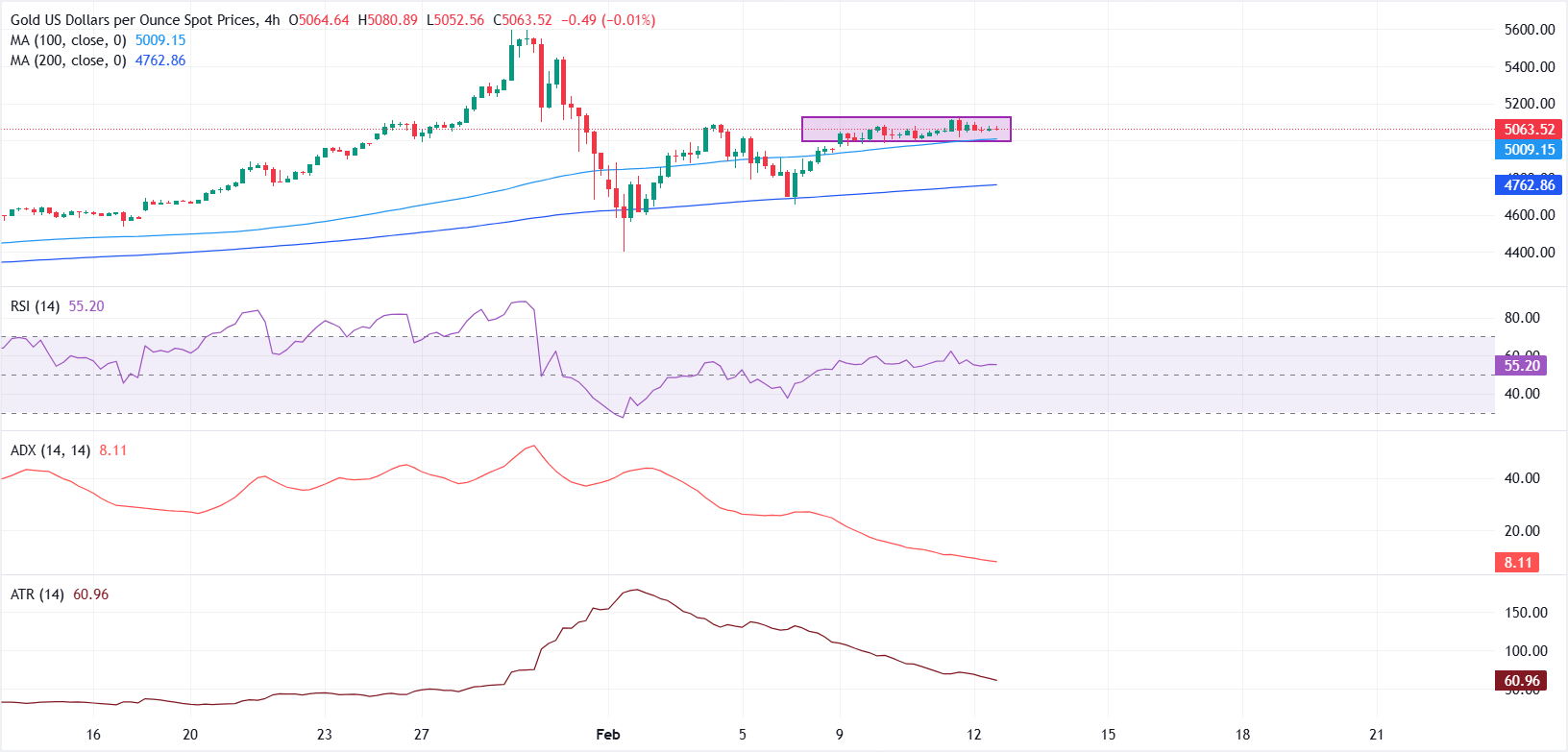
From a technical perspective, short-term momentum has cooled after the recent sharp correction, signalling that Gold is entering a consolidation phase. The Relative Strength Index (RSI) hovers around 55, reflecting a neutral near-term bias. The Average Directional Index (ADX) is near 8, indicating very weak trend strength, while the Average True Range (ATR) has started to roll over, showing that price volatility is easing.
On the 4-hour chart, XAU/USD is stabilising above the 100-period Simple Moving Average (SMA) near the $5,000 psychological level. A sustained break below this area would increase downside pressure, with the next support seen near $4,850, followed by the 200-period SMA.
On the upside, a break above $5,100 is needed to revive bullish momentum. The broader uptrend, however, remains intact.
Economic Indicator
Consumer Price Index (MoM)
Inflationary or deflationary tendencies are measured by periodically summing the prices of a basket of representative goods and services and presenting the data as The Consumer Price Index (CPI). CPI data is compiled on a monthly basis and released by the US Department of Labor Statistics. The MoM figure compares the prices of goods in the reference month to the previous month.The CPI is a key indicator to measure inflation and changes in purchasing trends. Generally, a high reading is seen as bullish for the US Dollar (USD), while a low reading is seen as bearish.
Read more.Next release: Fri Feb 13, 2026 13:30
Frequency: Monthly
Consensus: 0.3%
Previous: 0.3%
Source: US Bureau of Labor Statistics
The US Federal Reserve (Fed) has a dual mandate of maintaining price stability and maximum employment. According to such mandate, inflation should be at around 2% YoY and has become the weakest pillar of the central bank’s directive ever since the world suffered a pandemic, which extends to these days. Price pressures keep rising amid supply-chain issues and bottlenecks, with the Consumer Price Index (CPI) hanging at multi-decade highs. The Fed has already taken measures to tame inflation and is expected to maintain an aggressive stance in the foreseeable future.
Author

Vishal Chaturvedi
FXStreet
I am a macro-focused research analyst with over four years of experience covering forex and commodities market. I enjoy breaking down complex economic trends and turning them into clear, actionable insights that help traders stay ahead of the curve.