Robinhood Stock Price and Forecast: Why is HOOD stock crashing?
- Robinhood falls sharply after results disappoint investors.
- HOOD falls over 11% as the company warns about Q3 numbers.
- Robinhood is closely watched as a barometer of the retail volume in the market.

Robinhood (HOOD) released earnings after the market closed on Wednesday, and investors did not like what they heard. Earnings per share (EPS) came in ahead of analyst expectations at $0.11 versus $0.08. Revenue was also ahead of forecasts, coming in at $565 million versus the $531 million estimate. It should be noted these are Refinitiv estimates, which is the norm, but there are only three analysts covering the stock. Monthly active users also more than doubled from 10.2 million in Q2 2020 to 21.3 million. The numbers were good, so why the fall? The reason is that Robinhood warned that the next quarter Q3 would be impacted by lower trading activity. "For the three months ended September 30, 2021, we expect seasonal headwinds and lower trading activity across the industry to result in lower revenue and considerably fewer new funded accounts than in the prior quarter," the company said.
Probably this is not that surprising when you consider the explosion in retail trading that has taken place in the first half of 2021. Early January and February saw the GameStop (GME) story unfold and then moved to AMC apes as the summer came through. Keeping up with that level of growth and comparisons was always going to be a tough act. For example, revenue in Q2 was up 131%. The company had also benefited strongly from cryptocurrency trading and that sector has also quietened down as Bitcoin fell sharply and volatility had calmed down in the sector with Dogecoin also off the front pages.
Robinhood (HOOD) key statistics
| Market Cap | $42.3 billion |
| Price/Earnings | |
| Price/Sales | 41 |
| Price/Book | 19 |
| Enterprise Value | |
| Gross Margin | 0.54 |
| Net Margin |
-1.02 |
| 52-week high | $85 |
| 52-week low | $33.25 |
| Average Wall Street Rating and Price Target | Hold, $711 |
Investors also have concerns over a practice known as payment for order flow in which retail brokers send their orders to a larger wholesale broker and receive payment for sending orders. Payment for order flow is perfectly legal, but the SEC is looking into the practice. Robinhood said on the earnings call that it does not think payment for order flow will be banned and that it does not think that payment for order flow revenue would be difficult to replace.
Robinhood stock forecast
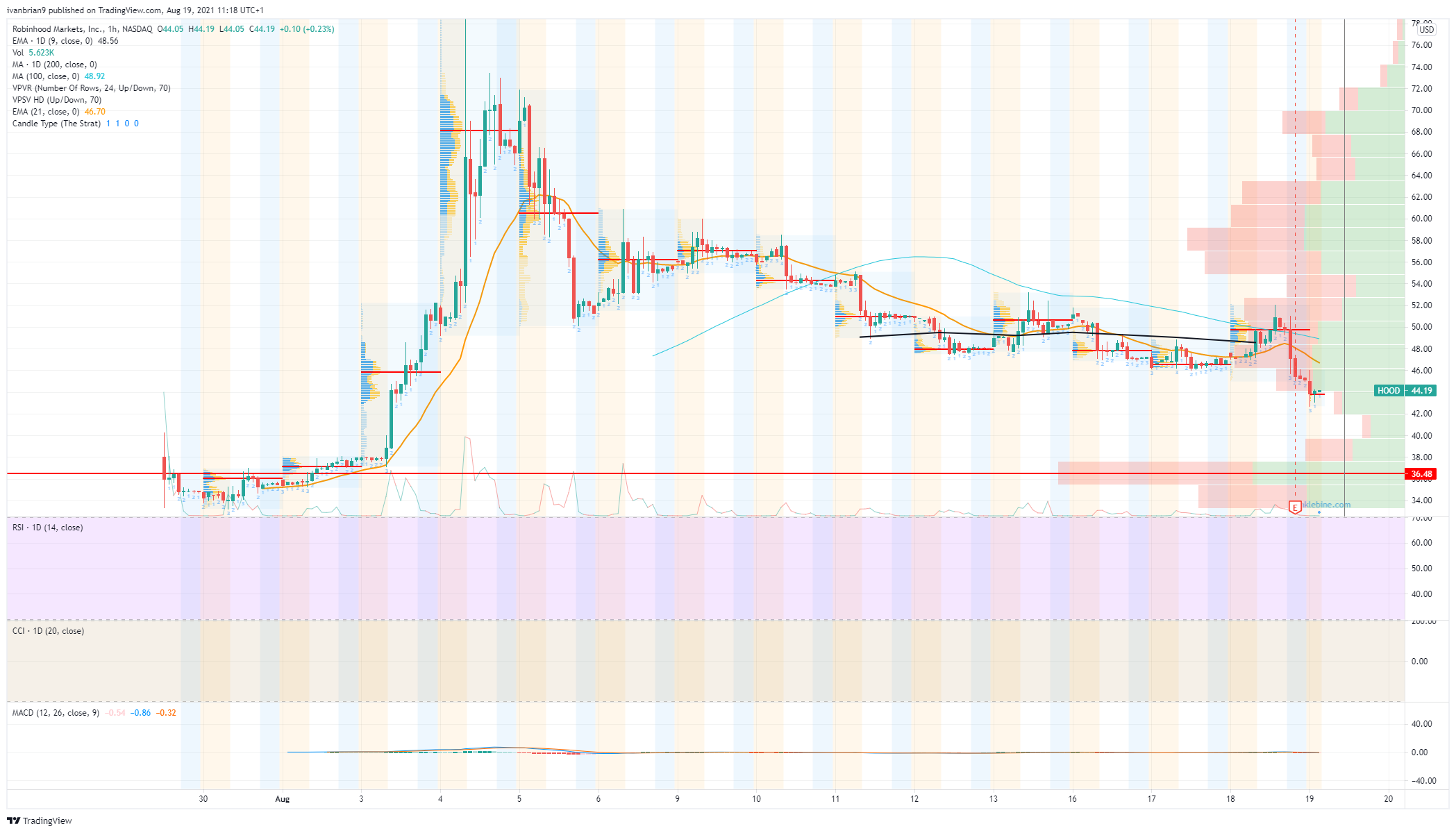
Robinhood is currently trading at $44.05 in Thursday's premarket after falling on the back of results. $36.48 is the point of control since the stock went public and would act as strong support. The point of control is the price with the highest level of volume. There is a gap or vacuum of volume between $44 and $36, so holding $44 is key, breaking is likely to see a further acceleration. Holding $44 should see a move back toward $50, the highest volume profile for August.
Like this article? Help us with some feedback by answering this survey:
Author

Ivan Brian
FXStreet
Ivan Brian started his career with AIB Bank in corporate finance and then worked for seven years at Baxter. He started as a macro analyst before becoming Head of Research and then CFO.