QuantumScape Stock Forecast: QS shares blast off 17% in second day of Volkswagen production rally
- QuantumScape stock rises another 17% on Friday, following Thursday's 30% run.
- Wall Street cheers on battery maker, loves capital-light strategy.
- NASDAQ, S&P 500 advance further after June CPI falls.
- Volkswagen could end up producing QuantumScape batteries for as many as 1 million vehicles annually.

QuantumScape (QS) stock is refusing to fade on Friday after its 30% Thursday session spike with shares of the automotive battery maker adding another 17% at the time of publication. The successful price action demonstrates that bulls are taking the company’s partnership with Volkswagen (VWAGY) quite seriously, which bodes well for a continued rally in the beaten-down stock.
In past episodes (and there have been many) in which good news fomented a spike in the share price, QuantumScape traders quickly abandoned ship, taking profits with them. This time is starting to look different however.
The broad market is also getting in on the party as optimism for a September interest rate cut from the Federal Reserve (Fed) continues to usher those on the sidelines back into equities. Thursday’s Consumer Price Index (CPI) report for June showed US inflation receding with headline prices actually declining from the previous month — a rarity.
The NASDAQ has gained 1.1% at the time of writing, while the S&P 500 climbs 0.9% and the Dow Jones Industrial Average adds 0.8%.
QuantumScape stock news
QuantumScape announced on Thursday that its patented solid state battery technology will begin its first commercial production event with Volkswagen’s PowerCo battery unit.
Upon certain undisclosed royalty payments, PowerCo will begin producing lithium-metal batteries via a non-exclusive license from QuantumScape. PowerCo has the right to produce up to 40 gigawatt-hours (GWh) of batteries annually with the present agreement, which would allow for the production of half a million electric vehicles (EVs).
QuantumScape’s solid state batteries are a paradigm shift away from the industry’s current reliance on lithium-ion batteries. Solid state batteries are cheaper to manufacture and offer much longer battery ranges for drivers.
However, another option would allow Volkswagen to double that production figure to 80 GWh per year if further details were hammered out.
“Combining our cutting-edge technology with PowerCo’s expertise in manufacturing and industrialization, this deal establishes a blueprint for a capital-light business approach and positions us at the forefront of energy storage innovation,” said Dr. Siva Sivaram, CEO and president of QuantumScape, in a statement. “Working closely with PowerCo as our first customer will help us accelerate commercialization and adoption of these game-changing batteries together.”
Volkswagen is already the largest shareholder of QuantumScape, and the new agreement means that PowerCo CEO Frank Blome has to leave QuantumScape’s board of directors in order to manage this production phase.
This agreement is thought to be the first of many for the battery maker, which seems intent on licensing its technology rather than producing battery cells in house. For its part, Volkswagen is coming off another agreement with an upstart EV firm, the one with Rivian (RIVN) just announced in late June. That one has Volkswagen investing as much as $5 billion in Rivian in order to use electrical, platform and software licenses from the latter for the German company’s own vehicles.
Wall Street was overjoyed with the breakthrough for QuantumScape. UBS analyst Joseph Spak pointed out that the agreement lays out a blueprint for further agreements with other automakers under a capital-light model. Morgan Stanley analyst Adam Jonas said the announcement portends lower risk of future dilution and said he was now leaning toward his bullish target for QS stock of $17.
Baird pointed out that besides Volkswagen, QuantumScape is working with a number of other automakers, and further production partnerships would push the share price much higher.
EV stocks FAQs
Electric vehicles or EVs are automobiles that use rechargable batteries and electric motors to accelerate rather than internal combustion engines (ICEs). They have been around for more that 100 years, but battery technology research & development was meager for much of the 20th century. Lithium-ion battery technology became advanced enough to produce EVs at scale in the late 1990s and 2000s, and sales have been steadily increasing since then Tesla’s Roadster was unveiled in 2008. EVs are viewed as a means of reducing carbon emissions since battery electric vehicles (BEVs) themselves produce zero emissions. Other vehicles called plug-in hybrid electric vehicles (PHEVs) utilize both battery electric power and ICEs as a backup.
EVs are growing from a small base, but they rose from 9% of global new auto sales in 2021 to 14% of the total in 2022. This was a 65% YoY growth rate, and the industry delivered 10.2 million EVs worldwide in 2022. Projections show this number climbing above 16 million in 2023. Across the world, market shares differ greatly among nations. Nearly 88% of Norwegian new car sales in 2022 were EVs. On the other hand, the United States, where much of the modern innovation in EVs was forged, had less than 8% of new vehicle sales go to EVs in 2022. The largest EV market in the world, China, saw 30% of the market go to EVs that year.
We know you’re thinking Elon Musk, but he’s probably more like the father of the mass-market, contemporary EV. All the way back in 1827, a Hungarian priest named Anyos Jedlik invented the electric motor and used it the following year to power a vehicle of sorts. French scientist Gaston Planté invented the lead-acid battery in 1859, and German engineer Andreas Flocken built the first true electric car for the public in 1888. EVs made up about 38% of all vehicles sold in the US around 1900. They began losing market share rapidly after 1910 when gasoline-powered vehicles grew much more affordable. They largely died off until new research programs in the 1990s led to gradual private sector investment in the 2000s.
China’s BYD is by far the largest manufacturer of EVs in the world. In 2022 it sold 1.8 million EVs and in the second half of the year made up 20% of the global market. The asterisk given to BYD is that the vast majority of these vehicles are hybrids. Tesla’s 12% market share is often treated as more significant than BYD, because it only sells BEVs and is the most famous EV brand in the world. Volkswagen, BMW and Wuling then round out the top five. As a new sector with heavy investment though, many startups have flooded the market. These include China’s Nio, Li Auto and Xpeng; a Swedish-Chinese manufacturer called Polestar; and Lucid and Rivian from the US.
QuantumScape stock forecast
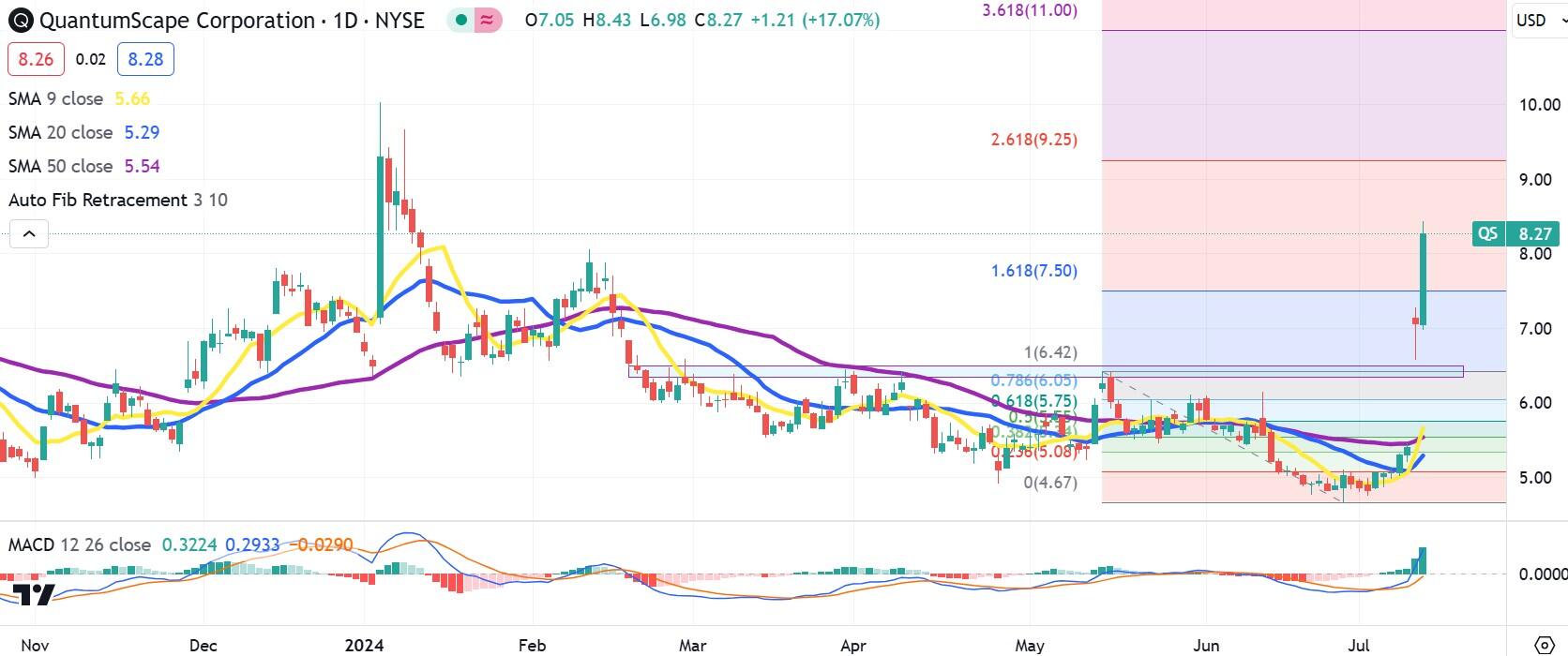
QuantumScape stock is now trading at levels on Friday it has not seen since early January when a sudden rally pushed shares above $10 temporarily before slumping back to a yearly low of $4.67 on June 27. The stock is on its way toward doubling since then in just the last two weeks.
It seems likely that bulls will push for $10 at the very least during this rally, but it would be unsurprising if shares rise further than that. The 261.8% Fibo Retracement arrives at $9.25 and the 361.8% Fibo comes at $11.00.
Judging from the February 12 range high, there may be support around $8.00 or at the 161.8% Fibo at $7.50.
QS daily stock chart
Author

Clay Webster
FXStreet
Clay Webster grew up in the US outside Buffalo, New York and Lancaster, Pennsylvania. He began investing after college following the 2008 financial crisis.