|

PPI adds this spin to equities

S&P 500 retreated in the pre-PPI uncertainty, offered a great swing entry point in the initial flush to 5,825 support, and then the UoM consumer data lent further support to the buyers – much to the satisfaction of all clients. The intraday ones benefits from my bullish focus on expected SPY and IWM (ES and RTY) leaders and Ellin‘s ES success – incoming data simply favored Nasdaq to lag considerably behind the two.

What spin then does PPI add, what does this title mean?

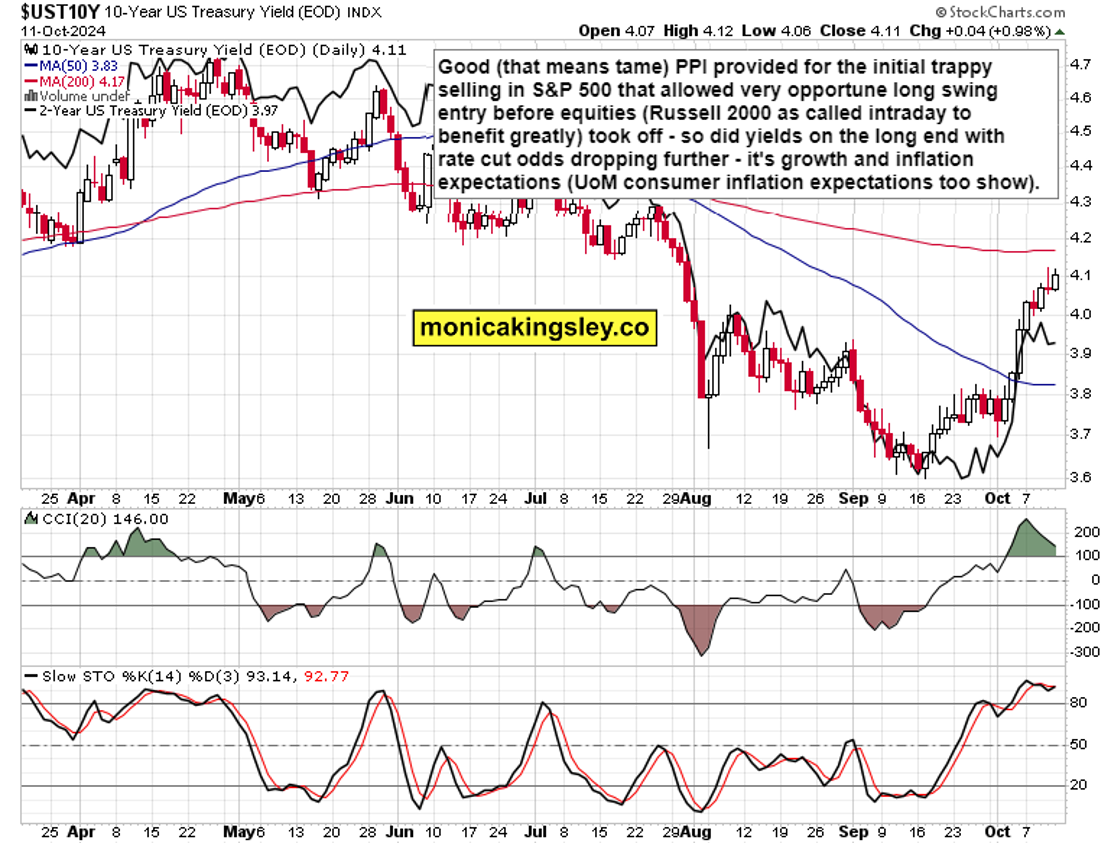
Thursday was about slightly hotter CPI, which means PPI is at odds through coming in tame. Rate cut odds also retreated, offering now not negligible 15% odds of only one more 25bp cut this year. The growth expectation and higher yields on the long end mean that inflation is expected to tick higher down the road, regardless of PPI being tame at the moment.

It‘s about raw materials and energy that I discussed before CPI with clients, therefore we‘re seeing greater risk appetite. UoM consumer data showed below expectations consumer confidence, which speaks for the soft landing engineered thesis – and add to that still some rate cuts ahead (not as many as expected in Aug), which is important for the historical experience of greatest stock market gains happening in the period when soft landing looks to have been secured, right before recession strikes (and rate cuts are evaluated as not reassuring but as stimulative necessity).

Is fear of recession justified? Not in the least, I do not expect recession any time soon, not even early in 2025, to put it mildly. Bostic even lately spoke about skipping some rate cuts. Yields are interpreting the incoming data neatly – and their message has to be squared with the high unemployment claims (some of it due to weather).
Author

Monica Kingsley

Monica Kingsley

Monicakingsley

Monica Kingsley is a trader and financial analyst serving countless investors and traders since Feb 2020.


More from Monica Kingsley
Share:

Editor's Picks

EUR/USD weakens to near 1.1900 as traders eye US data

EUR/USD eases to near 1.1900 in Tuesday's European trading hours, snapping the two-day winning streak. Markets turn cautious, lifting the haven demand for the US Dollar ahead of the release of key US economic data, including Retail Sales and ADP Employment Change 4-week average.

GBP/USD stays in the red below 1.3700 on renewed USD demand

GBP/USD trades on a weaker note below 1.3700 in the European session on Tuesday. The pair faces challenges due to renewed US Dollar demand, UK political risks and rising expectations of a March Bank of England rate cut. The immediate focus is now on the US Retail Sales data. 

Gold sticks to modest losses above $5,000 ahead of US data

Gold sticks to modest intraday losses through the first half of the European session, though it holds comfortably above the $5,000 psychological mark and the daily swing low. The outcome of Japan's snap election on Sunday removes political uncertainty, which along with signs of easing tensions in the Middle East, remains supportive of the upbeat market mood. This turns out to be a key factor exerting downward pressure on the safe-haven precious metal.

Bitcoin Cash trades lower, risks dead-cat bounce amid bearish signals

Bitcoin Cash trades in the red below $522 at the time of writing on Tuesday, after multiple rejections at key resistance. BCH’s derivatives and on-chain indicators point to growing bearish sentiment and raise the risk of a dead-cat bounce toward lower support levels.

Follow the money, what USD/JPY in Tokyo is really telling you

Over the past two Tokyo sessions, this has not been a rate story. Not even close. Interest rate differentials have been spectators, not drivers. What has moved USD/JPY in local hours has been flow and flow alone.

Bitcoin Cash trades lower, risks dead-cat bounce amid bearish signals

Bitcoin Cash (BCH) trades in the red below $522 at the time of writing on Tuesday, after multiple rejections at key resistance. BCH’s derivatives and on-chain indicators point to growing bearish sentiment and raise the risk of a dead-cat bounce toward lower support levels.